Near Shonto in Navajo County, Arizona — The American Mountains (Southwest)
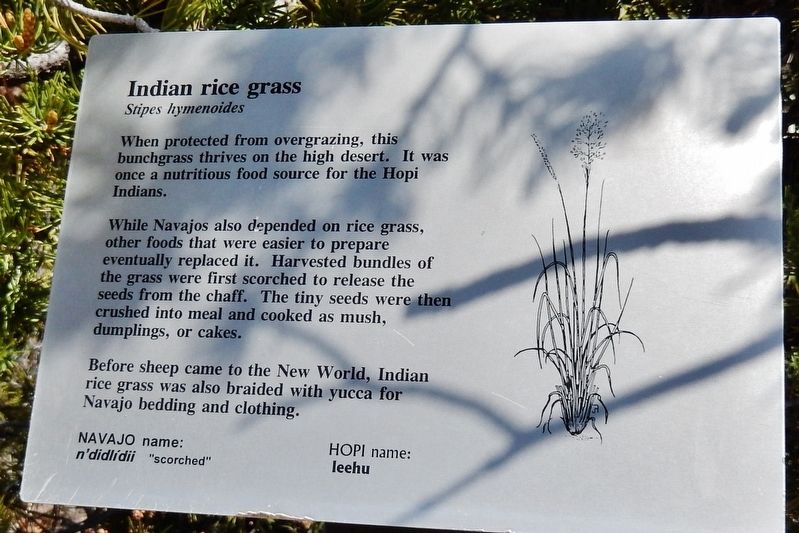
Indian Rice Grass
Stipa hymenoides
Photographed by Cosmos Mariner, May 24, 2016
1. Indian Rice Grass Marker
While Navajos also depended on rice grass, other foods that were easier to prepare eventually replaced it. Harvested bundles of the grass were first scorched to release the seeds from the chaff. The tiny seeds were then crushed into meal and cooked as mush, dumplings, or cakes.
Before sheep came to the New World, Indian rice grass was also braided with yucca for Navajo bedding and clothing.
NAVAJO name:
n’didli’dii "scorched"
HOPI name:
leehu
Topics. This historical marker is listed in these topic lists: Anthropology & Archaeology • Indigenous Peoples and Communities.
Location. 36° 40.736′ N, 110° 32.419′ W. Marker is near Shonto, Arizona, in Navajo County. It can be reached from the intersection of State Highway 564 and County Highway 221. Marker is located along the Aspen Forest Overlook Trail, just north of the Navajo National Monument Visitor Center. Touch for map. Marker is in this post office area: Shonto AZ 86054, United
this page online

Regionally, this marker is in the Navajo Nation and in Hopi. It is also in the American Southwest, in the Mountain West, on the Colorado Plateau, and at the Four Corners. Globally, it is in North America, the Western Hemisphere, the Western World, and the Anglosphere. Historically, it finds itself in what was once New Spain, the territory of the Ancestral Puebloans, and Mexico’s Alta California.
Other nearby markers. At least 8 other markers are within walking distance of this marker: Big Sagebrush (within shouting distance of this marker); The Pygmy Conifer Forest - An Indian Store (within shouting distance of this marker); Wagon (about 300 feet away, measured in a direct line); Upside-down Mountain (about 300 feet away); Canyons in Time (about 300 feet away); Dinosaur Footprint (about 300 feet away); Sweathouse (about 300 feet away); Sandal Trail (about 300 feet away). Touch for a list and map of all markers in Shonto.
Related markers. Click here for a list of markers that are related to this marker. Aspen Forest Overlook Trail, Navajo National Monument
Also see . . . Indian Ricegrass.
Photographed by Cosmos Mariner, May 24, 2016
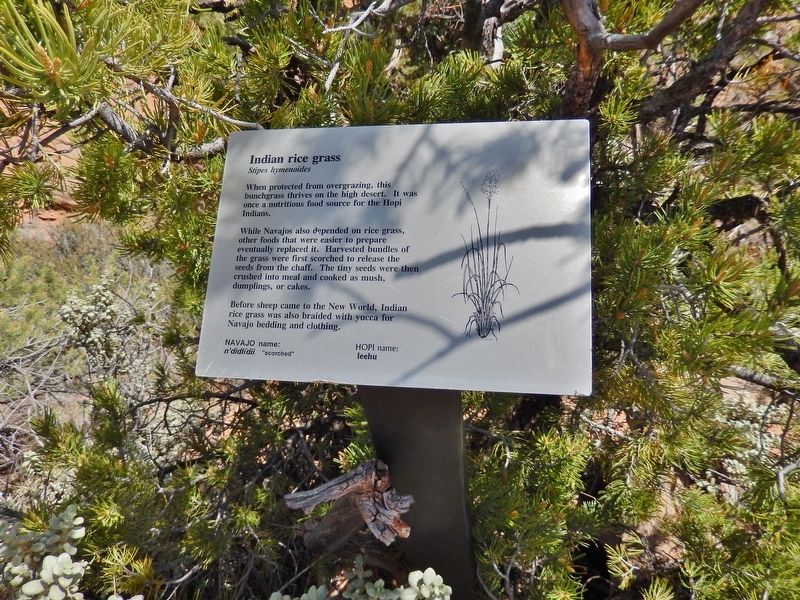
2. Indian Rice Grass Marker (wide view)
Photographed by Cosmos Mariner, May 24, 2016
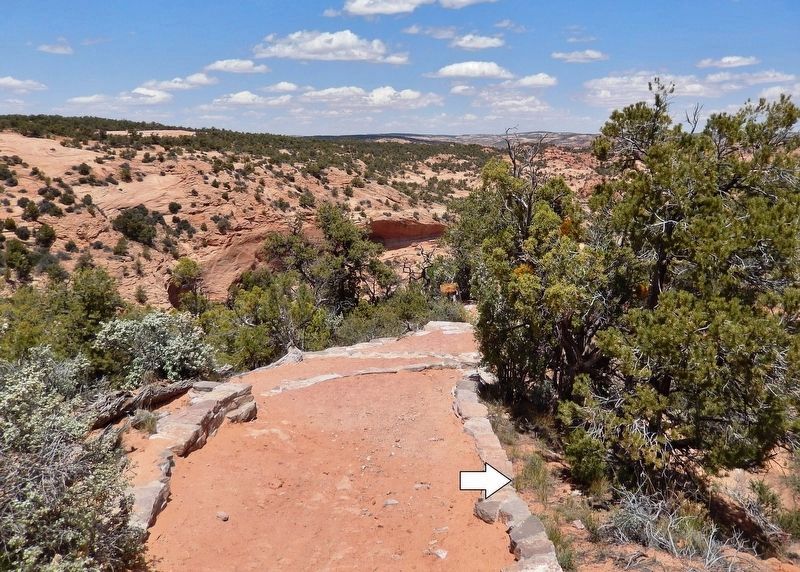
3. Aspen Forest Overlook Trail
(Indian Rice Grass visible along right trail edge)
(Indian Rice Grass visible along right trail edge)
Credits. This page was last revised on January 13, 2020. It was originally submitted on January 12, 2020, by Cosmos Mariner of Cape Canaveral, Florida. This page has been viewed 357 times since then and 26 times this year. Photos: 1, 2, 3. submitted on January 12, 2020, by Cosmos Mariner of Cape Canaveral, Florida.
