Near Shonto in Navajo County, Arizona — The American Mountains (Southwest)
Utah Juniper
Juniperus osteosperma
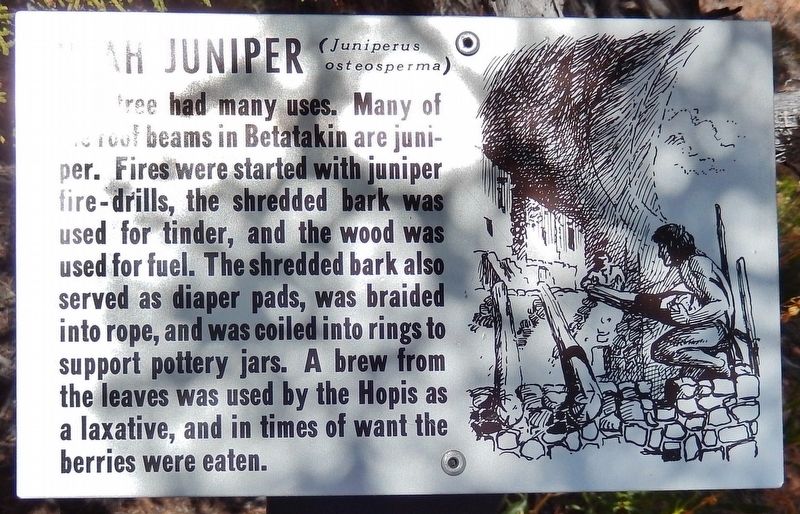
Photographed by Cosmos Mariner, May 24, 2016
1. Utah Juniper Marker
Topics. This historical marker is listed in these topic lists: Anthropology & Archaeology • Indigenous Peoples and Communities.
Location. 36° 40.81′ N, 110° 32.08′ W. Marker is near Shonto, Arizona, in Navajo County. It can be reached from the intersection of Arizona Route 564 and County Route 221. Marker is located along the Sandal Trail, about 1/2 mile northeast of the Navajo National Monument Visitor Center. Touch for map. Marker is in this post office area: Shonto AZ 86054, United States of America. Touch for directions.

Regionally, this marker is in the Navajo Nation and in Hopi. It is also in the American Southwest, in the Mountain West, on the Colorado
this page online
Other nearby markers. At least 8 other markers are within walking distance of this marker: Mormon Tea (a few steps from this marker); Broadleaf Yucca (within shouting distance of this marker); Prehistoric Pioneers (within shouting distance of this marker); Voices in the Canyon (within shouting distance of this marker); Into The Memory (within shouting distance of this marker); Cliffrose (about 300 feet away, measured in a direct line); Pinyon Pine (about 600 feet away); Roundleaf Buffaloberry (approx. 0.2 miles away). Touch for a list and map of all markers in Shonto.
Related markers. Click here for a list of markers that are related to this marker. Sandal Trail, Navajo National Monument
Also see . . . Juniperus osteosperma (Wikipedia). Native Americans such as the Havasupai used the bark for a variety of purposes, including beds, and ate the cones
Photographed by Cosmos Mariner, May 24, 2016
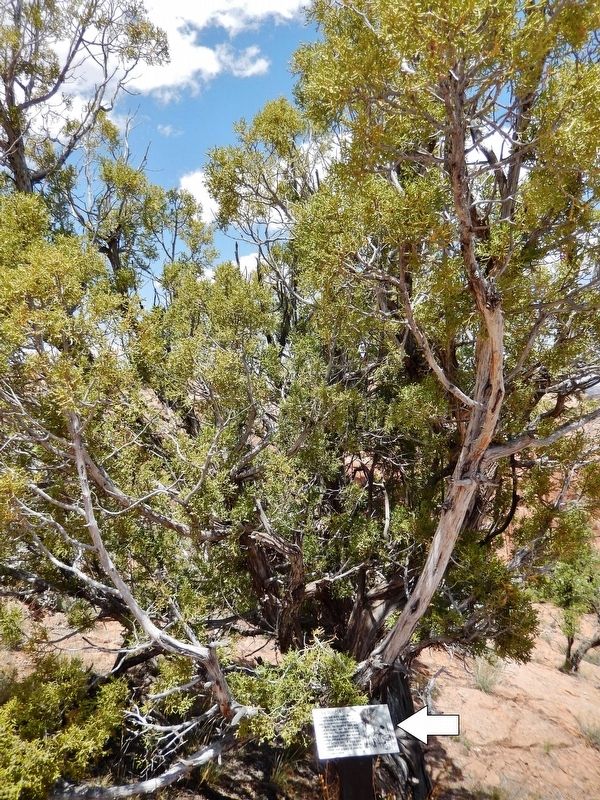
2. Utah Juniper Marker • tall view
(Utah Juniper in background)
(Utah Juniper in background)

Photographed by Cosmos Mariner, May 24, 2016
3. Utah Juniper Marker • wide view
(Utah Juniper bark detail in background)
(Utah Juniper bark detail in background)

Photographed by Cosmos Mariner, May 24, 2016
4. Utah Juniper
(Juniperus osteosperma)
(Juniperus osteosperma)
Credits. This page was last revised on January 13, 2020. It was originally submitted on January 12, 2020, by Cosmos Mariner of Cape Canaveral, Florida. This page has been viewed 349 times since then and 31 times this year. Photos: 1, 2, 3, 4. submitted on January 13, 2020, by Cosmos Mariner of Cape Canaveral, Florida.
