Edina in Knox County, Missouri — The American Midwest (Upper Plains)
Edina

Photographed by Michael E Sanchez, Jr., October 19, 2018
1. Edina Marker front
The county was first settled near Newark, to the south, by James Fresh in 1833. Early pioneers coming mainly from Ohio, Indiana, Maryland, and Kentucky were followed by a large Irish immigration and also a number if Germans in the late 1830’s. One of the first Catholic parishes in northeast Missouri was St. Joseph’s, formed here in 1837. Today’s St. Joseph Church was built, 1873-75.
Early schools in Edina were St. Joseph’s Academy (now a grade school) founded, 1865; Lyon Academy, 1866; Edina Seminary (Know Collegiate Institute), 1878; St. Joseph’s College for Boys, 1883; and at Novelty, to the south. Was Oaklawn College, founded in 1876.
Centered in rolling
this page online
During the Civil War, Edina was occupied July 30, 1861, by Colonel M.E. Green and the pro-Southern State Guards. At Newark, Union troops led by Capt. W.W. Lair surrendered to Confederates under Col. Joseph C. Porter, August 1, 1862, after a sharp skirmish. In the railroad boom after the war, Knox County subscribed $184,000 in bonds by 1870 to the unsuccessful Mo. and Miss. Railroad. By 1899 the debt was paid. The Quincy, Mo., and Pac. R.R. (C.B. & Q.) reached Edina, 1872.
Edina was the birthplace of noted jurist George Turner (1850-1932). Union General T.T. Taylor edited an Edina newspaper, 1868-73, and Confederate Capt. Griffin Frost, author of "Camp and Prison Journal," edited another paper here, 1874-1905. Henry E. Sever, book publisher, born near Hurdland to the south, bequeathed $100,000 to Knox County for a Wildlife Sanctuary, 1941."
Erected 1957 by State Historical Society of Missouri
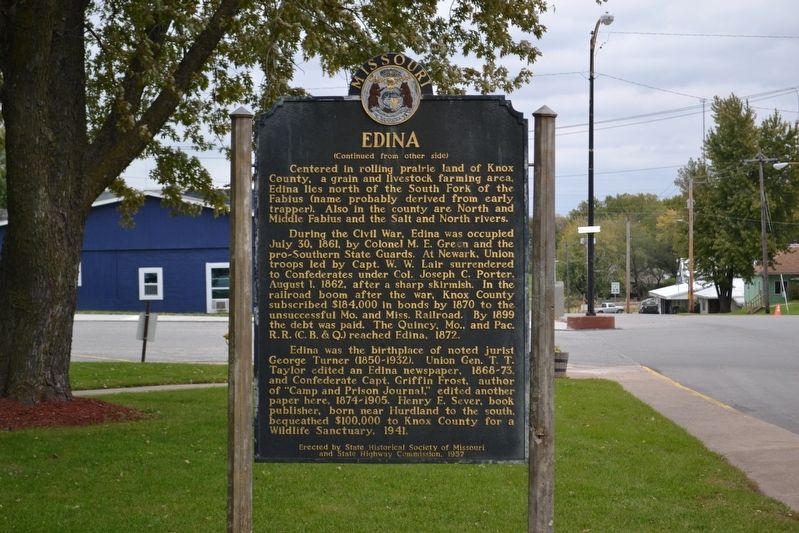
Photographed by Michael E Sanchez, Jr., October 19, 2018
2. Edina Marker back
Topics and series. This historical marker is listed in these topic lists: Indigenous Peoples and Communities • Religion & Religious Structures • Settlements & Settlers • War, US Civil. In addition, it is included in the Missouri, The State Historical Society of series list. A significant historical year for this entry is 1839.
Location. 40° 10.06′ N, 92° 10.311′ W. Marker is in Edina, Missouri, in Knox County. It is on East Lafayette (Missouri Route 6) just west of North 4th, on the right when traveling west. Touch for map. Marker is in this post office area: Edina MO 63537, United States of America. Touch for directions.

Regionally, this marker is in the American Midwest, in the Lewis & Clark Corridor, and in the Corn Belt. Globally, it is in North America, the Western Hemisphere, the Western World, and the Anglosphere. Historically, it finds itself in what was once the territory of the Mississippian Culture, the Louisiana Purchase, and the Antebellum South.
Other nearby markers. At least one other marker is within 16 miles of this marker, measured as the crow flies: Newark, Missouri (approx. 16 miles away).
More about this marker. 69 feet west of North fourth St on the north side of East Lafayette on the historic courthouse lawn
Credits. This page was last revised on July 20, 2020. It was originally submitted on January 14, 2020, by Michael E Sanchez, Jr. of Kansas City, Missouri. This page has been viewed 1,178 times since then and 101 times this year. Photos: 1, 2. submitted on January 14, 2020, by Michael E Sanchez, Jr. of Kansas City, Missouri. • Devry Becker Jones was the editor who published this page.
