Near Fredericksburg in Stafford County, Virginia — The American South (Mid-Atlantic)
The Washington Plantation
Photographed by Craig Swain, December 13, 2008
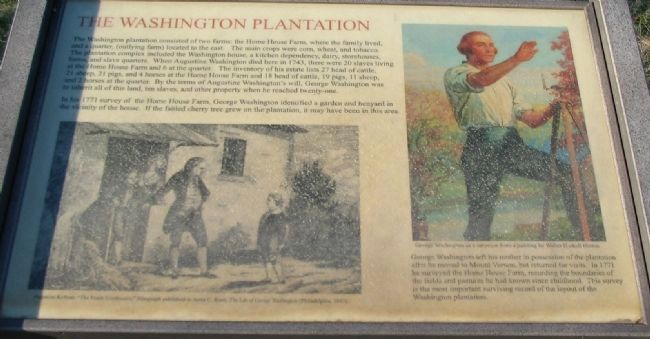
1. The Washington Plantation Marker
In his 1771 survey of the Home House Farm, George Washington identified a garden and henyard in the vicinity of the house. If the fabled cherry tree grew on the plantation, it may have been in this area.
George Washington left his mother in possession of the plantation after he moved to Mount Vernon, but returned for visits. In 1771 he surveyed the Home House Farm, recording
this page online
Topics and series. This historical marker is listed in these topic lists: African Americans • Agriculture • Colonial Era • Settlements & Settlers. In addition, it is included in the Former U.S. Presidents: #01 George Washington series list. A significant historical year for this entry is 1743.
Location. Marker has been reported missing. It was located near 38° 17.735′ N, 77° 26.974′ W. Marker was near Fredericksburg, Virginia, in Stafford County. It could be reached from Kings Highway (State Highway 3), on the right when traveling south. Located on the walking trail for the Washington's Boyhood Home site. Touch for map. Marker was at or near this postal address: 240 Kings Hwy, Fredericksburg VA 22405, United States of America. Touch for directions.

Regionally, this marker was in the Washington Metropolitan Area, in Northern Virginia, and in the Piedmont. It was also in the American South, specifically in the Upper South, in the Mid-Atlantic, and on
Photographed by Craig Swain, December 13, 2008
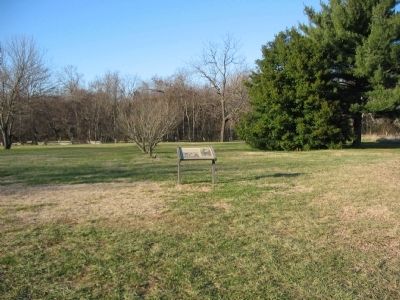
2. The Washington Plantation Marker
Other nearby markers. At least 8 other markers are within walking distance of this location: Enslaved Quarter (a few steps from this marker); The Quarter (within shouting distance of this marker); Cellar House (within shouting distance of this marker); Root Cellar (within shouting distance of this marker); George Washington Boyhood Home Site (about 800 feet away, measured in a direct line); George Washington’s Childhood Home (about 800 feet away); Creek Delegation in Fredericksburg (approx. 0.2 miles away); Fredericksburg's Wharves and Harbor (approx. 0.2 miles away). Touch for a list and map of all markers in Fredericksburg.
Other markers no longer nearby. The Ferries (was within shouting distance of this marker but has been confirmed missing); The Civil War at Ferry Farm (was
Photographed by Craig Swain, December 13, 2008
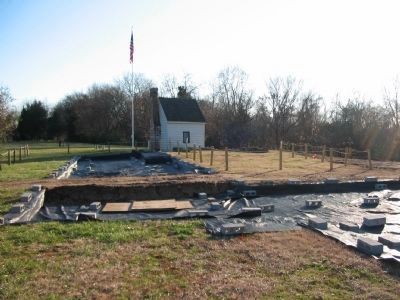
3. Ongoing Excavations around the House Foundation
In the summer of 2008 archeologists announced the discovery of Washington's boyhood home. The home had burned in a 1740 Christmas Eve fire. The white building behind the dig sites is the Surveyor's Shed, which dates to 1870.
More about this marker. In the lower left of the marker is a drawing, published in Anna C. Reed's The Life of George Washington from 1842, depicting the famous cherry tree incident. On the right is a depiction of George Washington as a surveyor from by Walter Haskell Hinton.
Also see . . . Archeologists Discover Historical Gem. Excavations at Washington’s Boyhood Home Uncover Vital Piece of Presidential History. (Submitted on December 15, 2008, by Craig Swain of Leesburg, Virginia.)
Credits. This page was last revised on April 28, 2023. It was originally submitted on December 15, 2008, by Craig Swain of Leesburg, Virginia. This page has been viewed 1,297 times since then and 37 times this year. Photos: 1, 2, 3. submitted on December 15, 2008, by Craig Swain of Leesburg, Virginia.
