Moundville in Hale County, Alabama — The American South (East South Central)
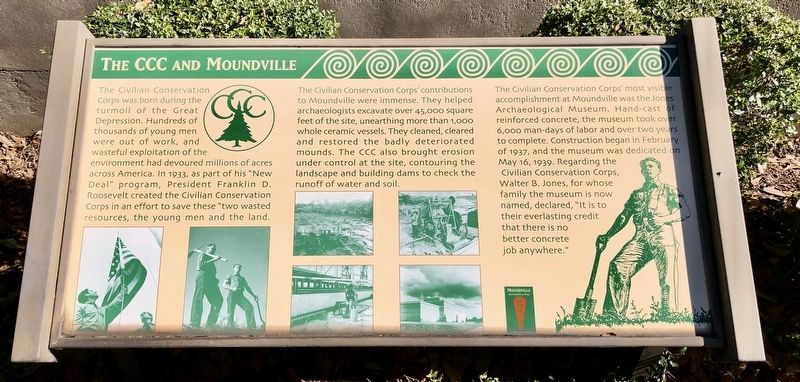
The CCC and Moundville
| — | Moundville Archaeological Park | — |
Photographed by Mark Hilton, January 19, 2020
1. The CCC and Moundville Marker
The Civilian Conservation Corps' contributions to Moundville were immense. They helped archaeologists excavate over 45,000 square feet of the site, unearthing more than 1,000 whole ceramic vessels. They cleaned, cleared and restored the badly deteriorated mounds. The CCC also brought erosion under control at the site, contouring the landscape and building dams to check the runoff of water and soil.
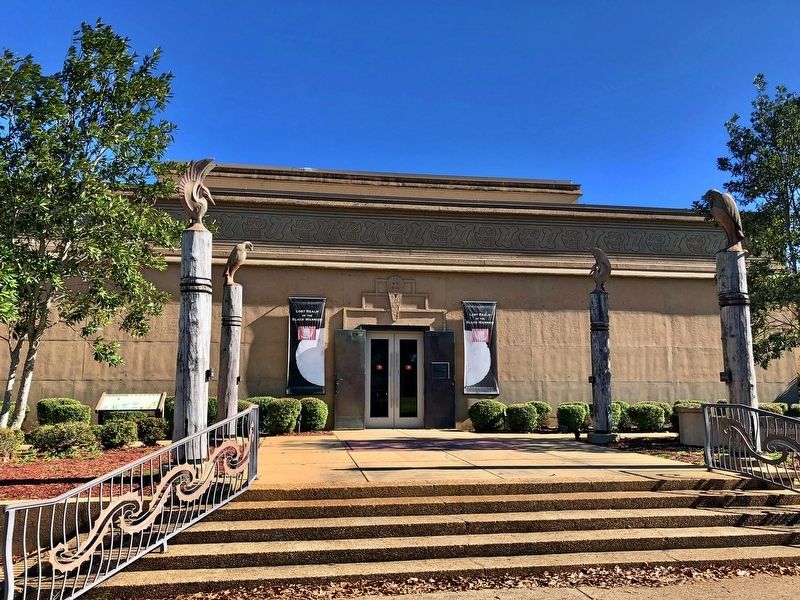
The Civilian Conservation Corps' most visible accomplishment at Moundville was the Jones Archaeological Museum. Hand-cast of reinforced concrete, the museum took over 6,000 man-days of labor and over two years to complete. Construction began in February of 1937, and the museum was dedicated on May
this page online
Erected by the University of Alabama.
Topics and series. This historical marker is listed in these topic lists: Anthropology & Archaeology • Indigenous Peoples and Communities. In addition, it is included in the Civilian Conservation Corps (CCC) series list. A significant historical month for this entry is February 1937.
Location. 33° 0.376′ N, 87° 38.104′ W. Marker is in Moundville, Alabama, in Hale County. It can be reached from River Bank Road, on the right when traveling south. Located in front of the Jones Archaeological Museum. Touch for map. Marker is at or near this postal address: River Bank Road, Moundville AL 35474, United States of America. Touch for directions.

Regionally, this marker is in the American South, specifically in the Deep South, and in the Black Belt. Globally, it is in North America, a Gulf of Mexico state, the Western Hemisphere, the Western World, and the Anglosphere. Historically, it finds itself
Photographed by Mark Hilton, January 19, 2020
2. The CCC and Moundville Marker at the Jones Archaeological Museum.
Other nearby markers. At least 8 other markers are within walking distance of this marker: A Perspective of Power (within shouting distance of this marker); Mound Arrangement (about 500 feet away, measured in a direct line); Protection and the Palisade (approx. ¼ mile away); Politics and Power (approx. ¼ mile away); a different marker also named Politics and Power (approx. ¼ mile away); Mound B (approx. ¼ mile away); Earthlodge (approx. ¼ mile away); Moundville Archaeological Park (approx. half a mile away). Touch for a list and map of all markers in Moundville.
Also see . . . The Jones Archaeological Museum on Moundville Archaeological Park website. (Submitted on January 21, 2020, by Mark Hilton of Montgomery, Alabama.)
Photographed by Mark Hilton, January 19, 2020
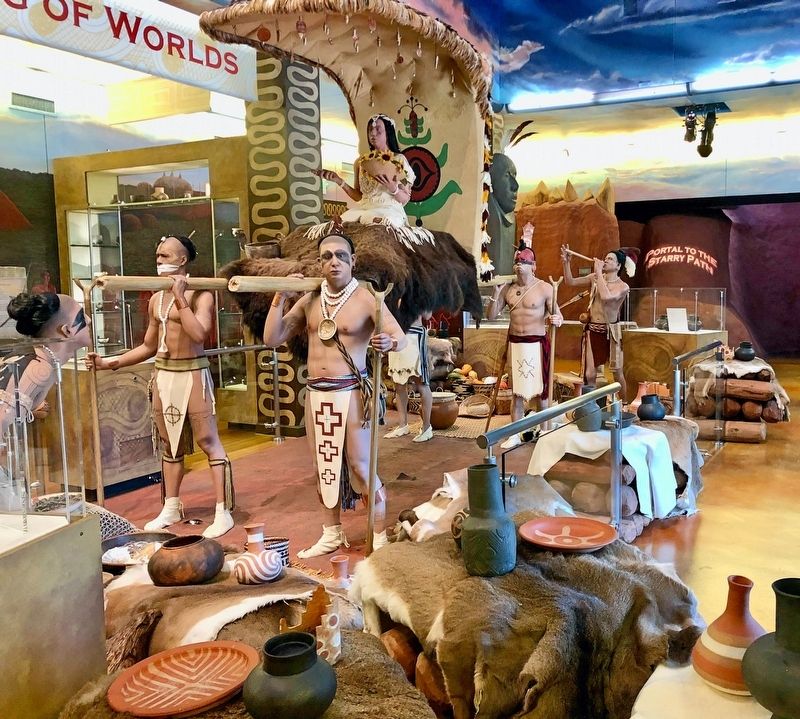
3. An exhibit located in the Jones Archaeological Museum.
Photographed by Mark Hilton, January 19, 2020
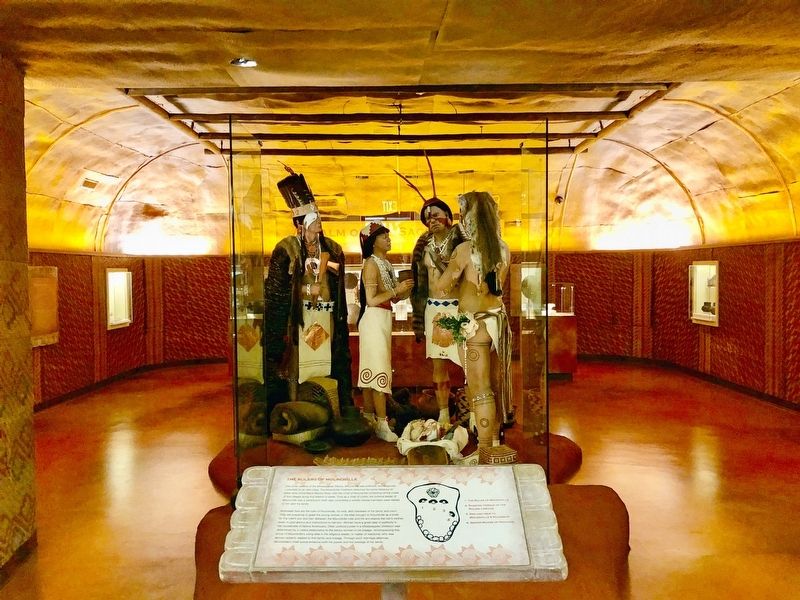
4. The Rulers of Moundville exhibit located in the Jones Archaeological Museum.
Credits. This page was last revised on January 21, 2020. It was originally submitted on January 21, 2020, by Mark Hilton of Montgomery, Alabama. This page has been viewed 824 times since then and 68 times this year. Photos: 1, 2, 3, 4. submitted on January 21, 2020, by Mark Hilton of Montgomery, Alabama.
