Maeystown in Monroe County, Illinois — The American Midwest (Great Lakes)
Village of Maeystown
Photographed by Thomas Smith, January 15, 2020
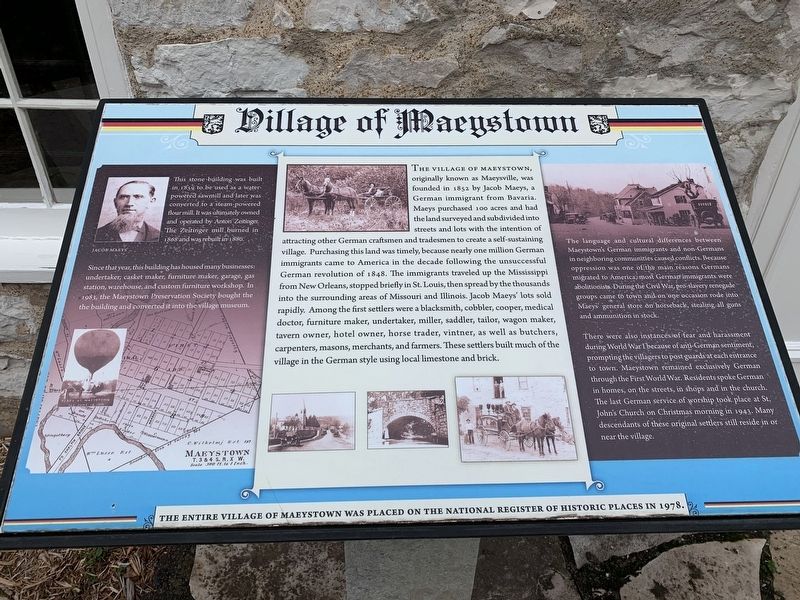
1. Village of Maeystown Marker
[Asides:]
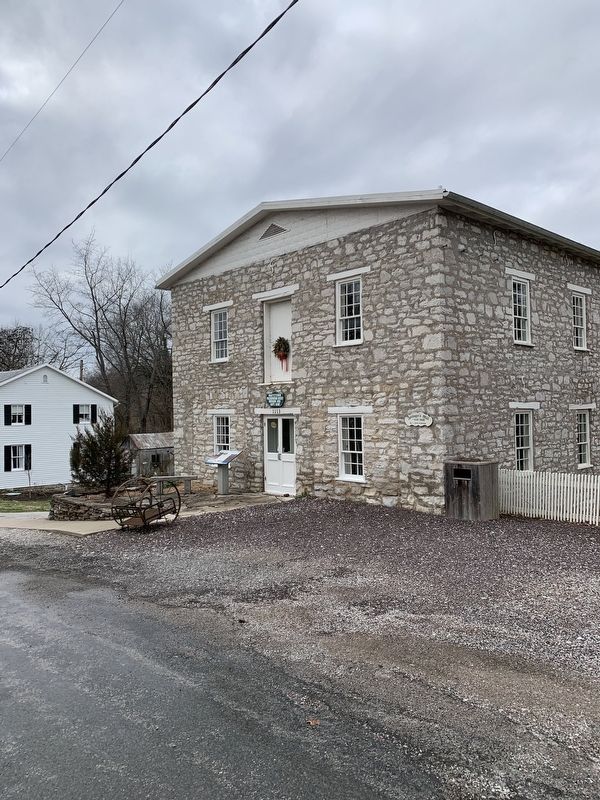
The stone building was built in 1852 to be used as a water- powered sawmill and later
this page online
Since that year this building has house many businesses: undertaker, casket maker, furniture maker, garage, gas station. warehouse and custom furniture workshop. In 1983 , the Maeystown Preservation Society bought the building and converted into the village museum.
The language and cultural difference between Maeystown's German immigrants and non-German in neighboring communities caused conflicts. Because oppression was one of the main reasons German migrated to America, most German immigrants were abolitionists. During the Civil War, pro-slavery renegade groups came to town and on one occasion rode into Maeys general store on horseback, stealing all guns and ammunition in stock.
There were also instances of fear and harassment during World War I because of anti-German sentiment, prompting the villagers to post guards at each entrance to the town. Maeystown remained exclusively German through the First World War. Residents spoke German in homes, on the streets, in shops and in church.
Photographed by Thomas Smith, January 15, 2020
2. Village of Maeystown Marker
Erected by Maeystown Preservation Society.
Topics. This historical marker is listed in these topic lists: Abolition & Underground RR • Communications • Religion & Religious Structures • Settlements & Settlers • War, US Civil • War, World I. A significant historical year for this entry is 1852.
Location. 38° 13.538′ N, 90° 13.988′ W. Marker is in Maeystown, Illinois, in Monroe County. It is at the intersection of Mill Street (Illinois Route 7) and Franklin Street on Mill Street. Touch for map. Marker is at or near this postal address: 1113 Mill Street, Fults IL 62244, United States of America. Touch for directions.

Regionally, this marker is in Greater St. Louis. It is also in the American Midwest, in the Lewis & Clark Corridor, in the Corn Belt, and in the Great River Road Region. Globally, it is in North America, the Western Hemisphere, the Western World, and the Anglosphere. Historically, it finds itself in what was once the territory of the Mississippian Culture and also the Northwest Territory.
Other nearby markers. At least 8 other markers are within 5 miles of this marker, measured as the crow flies: Maeystown (here, next to this marker); St. John's First Church (about 700 feet away); The Village of Maeystown, Ill. (approx. 0.2 miles away); William H. Bissell (approx. 2½ miles away); Pioneer Mill (approx. 2½ miles away); Immaculate Conception Church (approx. 2.8 miles away); Holy Cross Lutheran Cemetery (approx. 4.2 miles away); St. Joe, Illinois (approx. 4.2 miles away). Touch for a list and map of all markers in Maeystown.
Other markers no longer nearby. "James McRoberts and Mary his wife settled this place in the year of our Lord 1798"* (was about 400 feet away, measured in a direct line but has been confirmed missing); a different marker also named "James McRoberts and Mary his wife settled this place in the year of our Lord 1798"* (was about 400 feet away but has been confirmed missing); a different marker also named "James McRoberts and Mary his wife settled this place in the year of our Lord 1798"* (was about 400 feet away but has been confirmed missing).
Credits. This page was last revised on January 24, 2020. It was originally submitted on January 24, 2020, by Thomas Smith of Waterloo, Ill. This page has been viewed 443 times since then and 29 times this year. Photos: 1, 2. submitted on January 24, 2020, by Thomas Smith of Waterloo, Ill. • Devry Becker Jones was the editor who published this page.
