Kingston, Ontario — Central Canada (North America)
Discover the History of the Anna Lane Site
Photographed by Cosmos Mariner, August 15, 2019
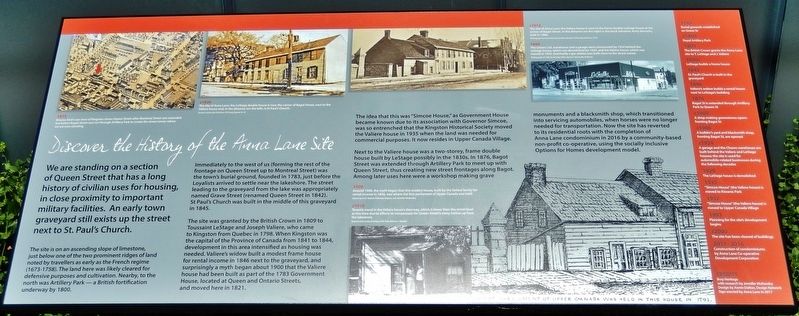
1. Discover the History of the Anna Lane Site Marker
The site is on an ascending slope of limestone, just below one of the two prominent ridges of land noted by travellers as early as the French regime (1673-1758). The land here was likely cleared for defensive purposes and cultivation. Nearby, to the north was Artillery Park — a British fortification underway by 1800.
Immediately to the west of us (forming the rest of the frontage on Queen Street up to Montreal Street) was the town's burial ground, founded in 1783, just before the Loyalists arrived to settle near the lakeshore. The street leading to the graveyard from the lake was appropriately named Grave Street (renamed Queen Street in 1842). St Paul's Church was built in the middle of this graveyard in 1845.
The site was granted by the British Crown in 1809 to Toussaint LeStage and Joseph Valiere, who came to Kingston from Quebec in 1798. When Kingston was the capital of the Province of
this page online
The idea that this was "Simcoe House,” as Government House became known due to its association with Governor Simcoe, was so entrenched that the Kingston Historical Society moved the Valiere house in 1935 when the land was needed for commercial purposes. It now resides in Upper Canada Village.
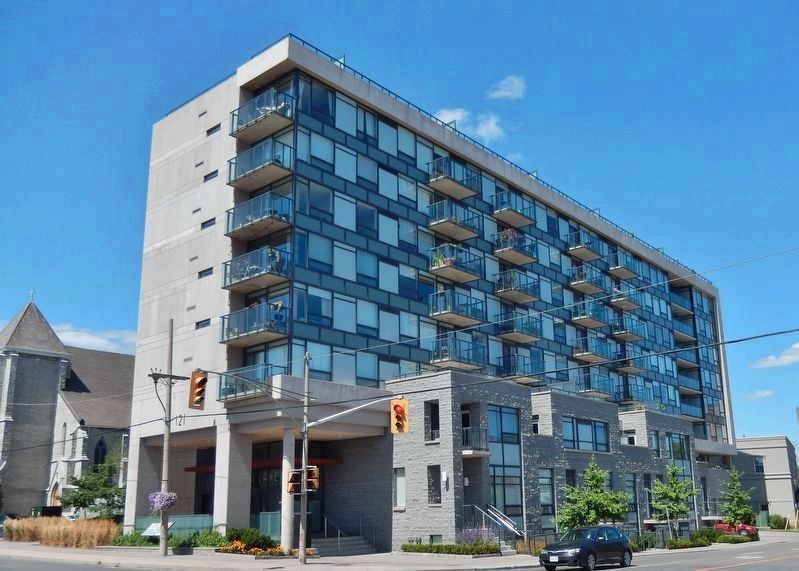
Next to the Valiere house was a two-storey, frame double house built by LeStage possibly in the 1830s. In 1876, Bagot Street was extended through Artillery Park to meet up with Queen Street, thus creating new street frontages along Bagot. Among later uses here were a workshop making grave monuments and a blacksmith shop, which transitioned into servicing automobiles, when horses were no longer needed for transportation. Now the site has reverted to its residential roots with the completion of
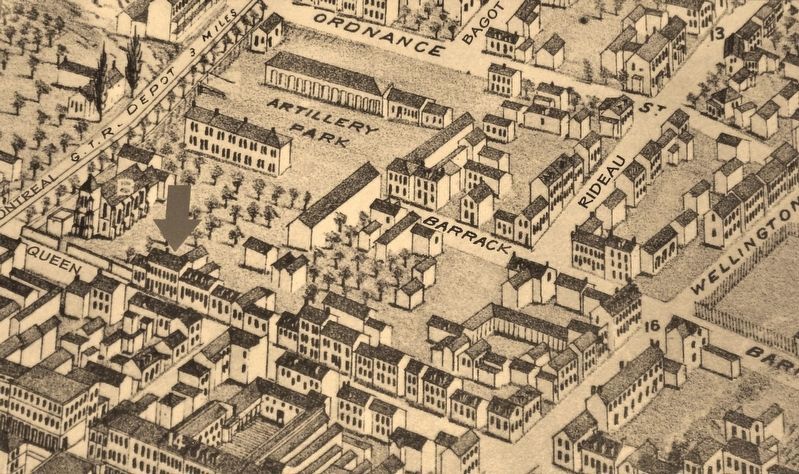
2. Marker detail: 1875
Brosius bird's-eye view of Kingston shows Queen Street after Montreal Street was extended but before Bagot Street was run through Artillery Park to create the street corner where we are now standing.
(side bar/timeline)
• 1783 Burial grounds established on Grave Street
• c1800 Royal Artillery Park
• 1809 The British Crown grants the Anna Lane site to T. LeStage and J. Valiere
• 1830s LeStage builds a frame house
• 1845 St. Paul's Church is built in the graveyard
• 1846 Valiere's widow builds a rental house next to LeStage's building
• 1876 Bagot Street is extended through Artillery Park to Queen Street
• c1900 A shop making gravestones opens fronting Bagot Street
• c1908 A builder’s yard and blacksmith shop, fronting Bagot Street, are opened
• c1924 A garage and the Chown warehouse are built behind the Valiere and LeStage houses; the site is used for automobile-related businesses during the following decades
• 1929 The LeStage house is demolished
• 1935 "Simcoe House" (the Valiere house) is moved to Kiwanis Park
• 1957 "Simcoe House" (the Valiere house) is moved to Upper Canada Village
• 1993 Planning for the site’s development begins
• c2000 The site has been cleared
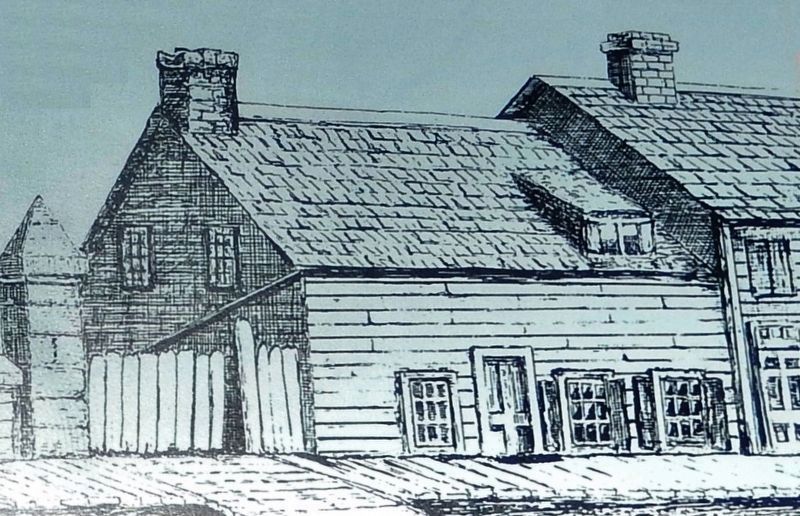
Drawn by Prof. Nathan Fellowes Dupuis, coll. Jennifer McKendry
3. Marker detail: 1908
Around 1900, the myth began that this modest house, built by the Valiere family for rental income in 1846, was where the first parliament of Upper Canada was held.
• 2013-2016 Construction of condominiums by Anna Lane Co-operative Development Corporation
Credits
Bray Heritage
with research by Jennifer McKendry
Design by Annie Dalton, Design Network
Sign erected by Anna Lane in 2017
Erected 2017 by Anna Lane.
Topics. This historical marker is listed in these topic lists: Cemeteries & Burial Sites • Industry & Commerce • Roads & Vehicles • Settlements & Settlers.
Location. 44° 13.973′ N, 76° 29.054′ W. Marker is in Kingston, Ontario. It is on Queen Street just west of Bagot Street, on the right when traveling west. Marker is mounted beside the sidewalk on the north side of Queen Street. Touch for map. Marker is at or near this postal address: 121 Queen Street, Kingston ON K7K 3B7, Canada. Touch for directions.

Regionally, this marker is in Eastern Ontario and specifically in Southeastern Ontario. It is also in Central Canada. Globally, it is in North America, on the Great Lakes, in the Western Hemisphere, in the Western World, and in the Anglosphere. Historically, it finds itself in what was once
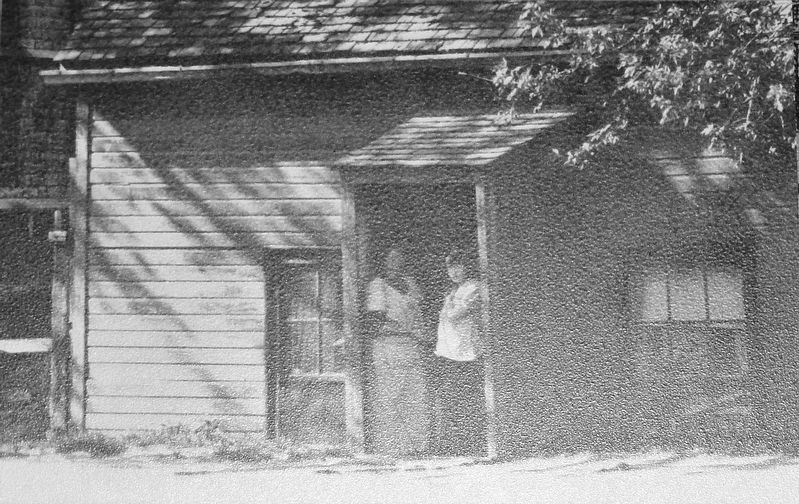
Queen's University Archives, V23-Pub-Simcoe-1
4. Marker detail: The site of Anna Lane, c1910
Tenants stand in the Valiere house's doorway, which is lower than the street level at this time due to efforts to compensate for Queen Street's steep incline up from the lakeshore.
Other nearby markers. At least 8 other markers are within walking distance of this marker: Molly Brant (within shouting distance of this marker); Queen Street Synagogue (within shouting distance of this marker); St. Paul's Churchyard (within shouting distance of this marker); Lower Burial Ground 1783-1863 (within shouting distance of this marker); Kingston Post Office / Bureau de Poste de Kingston (approx. 0.3 kilometers away); Bishop Alexander Macdonell (approx. 0.3 kilometers away); René-Amable Boucher 1735-1812 (approx. 0.4 kilometers away); The First Meeting of the Executive Council of Upper Canada (approx. 0.4 kilometers away). Touch for a list and map of all markers in Kingston.
More about this marker. Kingston is independent from the surrounding Frontenac County.
Henrietta Constantine, Queen's University Archives, V157
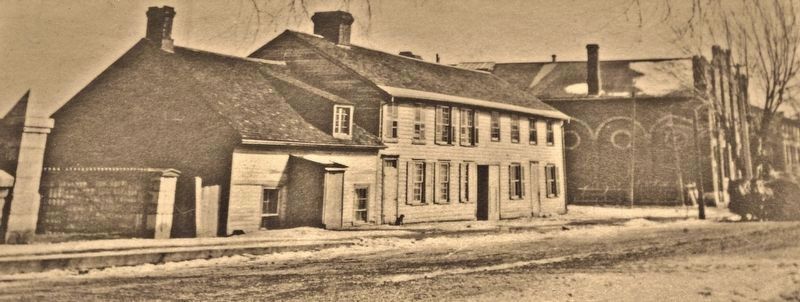
5. Marker detail: The site of Anna Lane, c1912
The Valiere house is next to the frame double LeStage house at the corner of Bagot Street. In the distance (on the right) is the brick Salvation Army Barracks, built in 1886.
Queen's University Archives, V23 Dwg-Queen St-10
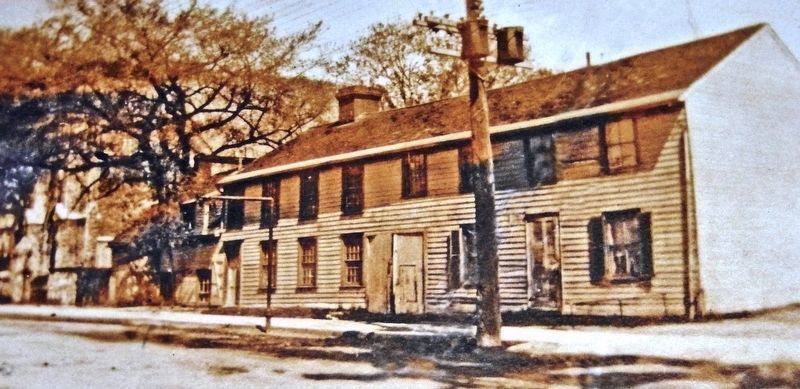
6. Marker detail: The site of Anna Lane, c1930
The LeStage double house is near the corner of Bagot Street, next to the Valiere house and, in the distance (on the left), is St Paul's Church.
George Liffey, Queen's University Archives
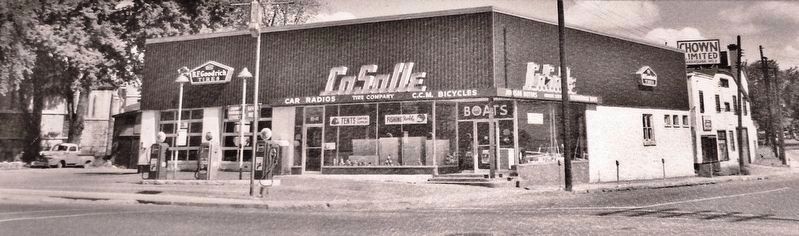
7. Marker detail: 1960
The Chown Ltd. warehouse and a garage were constructed by 1924 behind the LeStage house, which was demolished by 1929, and the Valiere house, which was moved in 1935. Eventually a gas station was built close to the street corner.
Photographed by Cosmos Mariner, August 15, 2019
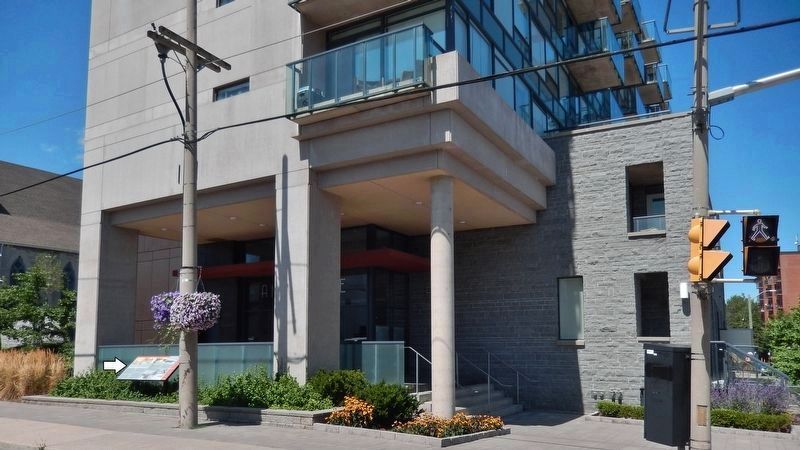
8. Discover the History of Anna Lane Site Marker
(view from Queen Street • marker on left)
(view from Queen Street • marker on left)
Photographed by Cosmos Mariner, August 15, 2019
9. Anna Lane Condominium
(view from Queen/Bagot Street intersection)
(view from Queen/Bagot Street intersection)
Credits. This page was last revised on March 27, 2024. It was originally submitted on January 30, 2020, by Cosmos Mariner of Cape Canaveral, Florida. This page has been viewed 1,105 times since then and 103 times this year. Photos: 1, 2, 3, 4, 5, 6, 7, 8, 9. submitted on January 30, 2020, by Cosmos Mariner of Cape Canaveral, Florida.
