
Colonia Polanco in Ciudad de México, Mexico — The Valley of Mexico (The Central Highlands)
Stela 6 of Piedras Negras

Photographed by J. Makali Bruton, November 30, 2019
1. Stela 6 of Piedras Negras Marker

(Reproduccion. El original se encuentra en el Museo Nacional de Arqueología y Etnología de Guatemala)
La ciudad de Piedras Negras ocupó la margen derecha del alto Usumacinta, cerca del raudal El Porvenir. En las inscripciones del periodo Clásico era conocida como Yokib', que significa 'entrada'. Su ocupación se remonta hacia finales de Preclásico medio, debida probablemente a inmigrantes de las Tierras Bajas del Centro, como también ocurrió con Altar de Sacrificios y Ceibal en la cuenca del río de la Pasión.
Durante el Clásico temprano surgieron las primeras construcciones monumentales al consolidarse el poder dinástico. Aunque no conocemos monumentos de este periodo hay referencias de cuatro gobernantes registrados en textos jeroglificos del Clásico tardio o bien en las inscripciones del vecino Yaxchilán, su eterno enemigo. Para el Clásico tardio y terminal conocemos siete gobernantes a quienes se les ha designado mediante números.
La Estela 6 muestra al Gobernante 3, Kihnich Yo'nal Ahk II, quien gobernó entre 687 al 726 d.C. Fue dedicada el 27 de diciembre del 687
this page online
Stela 6 of Piedras Negras
(Reproduction. The original is in the National Museum of Archaeology and Ethnology of Guatemala)
The city of Piedras Negras occupied the right bank of the high Usumacinta River, near the El Porvenir stream. In the inscriptions of the Classic Period it was known as Yokib ', which means 'entryway'. Its occupation dates back to the end of the Middle Preclassic, probably due to immigrants from the Central Lowlands, as was also the case with Altar de Sacrificios and Ceibal in the Pasión River basin.
During the Early Classic the first monumental constructions were made and the dynastic power was consolidated. Although we do not know of any existing monuments of this period, four rulers are referenced in late Classic hieroglyphic texts or in the inscriptions of the neighbor Yaxchilán, their eternal enemy. During the Late and Terminal Classic
Photographed by J. Makali Bruton, November 30, 2019
2. Stela 6 of Piedras Negras Marker
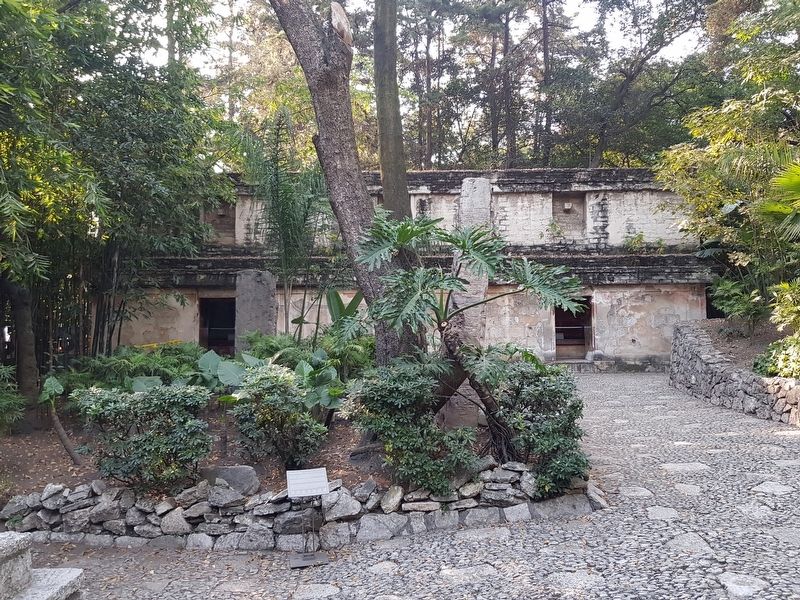
The marker can be seen here in the foreground, with the reproduction stela directly behind it. Further in the distance is the Bonampak reproduction building.
Stela 6 shows Ruler 3, Kihnich Yo'nal Ahk II, who ruled between 687 to 726 A.D. This stela was dedicated on December 27, 687 A.D. celebrating his enthronement. He is shown sitting inside a niche on a cushion of jaguar skin, framed by a celestial band crowned by the Main Bird Deity (Itzamnaah Yahx Kokaaj Muut): a metaphor of the place the ruler occupies in heaven. At the bottom a road marked by footprints ascends on the scaffold to the throne. His headdress is a turtle with brilliant feathers that symbolize his membership in the Casa de la Tortuga (House of the Turtle) lineage.
Topics. This historical marker is listed in these topic lists: Arts, Letters, Music • Indigenous Peoples and Communities • Wars, Non-US. A significant day of the year for for this entry is December 27.
Location. 19° 25.524′ N, 99° 11.217′ W. Marker is in Ciudad de México. It is in Colonia Polanco. It is on Avenida Paseo de la Reforma, on the left when traveling east. Touch for map. Marker is in this post office area: Ciudad de México 11100, Mexico. Touch for directions.

Regionally, this marker is in Central Mexico and specifically in Mexico City Metropolitan Area. Globally, it is in North America, specifically in Mesoamerica, on the Ring of Fire, and in the Western Hemisphere. Historically, it finds itself in what was once New Spain, a Spanish colony, and the Aztec Empire.
Other nearby markers. At least 8 other markers are within walking distance of this marker: Stela 12 of Piedras Negras (here, next to this marker); Hochob Building 2 (a few steps from this marker); Ek Balam Building 1 (within shouting distance of this marker); Bonampak (within shouting

Photographed by J. Makali Bruton, November 30, 2019
3. Stela 6 of Piedras Negras
The marker is behind the reproduction of the stela, closer to the reproduction Hochob Building 2.
Credits. This page was last revised on April 17, 2020. It was originally submitted on February 2, 2020, by J. Makali Bruton of Washington, District of Columbia. This page has been viewed 532 times since then and 28 times this year. Photos: 1, 2, 3. submitted on February 2, 2020, by J. Makali Bruton of Washington, District of Columbia.
