Near Tuxtla Chico, Chiapas, Mexico — The Southeast (North America)
Group F at Izapa Archaeological Zone
Photographed by J. Makali Bruton, December 20, 2019
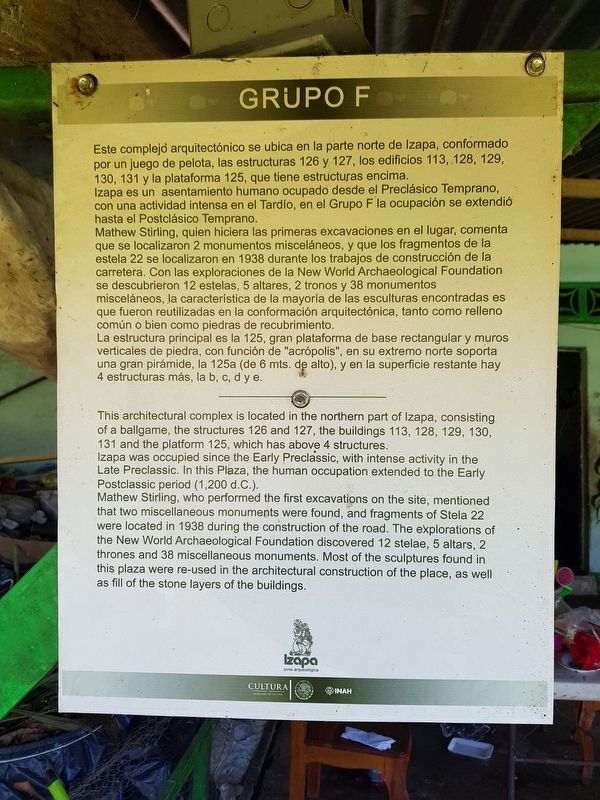
1. Group F at Izapa Archaeological Zone Marker

Este complejo arquitectónico se ubica en la parte norte de Izapa, conformado por un juego de pelota, las estructuras 126 y 127, los edificios 113, 128, 129, 130, 131 y la plataforma 125, que tiene estructuras encima.
Izapa es un asentamiento humano ocupado desde el Preclásico Temprano, con una actividad intensa en el Tardío, en el Grupo F la ocupación se extendió hasta el Postclásico Temprano.
Mathew Stirling, quien hiciera las primeras excavaciones en el lugar, comenta que se localizaron 2 monumentos misceláneos, y que los fragmentos de la estela 22 se localizaron en 1938 durante los trabajos de construcción de la carretera. Con las exploraciones de la New World Archaeological Foundation se descubrieron 12 estelas, 5 altares, 2 tronos y 38 monumentos misceláneos, la característica de la mayoría de las esculturas encontradas es que fueron reutilizadas en la conformación arquitectónica, tanto como relleno común o bien como piedras de recubrimiento.
La estructura principal es la 125, gran plataforma de base rectangular y muros verticales de piedra, con función de "acrópolis", en su extremo norte soporta una
this page online
Group F at the Izapa Archaeological Zone
This architectural complex is located in the northern part of Izapa, consisting of a ballgame, the structures 126 and 127, the buildings 113, 128, 129, 130, 131 and the platform 125, which has above 4 structures.
Izapa was occupied since the Early Preclassic, with intense activity in the Late Preclassic. In this Plaza, the human occupation extended to the Early Postclassic period (1,200 d.C.).
Mathew Stirling, who performed the first excavations on the site, mentioned that two miscellaneous monuments were found, and fragments of Stela 22 were located in 1938 during the construction of the road. The explorations of the New World Archaeological Foundation discovered 12 stelae, 5 altars, 2 thrones and 38 miscellaneous monuments. Most of the sculptures found in this plaza were re-used in the architectural construction of the place, as well as fill of the stone layers of the buildings.
Erected by Instituto Nacional de Antropología e Historia (INAH).
Topics. This
Photographed by J. Makali Bruton, December 20, 2019
2. Group F at Izapa Archaeological Zone Marker
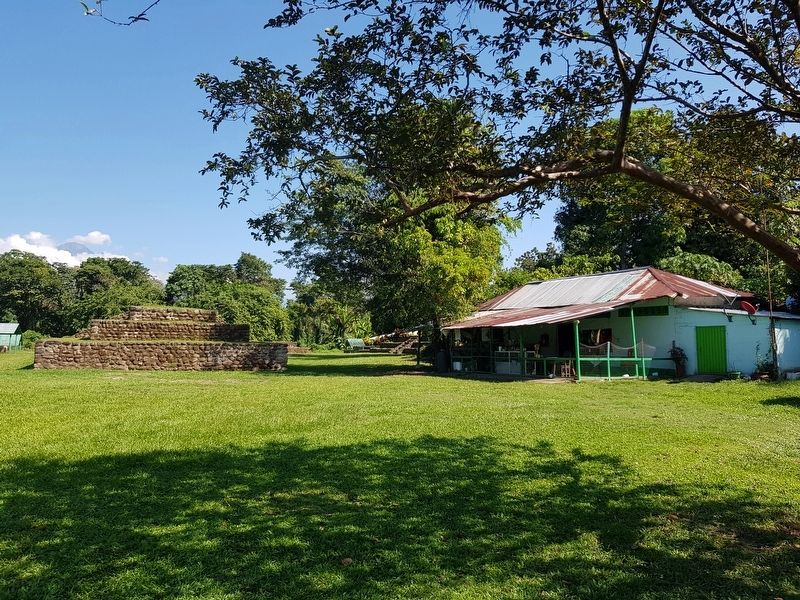
The marker can be seen under the roof of the building to the right.
Location. 14° 55.384′ N, 92° 10.788′ W. Marker is near Tuxtla Chico, Chiapas. It can be reached from Federal Route 200 just east of Avenida Obregón Sur, on the right when traveling west. Touch for map. Marker is in this post office area: Tuxtla Chico CHIS 30870, Mexico. Touch for directions.

Regionally, this marker is in Southern Mexico, in the Maya Heartland, on the Pacific Coast, and in the Sierra Madre. Globally, it is in North America, specifically in Mesoamerica, on the Ring of Fire, on the Pacific Rim, and in the Western Hemisphere. Historically, it finds itself in what was once New Spain, a Spanish colony, and the Aztec Empire.
Other nearby markers. At least 5 other markers are within 14 kilometers of this marker, measured as the crow flies: Izapa Archaeological Zone (within shouting distance of this marker); The End of Bʼakʼtun 13 (approx. 9.2 kilometers away); Tapachula and Chiapas (approx. 9.3 kilometers away); Benito Juárez
Photographed by J. Makali Bruton, December 20, 2019
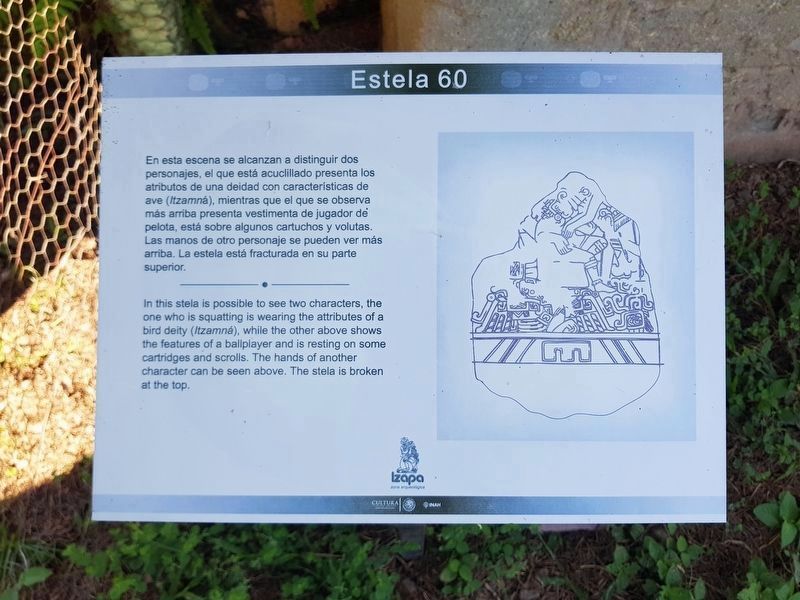
3. A nearby marker for Stela 60 at Izapa Archaeological Zone
Estela 60
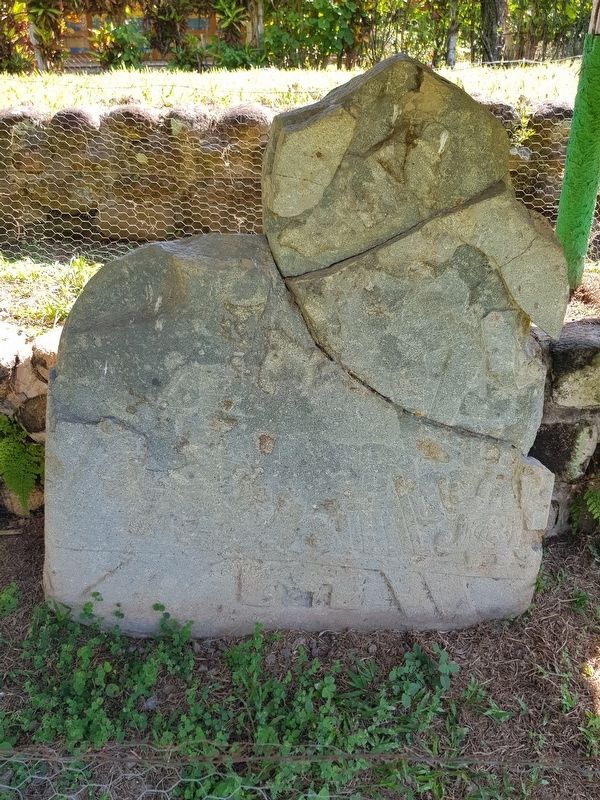
En esta escena se alcanzan a distinguir dos personajes, el que está acuclillado presenta los atributos de una deidad con características de ave (Itzamná), mientras que el que se observa más arriba presenta vestimenta de jugador de pelota, está sobre algunos cartuchos y volutas. Las manos de otro personaje se pueden ver más arriba. La estela está fracturada en su parte superior.
Stela 60
In this stela is possible to see two characters, the one who is squatting is wearing the attributes of a bird deity (Itzamná), while the other above shows the features of a ballplayer and is resting on some cartridges and scrolls. The hands of another character can be seen above. The stela is broken at the top.
Also see . . . Izapa Archaeological Zone. (Submitted on March 7, 2020, by J. Makali Bruton of Washington, District of Columbia.)
Photographed by J. Makali Bruton, December 20, 2019
4. Stela 60 at the Izapa Archaeological Zone

Photographed by J. Makali Bruton, December 20, 2019
5. The Izapa Archaeological Zone seen from Stela 60
Credits. This page was last revised on March 7, 2020. It was originally submitted on March 7, 2020, by J. Makali Bruton of Washington, District of Columbia. This page has been viewed 365 times since then and 39 times this year. Photos: 1, 2, 3, 4, 5. submitted on March 7, 2020, by J. Makali Bruton of Washington, District of Columbia.
