Lower Merion Township near Gladwyne in Montgomery County, Pennsylvania — The American Northeast (Mid-Atlantic)
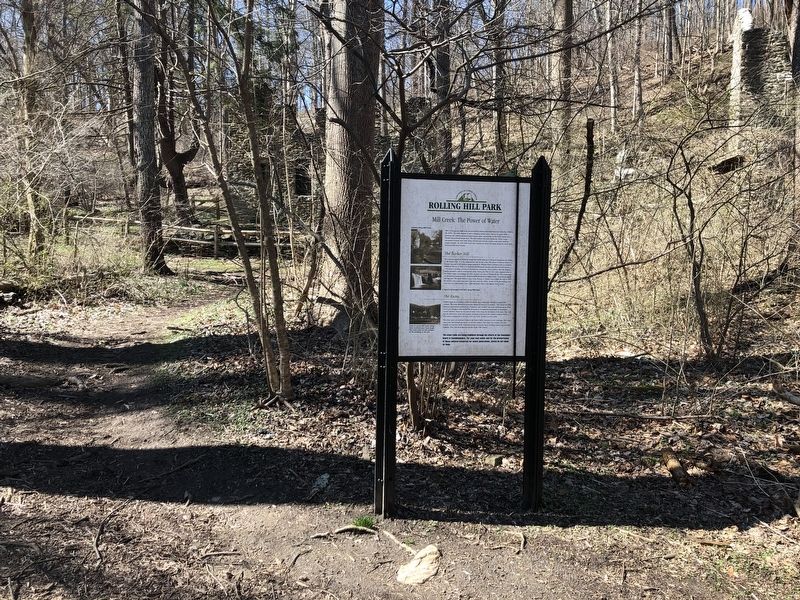
Mill Creek: The Power of Water
Rolling Hill Park
| — | Township of Lower Merion | — |

Mill Creek gets its name from the active mill industry that flourished here from the 1790s to the 1870s. The mills adapted to suit a changing market place. During the early 1800s, a growing mill industry produced paper, grain, guns, and powder. In the 1850s, cotton yarn became the predominant product. The mill industry declined during the 1890s. Large automated factories were built along railroad lines and the smaller scale mills could no longer compete. In 1893 Mill Creek had a disastrous flood. The dams along the creek were destroyed and never rebuilt.
The Barker Mill
The existing industrial buildings along Mill Creek adjacent to the park boundaries are known as the Barker Mill. It is the longest-lived mill on the creek. The parcel of land on which it is located was part of the original patent granted by William Penn to Robert Jones to establish the Welsh Barony in 1682. It is believed that Benjamin Brooke built the first mill around 1794 either to produce powder or manufacture armaments. From 1808 to 1861 the Nippes family operated a mill to manufacture rifles. During the War of 1812, they supplied rifles to the
this page online
The Ruins
Visible along the floodplain of Mill Creek are large stone ruins that once housed mill workers. The mills themselves generally employed about 6-10 workers. The census of 1850 indicates predominant populations of laborers, mill workers, and local craftsmen in the Mill Creek area. Workers were housed on the property in tenements that could accommodate several families. There are two sets of major ruins along the floodplain of the park. This ruin was the three-story stone mill workers tenement pictured at left. Samuel Lehman Smith, a mill owner, constructed it between 1837 and 1840. Nearby is a root cellar.
The other ruins, downstream closer to the Barker Mill, consisted of two buildings. One was a
The stone ruins are being stabilized through the efforts of the Township's Board of Commissioners. For your own safety and for the preservation of these cultural resources for future generations, please do not climb on them.
Erected by Township of Lower Merion.
Topics. This historical marker is listed in these topic lists: Colonial Era • Industry & Commerce • War of 1812 • Waterways & Vessels. A significant historical year for this entry is 1893.
Location. 40° 2.167′ N, 75° 15.906′ W. Marker is near Gladwyne, Pennsylvania, in Montgomery County. It is in Lower Merion Township. It is on Mill Creek Road 0.4 miles north of Conshohocken State Road (Pennsylvania Route 23), on the left when traveling north. Touch for map. Marker is at or near this postal address: 1288 Mill Creek Rd, Gladwyne PA 19035, United States of America. Touch for directions.

Regionally, this marker

Other nearby markers. At least 8 other markers are within 2 miles of this marker, measured as the crow flies: Lest We Forget (approx. 0.8 miles away); Henry Harley Arnold (approx. 0.8 miles away); Gladwyne Historic District (approx. 0.8 miles away); James A. Bland (approx. 1.8 miles away); Washington's Army Encampment (approx. 1.9 miles away); Merion Friends Meeting (approx. 1.9 miles away); Merion Friends Meeting House (approx. 1.9 miles away); Philadelphia and Columbia Railway (approx. 2 miles away). Touch for a list and map of all markers in Gladwyne.

Credits. This page was last revised on February 7, 2023. It was originally submitted on March 8, 2020, by Devry Becker Jones of Washington, District of Columbia. This page has been viewed 818 times since then and 89 times this year. Photos: 1, 2, 3, 4. submitted on March 8, 2020, by Devry Becker Jones of Washington, District of Columbia.
