Mount Vernon in Fairfax County, Virginia — The American South (Mid-Atlantic)
Preserving the Viewshed
Photographed by Jason Voigt, May 25, 2019
1. Preserving the Viewshed Marker
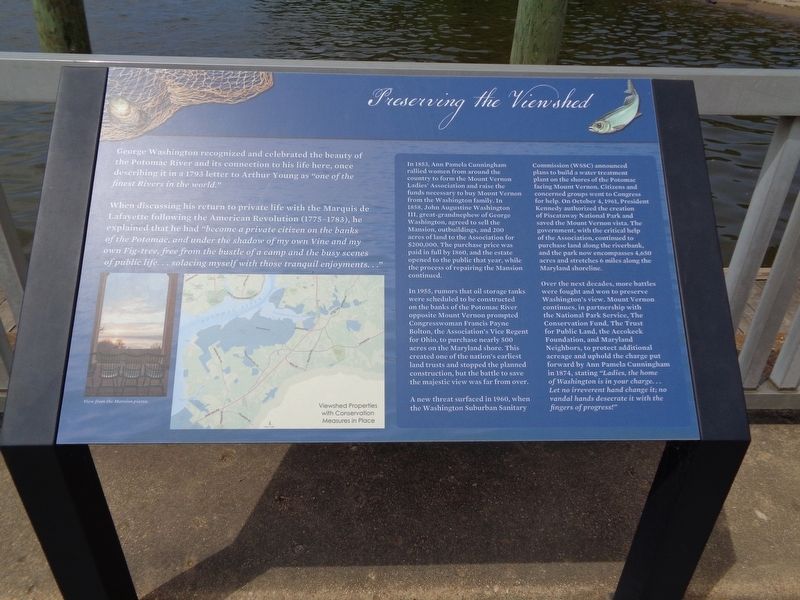
George Washington recognized and celebrated the beauty of the Potomac River and its connection to his life here, once describing it in a 1793 letter to Arthur Young as "one of the finest Rivers in the world."
When discussing his return to private life with the Marquis de Lafayette following the American Revolution (1775-1783), he explained that he had "become a private citizen on the banks of the Potomac, and under the shadow of my own Vine and my own Fig-tree, free from the bustle of a camp and the busy scenes of public life…solacing myself with those tranquil enjoyments…"
(sidebar:)
In 1853, Ann Pamela Cunningham rallied women from around the country to form the Mount Vernon Ladies' Association and raise the funds necessary to buy Mount Vernon from the Washington family. In 1858, John Augustine Washington III, great-grandnephew of George Washington, agreed to sell the Mansion, outbuildings, and 200 acres of land to the Association for $200,000. The purchase price was paid in full by 1860, and the estate opened to the public that year, while the process of repairing the Mansion continued.
In 1955, rumors
this page online
A new threat surfaced in 1960, when the Washington Suburban Sanitary Commission (WSSC) announced plans to build a water treatment plant on the shores of the Potomac facing Mount Vernon. Citizens and concerned groups went to Congress for help. On October 4, 1961, President Kennedy authorized the creation of Piscataway National Park and saved the Mount Vernon vista. The government, with the critical help of the Association, continued to purchase land along the riverbank, and the park now encompasses 4,650 acres and stretches 6 miles along the Maryland shoreline.
Over the next decades, more battles were fought and won to preserve Washington's view. Mount Vernon continues, in partnership with the National Park Service, the Conservation
Photographed by Jason Voigt, May 25, 2019
2. Preserving the Viewshed Marker
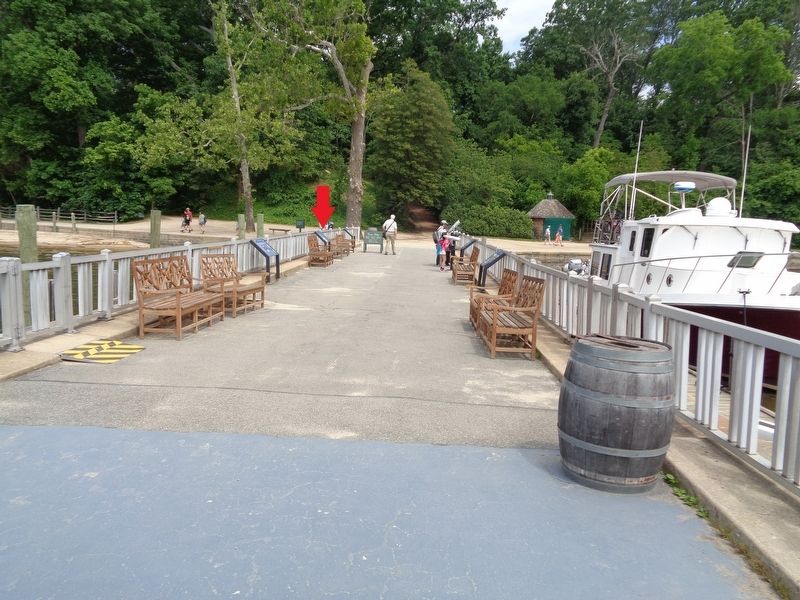
Marker is where the red arrow points
Topics. This historical marker is listed in these topic lists: Waterways & Vessels • Women.
Location. 38° 42.306′ N, 77° 5.295′ W. Marker is in Mount Vernon, Virginia, in Fairfax County. It can be reached from the intersection of Mount Vernon Memorial Highway (Virginia Route 235) and George Washington Memorial Parkway, on the right when traveling east. Marker is located at the Mount Vernon Wharf, which is on the grounds of George Washington's Mount Vernon estate. Touch for map. Marker is at or near this postal address: 3200 Mount Vernon Memorial Hwy, Alexandria VA 22309, United States of America. Touch for directions.

Regionally, this marker is in the Washington Metropolitan Area and in Northern Virginia. It is also in the American South, specifically in the Upper South, in the Mid-Atlantic, and on the Eastern Seaboard. Globally, it is in the North Atlantic Region, North America, the Western Hemisphere, the Western World, and the Anglosphere. Historically, it finds itself in what was once the territory of the Mississippian Culture, one of the original Thirteen Colonies, one of the Confederate States of America, and the Antebellum South.
Other nearby markers. At least 8 other markers are within walking distance of this marker: War at our Doorstep (here, next to this marker); The Potomac Watershed (a few steps from this marker); George Washington's Fisheries (a few steps from this marker); Commerce and Transportation (a few steps from this marker); History of the Wharf (a few steps from this marker); Home of George and Martha Washington / See Mount Vernon From The Water! (within shouting distance of this marker); The Mount Vernon Wharf (within shouting distance of this marker); Visionary Farmer (within shouting distance of this marker). Touch for a list and map of all markers in Mount Vernon.
Credits. This page was last revised on July 17, 2023. It was originally submitted on April 13, 2020, by Jason Voigt of Glen Carbon, Illinois. This page has been viewed 298 times since then and 19 times this year. Photos: 1, 2. submitted on April 13, 2020, by Jason Voigt of Glen Carbon, Illinois. • Devry Becker Jones was the editor who published this page.
