Fredericksburg, Virginia — The American South (Mid-Atlantic)
The African Baptist Church
Fredericksburg: Timeless.
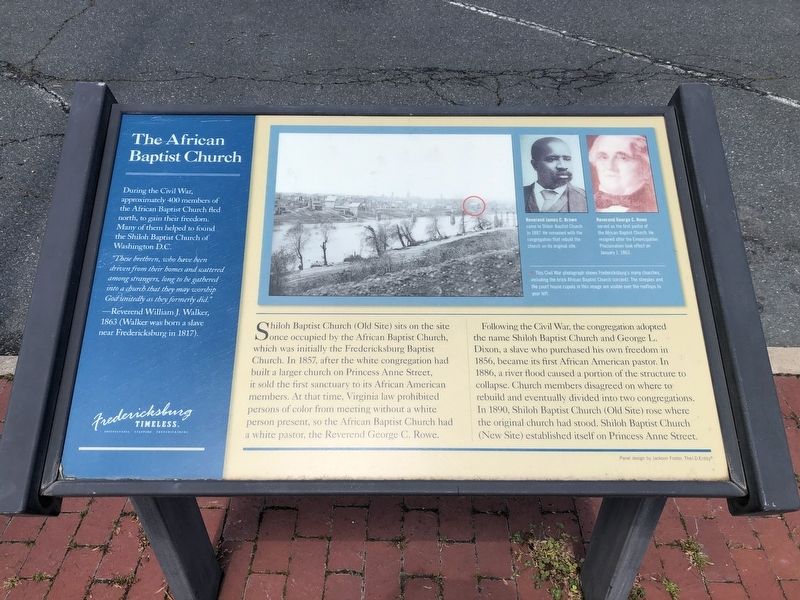
Shiloh Baptist Church (Old Site) sits on the site once occupied by the African Baptist Church, which was initially the Fredericksburg Baptist Church. In 1857, after the white congregation had built a larger church on Princess Anne Street, it sold the first sanctuary to its African American members. At that time, Virginia law prohibited persons of color from meeting without a white person present, so the African Baptist Church had a white pastor, the Reverend George C. Rowe.
Following the Civil War, the congregation adopted the name Shiloh Baptist Church and George L. Dixon, a slave who purchased his own freedom in 1856 became its first African American pastor. In 1886, a river flood caused a portion of the structure to collapse. Church members disagreed on where to rebuild and eventually divided into two congregations. In 1890, Shiloh Baptist Church (Old Site) rose where the original church had stood. Shiloh Baptist Church (New Site) established itself on Princess Anne Street.
[Aside:]
During the Civil War, approximately 400 members of the African Baptist Church fled north, to gain their freedom. Many of them helped
this page online
"These brethren, who have been driven from their homes and scattered among strangers, long to be gathered into a church that they may worship God unitedly as they formerly did."
—Reverend William J. Walker, 1863 (Walker was born a slave near Fredericksburg in 1817).
[Captions:]
Reverend Jame C. Brown came to Shiloh Baptist Church in 1887. He remained with the congregation that rebuilt the church on its original site.
Reverend George C. Rowe served as the first pastor of the African Baptist Church. He resigned after the Emancipation Proclamation took effect on January 1, 1863.
This Civil War photograph shows Fredericksburg's many churches, including the brick African Baptist Church (circled). The steeples and the court house cupola in this image are visible over the rooftops to your left.
Erected by Fredericksburg Economic Development and Tourism Office.
Topics and series. This historical marker is listed in these topic lists: African Americans • Civil Rights • Religion & Religious Structures • War, US Civil. In addition, it is included
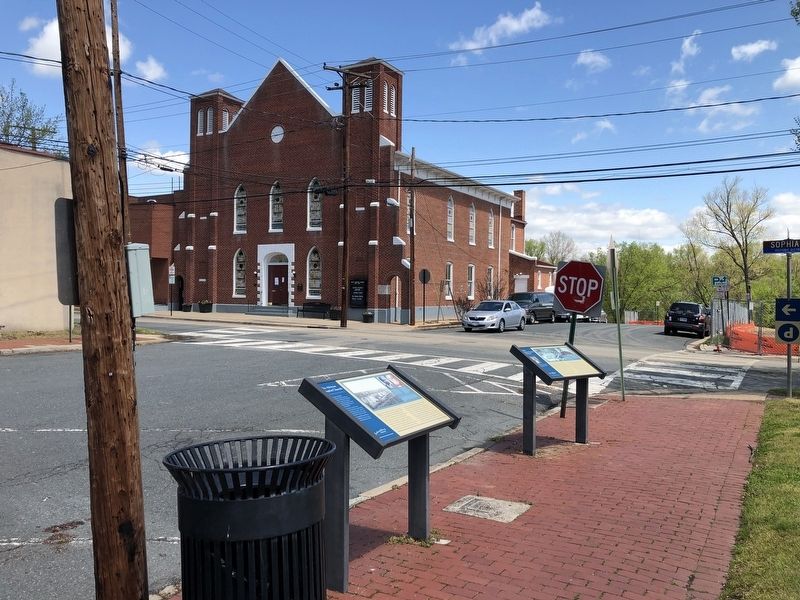
Location. 38° 18.121′ N, 77° 27.45′ W. Marker is in Fredericksburg, Virginia. It is at the intersection of Hanover Street and Sophia Street, on the right when traveling east on Hanover Street. Touch for map. Marker is at or near this postal address: 100 Hanover St, Fredericksburg VA 22401, United States of America. Touch for directions.

Regionally, this marker is in the Washington Metropolitan Area and in Northern Virginia. It is also in the American South and specifically in the Upper South. Globally, it is in North America, the Western Hemisphere, the Western World, and the Anglosphere. Historically, it finds itself in what was once the territory of the Mississippian Culture, one of the original Thirteen Colonies, one of the Confederate States of America, and the Antebellum South.
Other nearby markers. At least 8 other markers are within walking distance of this marker: Shiloh Baptist Church (Old Site) (a few steps from this marker); a different marker also named Shiloh Baptist Church (Old Site) (within shouting distance of this marker); 1950 Walker-Grant Protest (within shouting distance of this marker); c. 1785 (within shouting distance of this marker); 1831 (within shouting distance of this marker); a different marker also named 1831 (within shouting distance of this marker); Fredericksburg Center for the Creative Arts (within shouting distance of this marker); 1892 (about 300 feet away, measured in a direct line). Touch for a list and map of all markers in Fredericksburg.
Other markers no longer nearby. Shiloh Baptist Church (Old Site) (was a few steps from this marker but has been replaced with another marker now near it); African Baptist Church of Fredericksburg (was a few steps from this marker but has been replaced with another marker now near it).
Related marker. Click here for another marker that is related to this marker. This marker has replaced the linked marker.
Credits. This page was last revised on February 2, 2023. It was originally submitted on April 19, 2020, by Devry Becker Jones of Washington, District of Columbia. This page has been viewed 456 times since then and 17 times this year. Photos: 1, 2. submitted on April 19, 2020, by Devry Becker Jones of Washington, District of Columbia.
