New Rochelle in Westchester County, New York — The American Northeast (Mid-Atlantic)
Thomas Paine
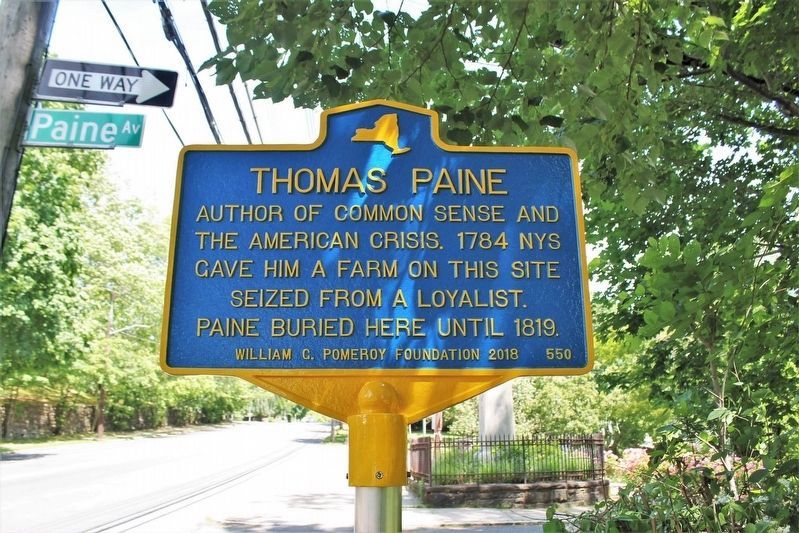
Photographed by Suzanne K. Tanswell, June 8, 2019
1. Thomas Paine Marker
Original burial site of the author of Common Sense and The American Crisis. "These are the times that try men's souls"
Author of Common Sense and The American Crisis. 1784 NYS gave him a farm on this site seized from a loyalist. Paine buried here until 1819.
Erected 2018 by William G. Pomeroy Foundation. (Marker Number 550.)
Topics. This historical marker is listed in these topic lists: Cemeteries & Burial Sites • Colonial Era • Patriots & Patriotism • War, US Revolutionary. A significant historical year for this entry is 1784.
Location. 40° 56.06′ N, 73° 47.495′ W. Marker is in New Rochelle, New York, in Westchester County. It is at the intersection of North Avenue (County Route 101) and Paine Avenue, on the right when traveling north on North Avenue. Touch for map. Marker is at or near this postal address: 20 Sicard Avenue, New Rochelle NY 10804, United States of America. Touch for directions.

Regionally, this marker is in the Hudson Valley and in the New York City Metropolitan Area. It is also in the American Northeast, in the Mid-Atlantic, and on the Eastern Seaboard. Globally, it is in the North Atlantic Region, North America, the Western Hemisphere, the Western World, and the Anglosphere. Historically,
this page online
Other nearby markers. At least 8 other markers are within 2 miles of this marker, measured as the crow flies: Korean Conflict Memorial (approx. one mile away); World War II Memorial (approx. one mile away); Vietnam Conflict Memorial (approx. one mile away); Vietnam Veterans Memorial (approx. one mile away); Welcome to the New Rochelle Walk of Fame (approx. 1.7 miles away); Ossie Davis & Ruby Dee (approx. 1.7 miles away); Norman Rockwell (approx. 1.7 miles away); Elizabeth Ann Seton (approx. 1.7 miles away). Touch for a list and map of all markers in New Rochelle.
More about this marker.
Located on the grounds of the Thomas Paine Cottage Museum next to the Thomas Paine National Historical Association.
Regarding Thomas Paine.
Thomas Paine, author of Common Sense, was an obscure immigrant when this small pamphlet was published in January, 1776. In the first three months, 120,000 copies were sold, helping to ignite the flame of independence in America.
During the American Revolution, Paine volunteered as a personal assistant to General
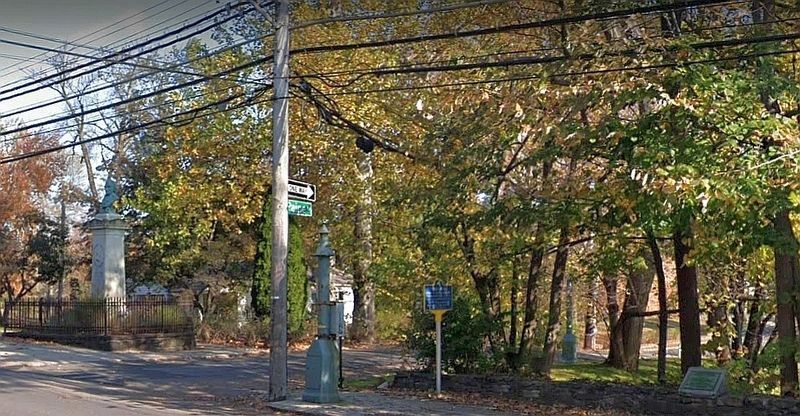
2. Thomas Paine Marker, Paine Burial Plaque, Thomas Paine Monument on North Avenue
George Washington's ordered the pamphlet be read to all of his troops at Valley Forge to bolster morale on December 23, 1776, three days before the Battle of Trenton.
Related marker. Click here for another marker that is related to this marker. Thomas Paine's House in Lewes, England before he emigrated to the colonies.
Also see . . .
1. Thomas Paine Cottage Museum. (Submitted on April 30, 2020, by Suzanne K. Tanswell of New Rochelle, New York.)
2. Thomas Paine (Wikipedia). (Submitted on April 30, 2020, by Michael Herrick of Southbury, Connecticut.)
3. The American Crisis (Wikipedia). (Submitted on April 30, 2020, by Michael Herrick of Southbury, Connecticut.)
Additional keywords. Thomas Paine Cottage Museum, New Rochelle, New York, Historical Landmark
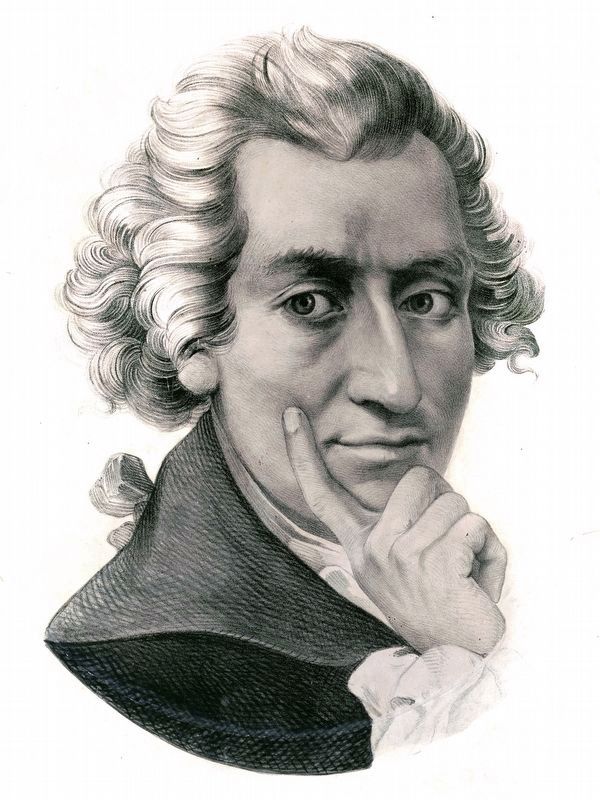
Library of Congress
3. Thomas Paine, Esqr.
The Spirit of the American Revolution
The Spirit of the American Revolution
Lithograph by Peter Kramer
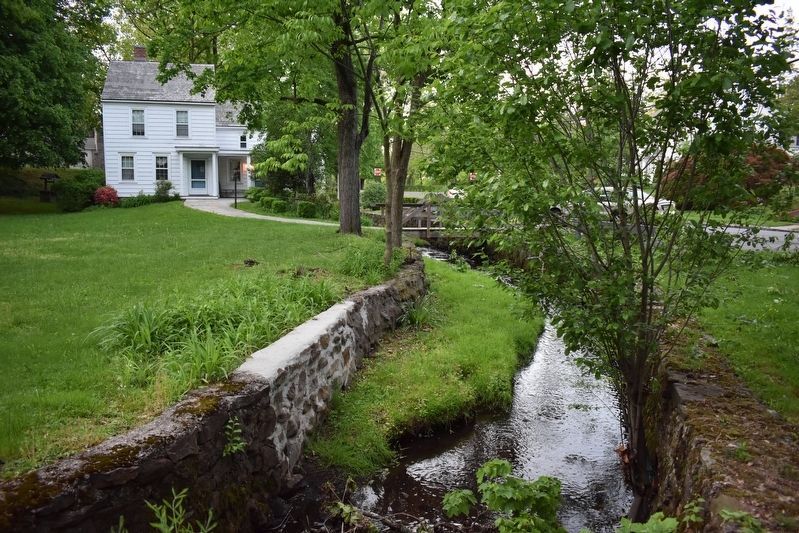
Photographed by Suzanne K. Tanswell, circa July 2019
4. Thomas Paine Cottage Museum and grounds
Credits. This page was last revised on April 23, 2025. It was originally submitted on April 28, 2020, by Suzanne K. Tanswell of New Rochelle, New York. This page has been viewed 714 times since then and 97 times this year. Photos: 1. submitted on April 28, 2020, by Suzanne K. Tanswell of New Rochelle, New York. 2. submitted on April 30, 2020, by Suzanne K. Tanswell of New Rochelle, New York. 3. submitted on September 17, 2023, by Allen C. Browne of Silver Spring, Maryland. 4. submitted on April 30, 2020, by Suzanne K. Tanswell of New Rochelle, New York. • Michael Herrick was the editor who published this page.
Editor’s want-list for this marker. A wide angle photo of the marker and its surroundings. • Can you help?
