Near Fredonia in Mohave County, Arizona — The American Mountains (Southwest)
Suh-uhv'
Rhus trilobata
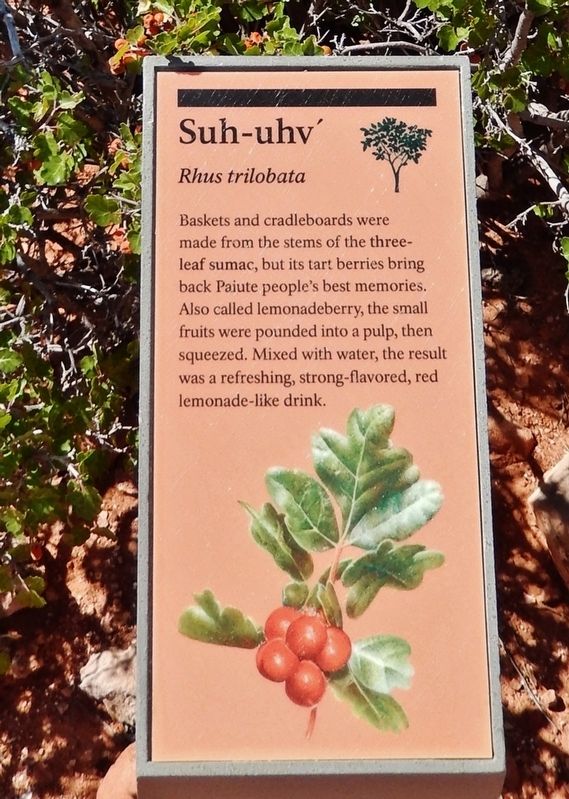
Photographed by Cosmos Mariner, June 10, 2016
1. Suh-uhv' Marker
Topics. This historical marker is listed in this topic list: Indigenous Peoples and Communities.
Location. 36° 51.876′ N, 112° 44.496′ W. Marker is near Fredonia, Arizona, in Mohave County. It can be reached from North Pipe Spring Road 0.3 miles north of Arizona Route 389, on the left when traveling north. Marker is located along the Ridge Trail in Pipe Spring National Monument. Touch for map. Marker is at or near this postal address: 406 North Pipe Spring Road, Fredonia AZ 86022, United States of America. Touch for directions.

Regionally, this marker is in the American Southwest and on the Colorado Plateau. Globally, it is in North America, the Western Hemisphere, the Western World, and the Anglosphere. Historically, it finds itself in what was once New
this page online
Other nearby markers. At least 8 other markers are within walking distance of this marker: Plateau Country Trees (within shouting distance of this marker); Remnants of a Frozen Sahara (within shouting distance of this marker); Oos'eev (within shouting distance of this marker); Kwi'-uv (within shouting distance of this marker); Tup' (within shouting distance of this marker); Cut Off By The Grand Canyon (within shouting distance of this marker); Boundaries and Fencing (within shouting distance of this marker); Powell’s Surveyors at Pipe Spring (about 300 feet away, measured in a direct line). Touch for a list and map of all markers in Fredonia.
Related markers. Click here for a list of markers that are related to this marker. Pipe Spring National Monument
Also see . . . Rhus trilobata (Wikipedia). The Zuni people, Navajo, and Mono tribes use the stems with the bark removed to make baskets. The bark has been chewed or brewed into a drink for cold symptoms, the berries eaten for gastrointestinal complaints and toothache, and the leaves and roots boiled and eaten for many complaints.
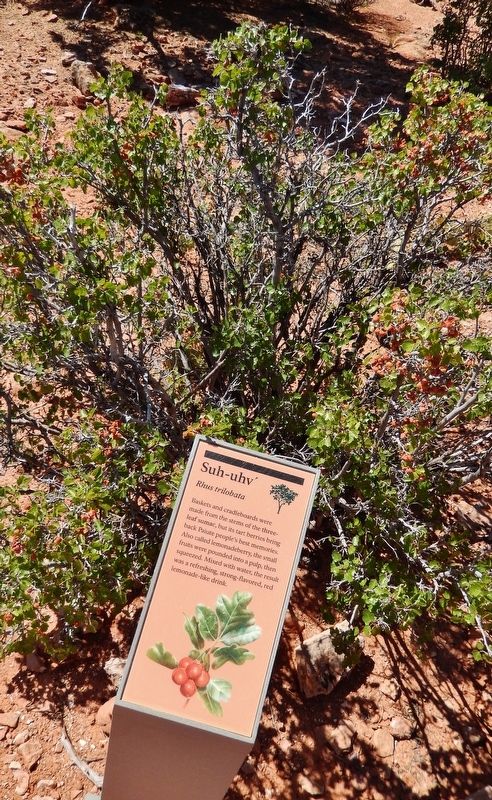
Photographed by Cosmos Mariner, June 10, 2016
2. Suh-uhv' Marker
Credits. This page was last revised on May 7, 2020. It was originally submitted on May 5, 2020, by Cosmos Mariner of Cape Canaveral, Florida. This page has been viewed 271 times since then and 21 times this year. Photos: 1, 2. submitted on May 6, 2020, by Cosmos Mariner of Cape Canaveral, Florida.
