Coconut Grove in Miami-Dade County, Florida — The American South (South Atlantic)
Mariah Brown House
Photographed by Tim Fillmon, January 24, 2018
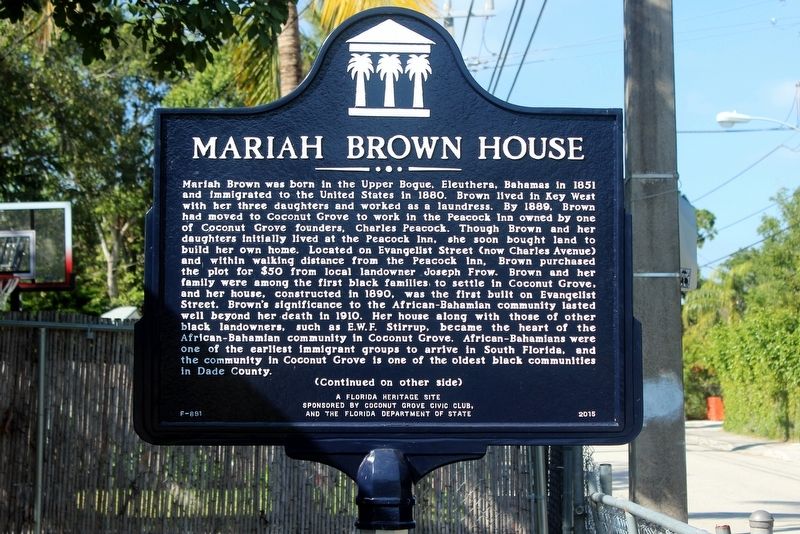
1. Mariah Brown House Marker Side 1
Mariah Brown was born in the Upper Bogue, Eleuthera, Bahamas in 1851 and immigrated to the United States in 1880. Brown lived in Key West with her three daughters and worked as a laundress. By 1889, Brown had moved to Coconut Grove to work in the Peacock Inn owned by one of Coconut Grove founders, Charles Peacock. Though Brown and her daughters initially lived at the Peacock Inn, she soon bought land to build her own home. Located on Evangelist Street (now Charles Avenue) and within walking distance from the Peacock Inn, Brown purchased the plot for $50 from local landowner Joseph Frow. Brown and her family were among the first black families to settle in Coconut Grove, and her house, constructed in 1890, was the first built on Evangelist Street. Brown’s significance to the African-Bahamian community lasted well beyond her death in 1910. Her house along with those of other black landowners, such as E.W.F. Stirrup, became the heart of the African-Bahamian community in Coconut Grove. African-Bahamians were one of the earliest immigrant groups to arrive in South Florida, and the community in Coconut Grove is one of the oldest
this page online
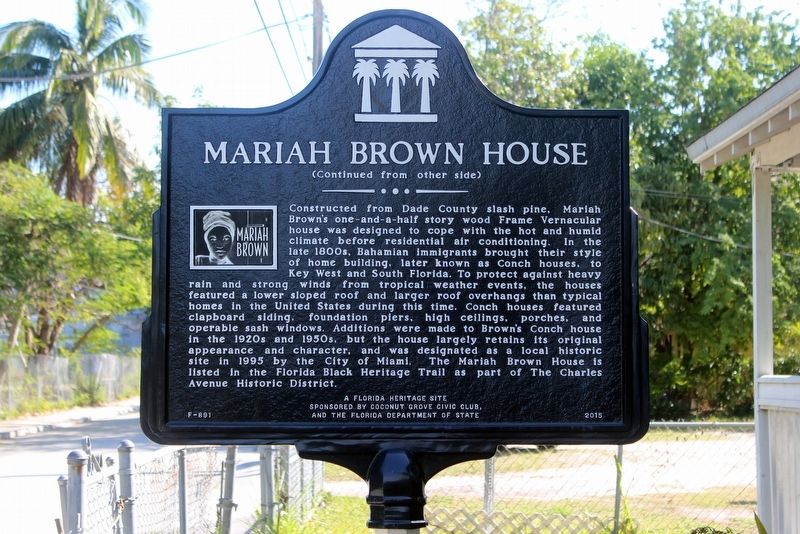
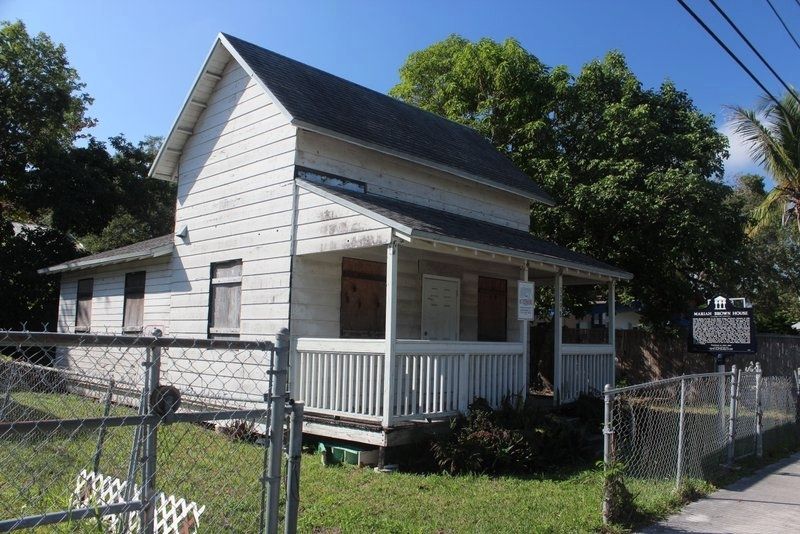
Constructed from Dade County slash pine, Mariah Brown’s one-and-a-half story wood Frame Vernacular house was designed to cope with the hot and humid climate before residential air conditioning. In the late 1800s, Bahamian immigrants brought their style of home building, later known as Conch houses, to Key West and South Florida. To protect against heavy rain and strong winds from tropical weather events, the houses featured a lower sloped roof and larger roof overhangs than typical homes in the United States during this time. Conch houses featured clapboard siding, foundation piers, high ceilings, porches, and operable sash windows. Additions were made to Brown’s Conch house in the 1920s and 1950s, but the house largely retains its original appearance and character, and was designated as a local historic site in 1995 by the City of Miami. The Mariah Brown House is listed in the Florida Black Heritage Trail as part of The Charles Avenue Historic District.
Erected 2015 by Coconut Grove Civic Club and the Florida Department of State. (Marker Number F-891.)
Topics. This historical marker
Photographed by Tim Fillmon, January 24, 2018
2. Mariah Brown House Marker Side 2
Location. 25° 43.535′ N, 80° 14.779′ W. Marker is in Coconut Grove, Florida, in Miami-Dade County. It is on Charles Avenue 0.1 miles west of Main Highway, on the left when traveling west. Touch for map. Marker is at or near this postal address: 3298 Charles Avenue, Miami FL 33133, United States of America. Touch for directions.

Regionally, this marker is in South Florida, on the Gold Coast, and in Greater Miami. It is also in the American South and on the Eastern Seaboard. Globally, it is in the North Atlantic Region, North America, a Gulf of Mexico state, the Western Hemisphere, the Western World, and the Anglosphere. Historically, it finds itself in what was once New Spain, the territory of the Mississippian Culture, one of the Confederate States of America, and the Antebellum South.
Other nearby markers. At least 8 other markers are within walking distance of this marker: Charles Avenue (about 300 feet away, measured in a direct line); E.W.F. Stirrup House (about
Photographed by Tim Fillmon, January 24, 2018
3. Mariah Brown House and Marker
Photographed by Tim Fillmon, January 24, 2018
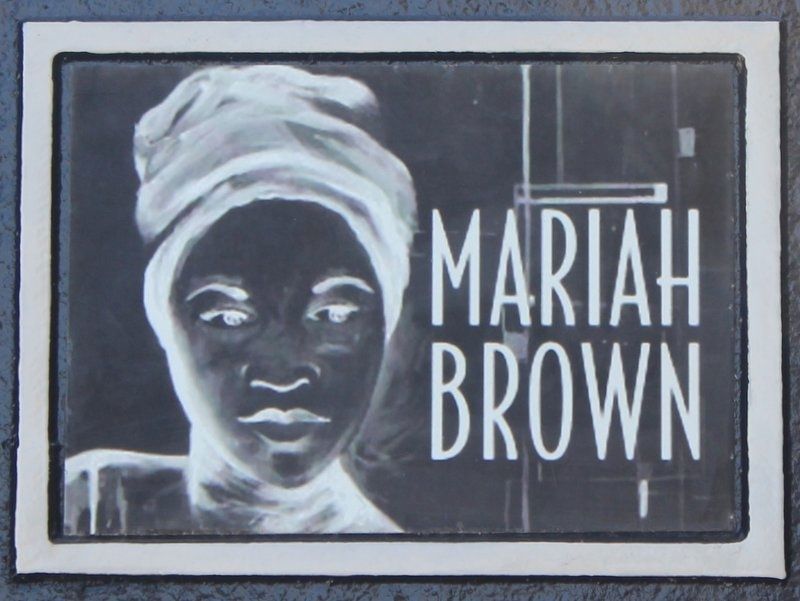
4. Mariah Brown
Credits. This page was last revised on January 9, 2025. It was originally submitted on May 31, 2020, by Tim Fillmon of Webster, Florida. This page has been viewed 2,952 times since then and 260 times this year. Photos: 1, 2, 3, 4. submitted on May 31, 2020, by Tim Fillmon of Webster, Florida. • Bernard Fisher was the editor who published this page.
