
Vieux-Québec-Cap-Blanc-colline Parlementaire in Capitale-Nationale, — Central Canada (French-Canadian)
Les vestiges des maisons Gaillard et Soulard
Remains of the Gaillard and Soulard houses
Photographed by Cosmos Mariner, August 4, 2019
1. Remains of the Gaillard & Soulard Houses Marker

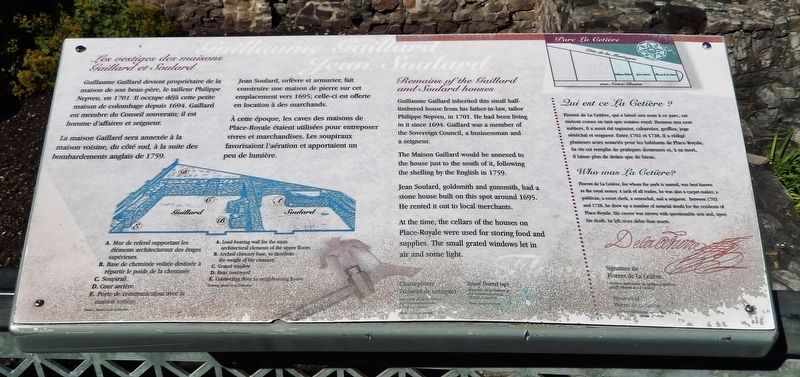
Guillaume Gaillard devient propriétaire de la maison de son beau-père, le tailleur Philippe Nepveu, en 1701. Il occupe déjà cette petite maison de colombage depuis 1694. Gaillard est membre du Conseil souverain; il est homme d'affaires et seigneur.
La maison Gaillard sera annexée à la maison voisine, du côté sud, à la suite des bombardements anglais de 1759.
Jean Soulard, orfèvre et armurier, fait construire une maison de pierre sur cet emplacement vers 1695; celle-ci est offerte en location à des marchands.
À cette époque, les caves des maisons de Place-Royale étaient utilisées pour entreposer vivres et marchandises. Les soupiraux favorisaient l'aération et apportaient un peu de lumière.
Qui est ce La Cetière ?
Florent de La Cetière, qui a laissé son nom à ce parc, est surtout connu en tant que notaire royal. Homme aux cent métiers, il a aussi été tapissier, cabaretier, greffier, juge sénéchal et seigneur. Entre 1702 et 1728, il a rédigé plusieurs actes notariés pour les habitants de Place-Royale. Sa vie est remplie de pratiques douteuses et, à sa mort, il laisse plus de dettes que de biens.
(légendes de photos)
• Chantepleure (robinet de tonneau)
• Signature de Florent de La Cetière
Guillaume Gaillard inherited this small half-timbered house from his father-in-law, tailor Philippe Nepveu, in 1701. He had been living in it since 1694. Gaillard was a member of the Sovereign Council, a businessman and a seigneur.
The Maison Gaillard would be annexed to the house just to the south of it, following the shelling by the English in 1759.
Jean Soulard, goldsmith and gunsmith, had a stone house built on this spot around 1695. He rented it out to local merchants.
At the time, the cellars of the houses on Place-Royale were used for storing food and supplies. The small grated windows let in air and some light.
Who was La Cetière?
Florent de La Cetière, for whom the park is named, was best known as the royal notary. A jack of all trades, he was also a carpet maker, a publican, a court clerk, a seneschal, and a seigneur. Between 1702 and 1728, he drew up a number of notarial deeds for the residents of Place-Royale. His career was strewn with questionable acts and, upon his death, he left more debts than assets.
(photo captions)
• Spigot (barrel tap)
• Signature of Florent de La Cetière
Topics.
this page online
Location. 46° 48.818′ N, 71° 12.191′ W. Marker is in Québec, in Capitale-Nationale. It is in Vieux-Québec-Cap-Blanc-colline Parlementaire. It is on Rue Notre-Dame just north of Rue du Porche, on the left when traveling north. Marker is mounted on the fence rail in Parc de la Cetière, overlooking the stone foundations exposed there. Touch for map. Marker is at or near this postal address: Rue Notre-Dame, Québec G1K 4E9, Canada. Touch for directions.

Regionally, this marker is in Central Canada. Globally, it is in North America, the Western Hemisphere, and the Western World. Historically, it finds itself in what was once a British colony, the Viceroyalty of New France, the Haudenosaunee (Iroquois) Confederacy, and Rupert’s Land.
Other nearby markers. At least 8 other markers are within walking distance of this marker: Un horloger bien de son temps / A clock-maker of the time (here, next to this marker); À la française… / French Style… (here, next
Photographed by Musée de la civilisation
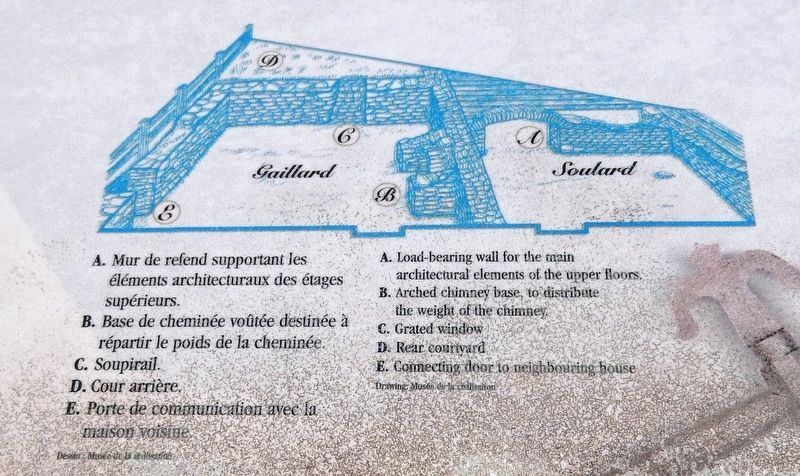
2. Marker detail: Diagramme des ruines / Diagram of Ruins
Related markers. Click here for a list of markers that are related to this marker. Parc de la Cetière
Also see . . .
1. Guillaume Gaillard. At the age of 16, Gaillard had come to New France to be a servant of Jean-François Hazeur, Sieur de Petit-Marais, a Montreal merchant, but as the latter had died before Gaillard arrived, in 1685, the young man went to Quebec. On 20 March 1712, Gaillard acquired for 24,000 livres in French currency the seigneury of the island and countship of Saint-Laurent (Île d’Orléans). (Submitted on July 13, 2020, by Cosmos Mariner of Cape Canaveral, Florida.)
2. Jean Soullard.
Photographed by Cosmos Mariner, August 4, 2019
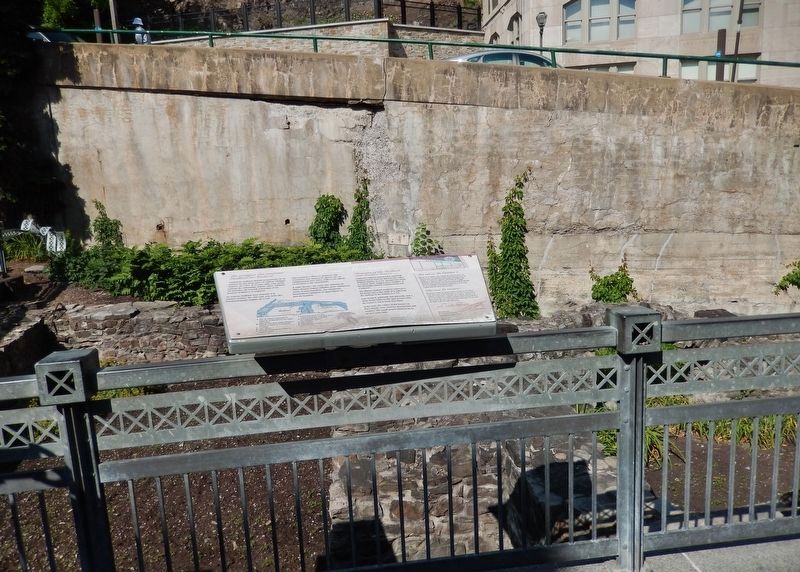
3. Remains of the Gaillard & Soulard Houses Marker
3. Florent de La Cetière. The first mention of La Cetière’s presence in Canada is on the occasion of his marriage contract on 10 Nov. 1687. He was then an upholsterer, but speedily took on other jobs: in 1695 he was at one and the same time an upholsterer, a tavern-keeper (and had been since at least the preceding year), a soldier in the Quebec garrison, and a legal practitioner. A man ready to turn his hand to anything, and with never a penny to his name! (Submitted on July 13, 2020, by Cosmos Mariner of Cape Canaveral, Florida.)
Photographed by Cosmos Mariner, August 4, 2019
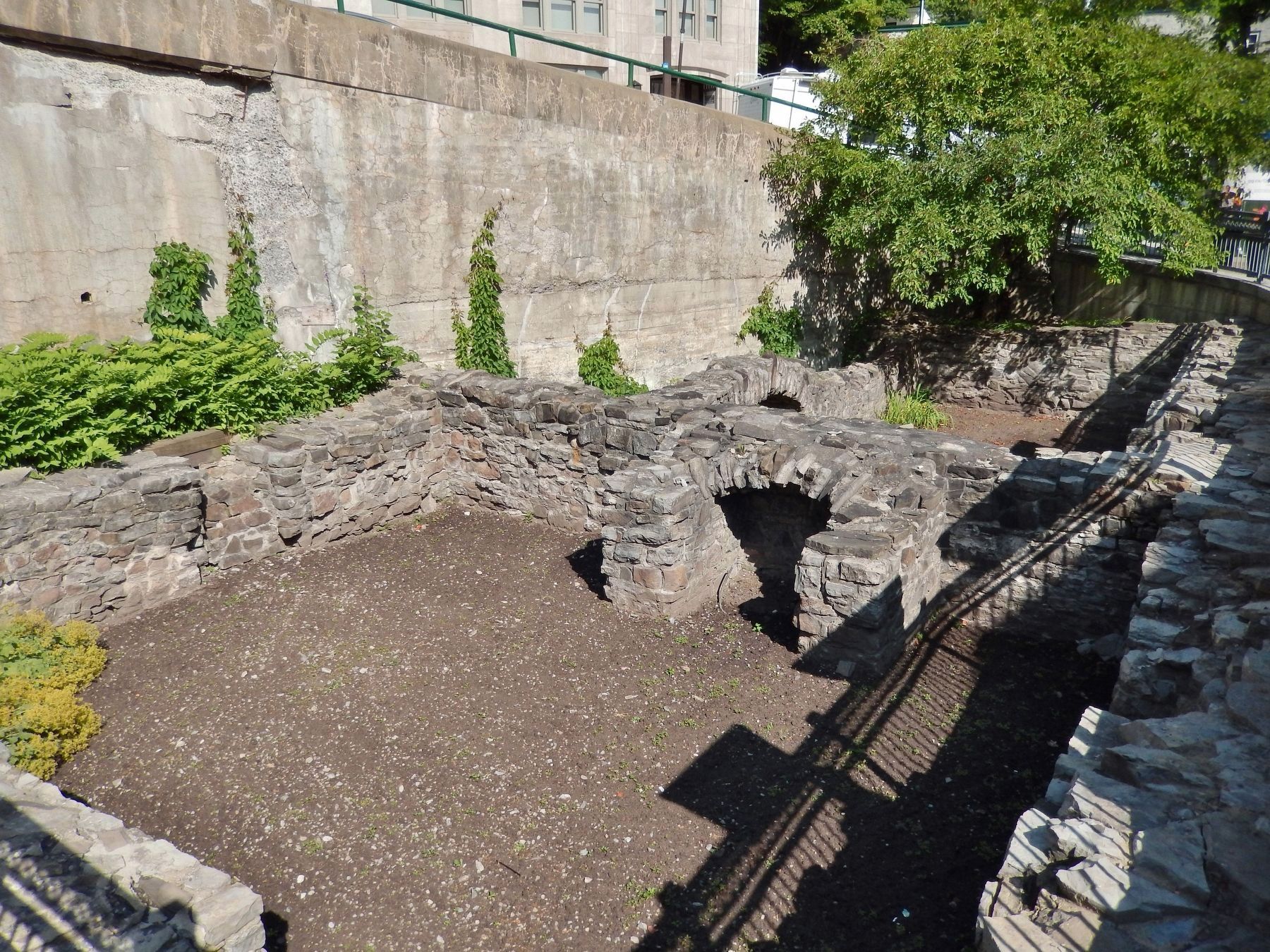
4. Les vestiges des maisons Gaillard et Soulard
• • •
(remains of the Gaillard and Soulard houses • behind marker)
Credits. This page was last revised on February 9, 2023. It was originally submitted on July 11, 2020, by Cosmos Mariner of Cape Canaveral, Florida. This page has been viewed 514 times since then and 43 times this year. Photos: 1. submitted on July 12, 2020, by Cosmos Mariner of Cape Canaveral, Florida. 2, 3, 4. submitted on July 13, 2020, by Cosmos Mariner of Cape Canaveral, Florida.
