
Downtown in St. Louis, Missouri — The American Midwest (Upper Plains)
Chief Pontiac
Photographed by Jason Voigt, June 14, 2020
1. Chief Pontiac Marker
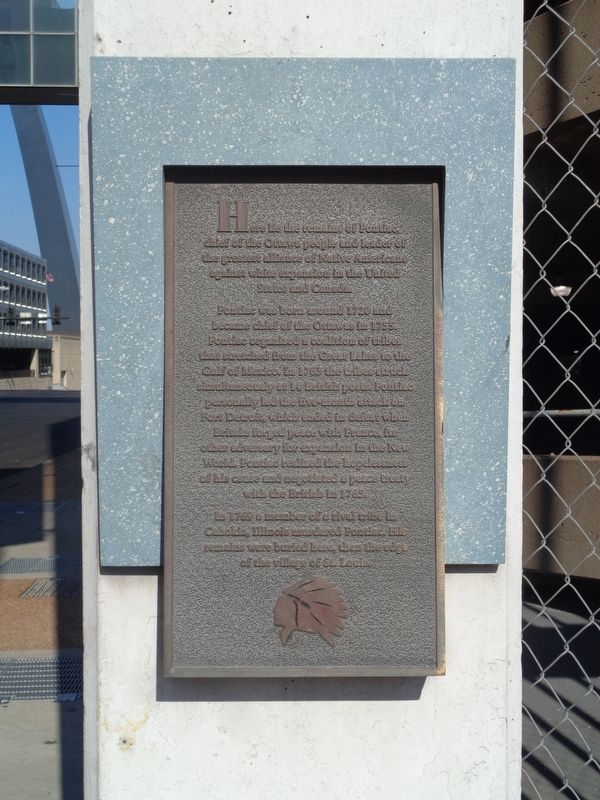
Here lie the remains of Pontiac, chief of the Ottawa people and leader of the greatest alliance of Native Americans against white expansion in the United States and Canada.
Pontiac was born around 1720 and became chief of the Ottawas in 1755. Pontiac organized a coalition of tribes that stretched from the Great Lakes to the Gulf of Mexico. In 1763 the tribes struck simultaneously at 14 British posts. Pontiac personally led the five-month attack on Fort Detroit, which ended in defeat when Britain forged peace with France, its other adversary for expansion in the New World. Pontiac realized the hopelessness of his cause and negotiated a peace treaty with the British in 1765.
In 1769 a member of a rival tribe in Cahokia, Illinois murdered Pontiac. His remains were buried here, then the edge of the village of St. Louis.
Topics. This historical marker is listed in these topic lists: Cemeteries & Burial Sites • Indigenous Peoples and Communities • Wars, US Indian. A significant historical year for this entry is 1720.
Location. 38° 37.465′ N, 90° 11.416′ W. Marker is in St. Louis, Missouri. It is in Downtown. It
this page online

Regionally, this marker is in the American Midwest, in the Lewis & Clark Corridor, in the Corn Belt, and in the Great River Road Region. Globally, it is in North America, the Western Hemisphere, the Western World, and the Anglosphere. Historically, it finds itself in what was once the territory of the Mississippian Culture, the Louisiana Purchase, and the Antebellum South.
Other nearby markers. At least 8 other markers are within walking distance of this marker: Fort San Carlos (within shouting distance of this marker); Phelim O'Toole (within shouting distance of this marker); Battle of St. Louis (about 300 feet away, measured in a direct line); Rue de la Tour (about 300 feet away); American Zinc Building (about 400 feet away); Engineers' Club of St. Louis (about
Photographed by Jason Voigt, June 14, 2020
2. Chief Pontiac Marker
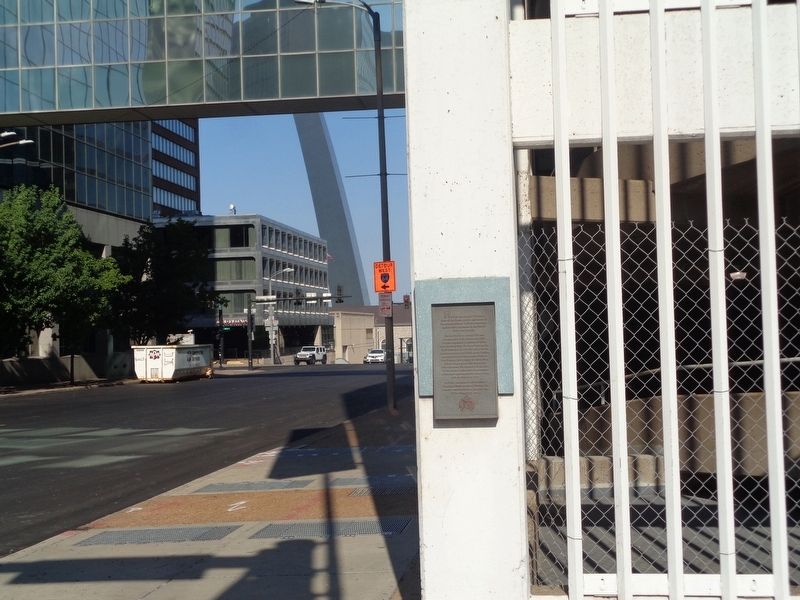
Pontiac's remains are believed to be buried beneath the parking garage.
Also see . . . Pontiac (Ottawa leader) on Wikipedia. A full biography on the war chief. There have been disagreements among historians over Pontiac's birth date, as well as the cause of his death and place of burial. Some believe he is buried in Cahokia, Illinois, but no evidence supports it. Places named for Pontiac include the cities in Illinois and Michigan, and even in Quebec in Canada. It was also the name for a popular General Motors automobile brand, which was discontinued in 2010. (Submitted on July 24, 2020, by Jason Voigt of Glen Carbon, Illinois.)
Credits. This page was last revised on January 5, 2025. It was originally submitted on July 24, 2020, by Jason Voigt of Glen Carbon, Illinois. This page has been viewed 2,326 times since then and 88 times this year. Photos: 1, 2. submitted on July 24, 2020, by Jason Voigt of Glen Carbon, Illinois.
