Circleville in Piute County, Utah — The American Mountains (Southwest)
Circleville Massacre Monument
Photographed by Jacob Oscarson, July 26, 2020
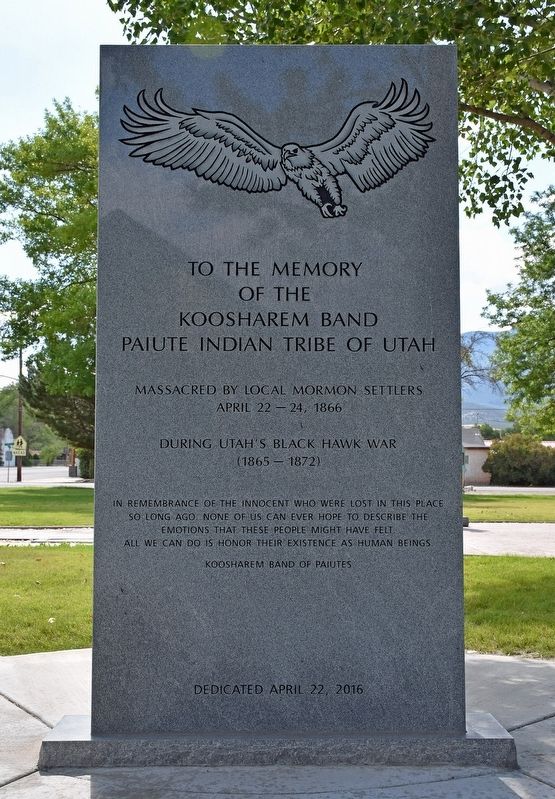
1. East side of marker
(front of monument)
Koosharem Band
Paiute Indian Tribe of Utah
Massacred by local Mormon Settlers April 22–24, 1866
during Utah's Black Hawk War (1865–1872)
Dedicated April 22, 2016
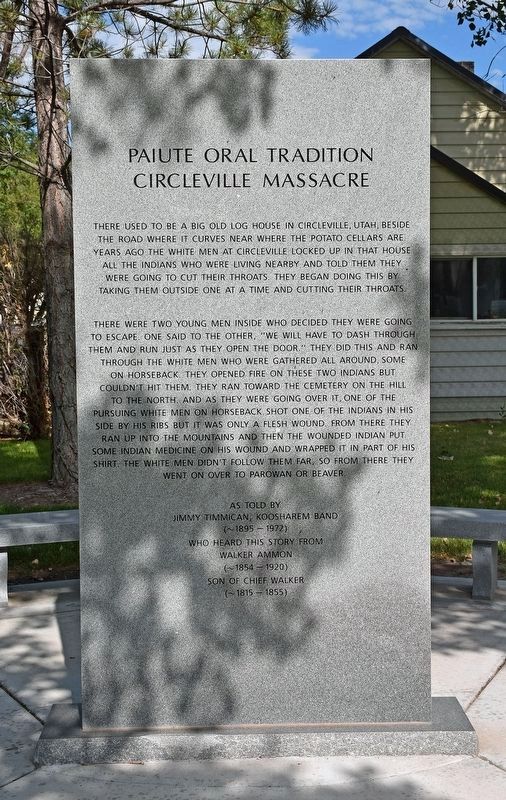
(back of monument)
Circleville Massacre
There used to be a big old log house in Circleville, Utah, beside the road where it curves near where the potato cellars are. Years ago the white men at Circleville locked up in that house all the Indians who were living nearby and told them they were going to cut their throats. They began doing this by taking them outside one at a time and cutting their throats.
There were two young men inside who decided they were going to escape. One said to the other, "We will have to dash through them and run just as they open the door." They did this and ran through the white men who were gathered all around,
this page online
As told by Jimmy Timmican, Koosharem band (~1895–1972)
who heard this story from Walker Ammon (~1854–1920) son of Chief Walker (~1815–1855)
Erected 2016.
Topics. This monument and memorial is listed in these topic lists: Indigenous Peoples and Communities • Settlements & Settlers • Wars, US Indian. A significant historical month for this entry is April 1866.
Location. 38° 10.319′ N, 112° 16.194′ W. Monument is in Circleville, Utah, in Piute County. It is on U.S. 89, on the left when traveling east. Touch for map. Monument is in this post office area: Circleville UT 84723, United States of America. Touch for directions.

Regionally, this memorial monument is in
Photographed by Jacob Oscarson, July 26, 2020
2. West side of marker
Other nearby markers. At least 8 other markers are within 5 miles of this marker, measured as the crow flies: The Circleville Massacre (here, next to this marker); Circleville Veterans Memorial (a few steps from this marker); Circleville (within shouting distance of this marker); "The Paiute Trail Story" (approx. 2.7 miles away); Trade with the Native Americans (approx. 2.7 miles away); Butch Cassidy Childhood Home (approx. 2.7 miles away); "More lives than a dozen cats" (approx. 2.7 miles away); Kingston Ward (approx. 5.1 miles away). Touch for a list and map of all markers in Circleville.
Related marker. Click here for another marker that is related to this marker.
Additional commentary.
1. Father of Walker Ammon
Walker Wasn't Walker Ammon's father. Ammon, half brother to Walker, was Walker Ammon's father. It was traditional to name a son after your brother.
— Submitted March 7, 2024, by Fern Lerwick of Minneapolis, Minnesota.
2. The two boys that escaped
One of the two boys that escaped was my great grandfather who eventually was adopted by a Mormon family and given the last name of Monson. He was known in his later life as Indian Dave Monson (sometimes misspelled as Munson or Munsen) He is buried in Saratoga, WY. I am the oldest last living member of that family.
Because of the escape and poor record keeping, our family had to go to court to get recognized as part of the Paiute Tribe. Note To Editor only visible by Contributor and editor
— Submitted March 28, 2025, by Dewayne Monson of Sun City West, Arizona.
Photographed by Jacob Oscarson, July 26, 2020
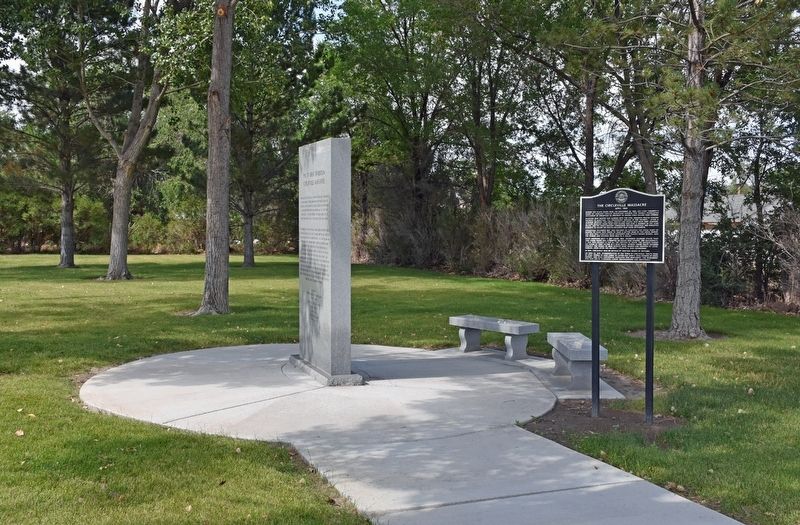
3. General view
Credits. This page was last revised on March 31, 2025. It was originally submitted on August 1, 2020, by Jacob Oscarson of Salt Lake City, Utah. This page has been viewed 737 times since then and 77 times this year. Photos: 1, 2, 3. submitted on August 1, 2020, by Jacob Oscarson of Salt Lake City, Utah. • Andrew Ruppenstein was the editor who published this page.
