An Era of Dramatic Change
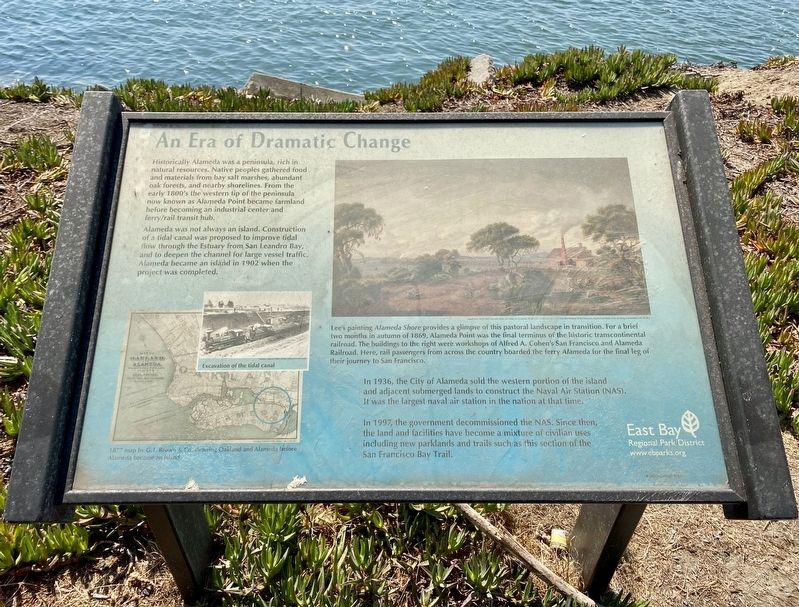
Alameda was not always an island. Construction of a tidal canal was proposed to improve tidal flow through the Estuary from San Leandro Bay, and to deepen the channel for large vessel traffic. Alameda became an island in 1902 when the project was completed.
In 1936, the City of Alameda sold the western portion of the island and adjacent submerged lands to construct the Naval Air Station (NAS). It was the largest naval air station in the nation at that time.
In 1997, the government decommissioned the NAS. Since then, the land and facilities have become a mixture of civilian uses including new parklands and trails such as this section of the San Francisco Bay Trail.
(picture caption:)
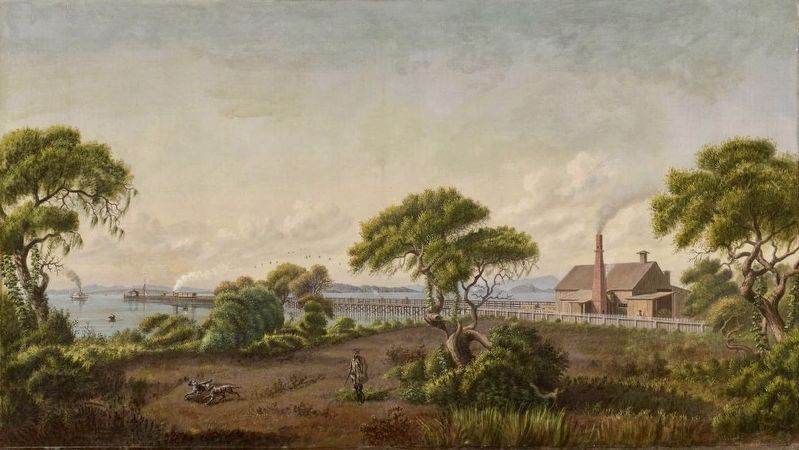
Lee's painting Alameda Shore provides a glimpse of this pastoral landscape in
this page online
Erected by East Bay Regional Parks District.
Topics. This historical marker is listed in these topic lists: Air & Space • Environment • Waterways & Vessels. A significant historical year for this entry is 1902.
Location. 37° 46.303′ N, 122° 17.894′ W. Marker is in Alameda, California, in Alameda County. It can be reached from Alameda Point Shoreline Trail. Touch for map. Marker is in this post office area: Alameda CA 94501, United States of America. Touch for directions.
Regionally, this marker is in the San Francisco Bay Area and on the Coast Ranges. It is also on the American Pacific Coast. Globally, it is in North America, on the Ring of Fire, on the Pacific Rim, in the Western Hemisphere, in the Western World, and in the Anglosphere. Historically,
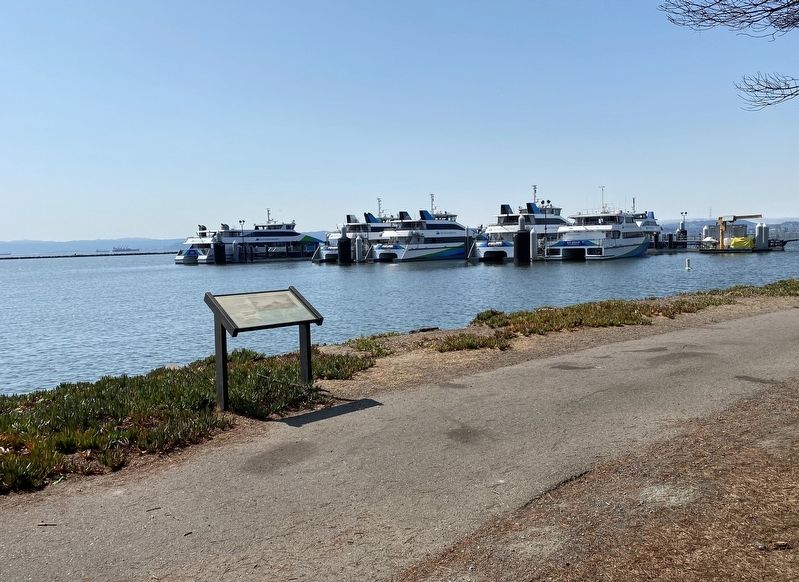
Other nearby markers. At least 8 other markers are within walking distance of this marker: A Working Waterfront (a few steps from this marker); The Jimmy Doolittle Pier – Alameda Naval Air Station (approx. 0.2 miles away); Alameda: Bay Area Aviation Center (approx. 0.4 miles away); Seaplane Lagoon (approx. 0.4 miles away); Seaplanes and Flying Boats at NAS Alameda (approx. 0.4 miles away); Aircraft Carriers and Seaplane Tenders (approx. 0.4 miles away); Douglas SBD Dauntless (approx. 0.6 miles away); Grumman J2F Duck (approx. 0.6 miles away). Touch for a list and map of all markers in Alameda.
Credits. This page was last revised on October 8, 2020. It was originally submitted on September 30, 2020, by Andrew Ruppenstein of Lamorinda, California. This page has been viewed 452 times since then and 46 times this year. Photos: 1, 2, 3. submitted on September 30, 2020, by Andrew Ruppenstein of Lamorinda, California.
