Near Bigelow in Nobles County, Minnesota — The American Midwest (Upper Plains)
Welcome to Minnesota
⎯⎯⎯
The Minnesota-Iowa Boundary
Photographed by Cosmos Mariner, August 19, 2014
1. Welcome to Minnesota (marker east side)
(marker east side)
• • •
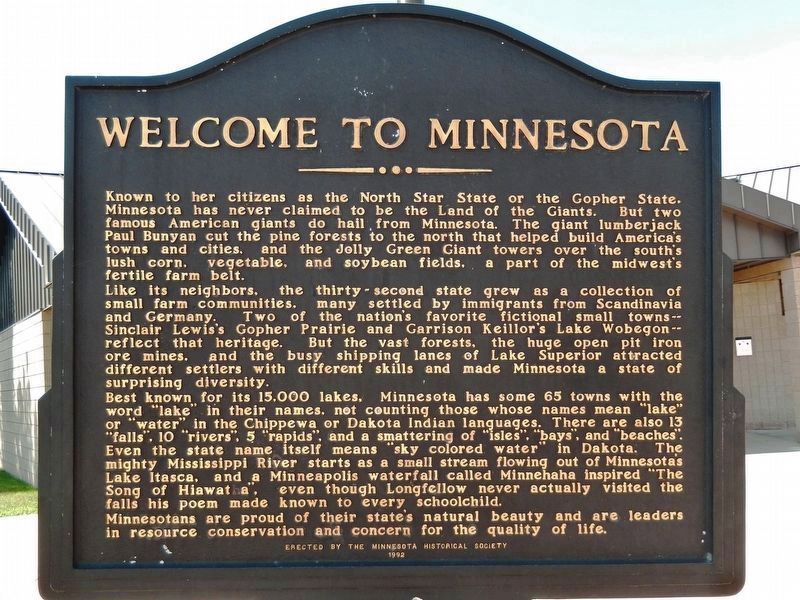
Like its neighbors, the thirty-second state grew as a collection of small farm communities, many settled by immigrants from Scandinavia and Germany. Two of the nation's favorite fictional small towns — Sinclair Lewis's Gopher Prairie and Garrison Keillor's Lake Wobegon — reflect that heritage. But the vast forests, the huge open pit iron ore mines, and the busy shipping lanes of Lake Superior attracted different settlers with different skills and made Minnesota a state of surprising diversity.
Best known for its 15,000 lakes, Minnesota has some 65 towns with the word "lake" in their names, not counting those whose names mean "lake" or "water" in the Chippewa,
this page online
Minnesotans are proud of their state's natural beauty and are leaders in resource conservation and concern for the quality of life.
(marker west side)
• • •
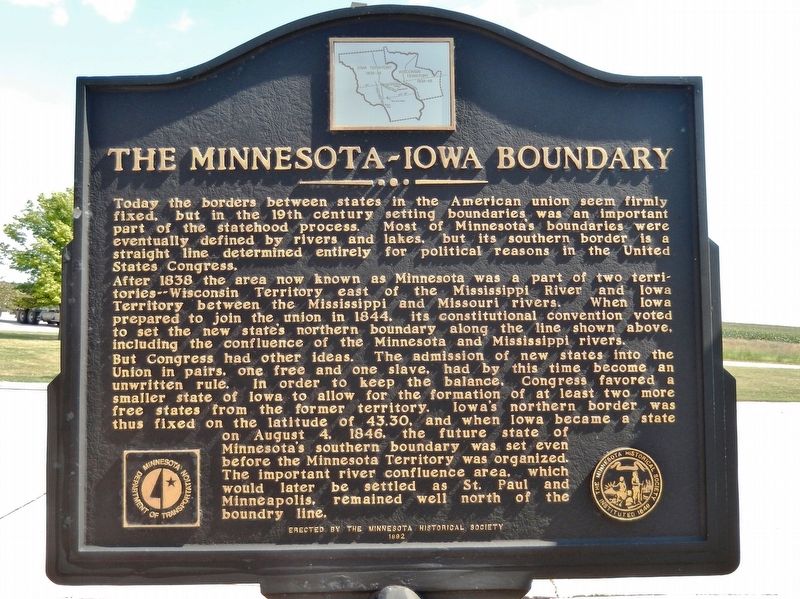
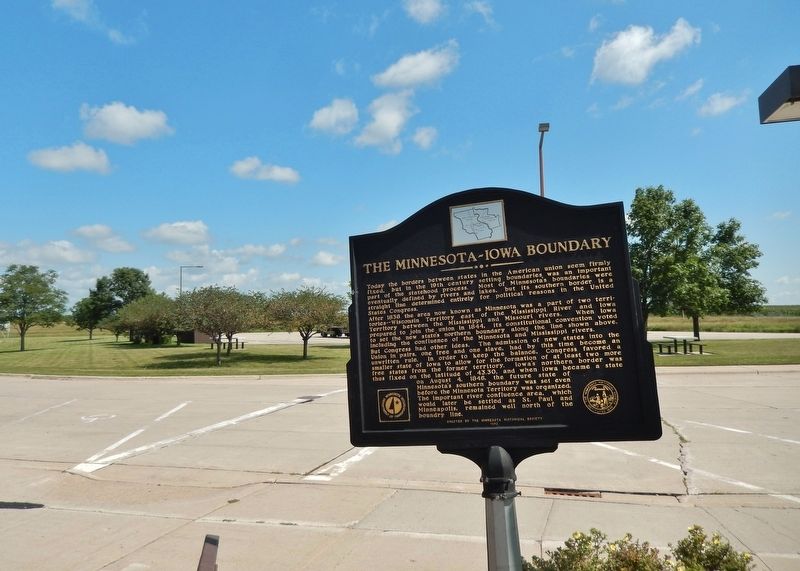
After 1838 the area now known as Minnesota was a part of two territories — Wisconsin Territory east of the Mississippi River and Iowa Territory between
Photographed by Cosmos Mariner, August 19, 2014
2. The Minnesota-Iowa Boundary (marker west side)
But Congress had other ideas. The admission of new states into the Union in pairs, one free and one slave, had by this time become an unwritten rule. In order to keep the balance, Congress favored a smaller state of Iowa to allow for the formation of at least two more free states from the former territory. Iowa's northern border was thus fixed on the latitude of 43.30, and when Iowa became a state on August 4, 1846, the future state of Minnesota's southern boundary was set even before the Minnesota Territory was organized. The important river confluence area, which would later be settled as St. Paul and Minneapolis, remained well north of the boundary line.
Erected 1992 by Minnesota Historical Society.
Topics and series. This historical marker is listed in these topic lists: Agriculture • Horticulture & Forestry • Settlements & Settlers • Waterways & Vessels.
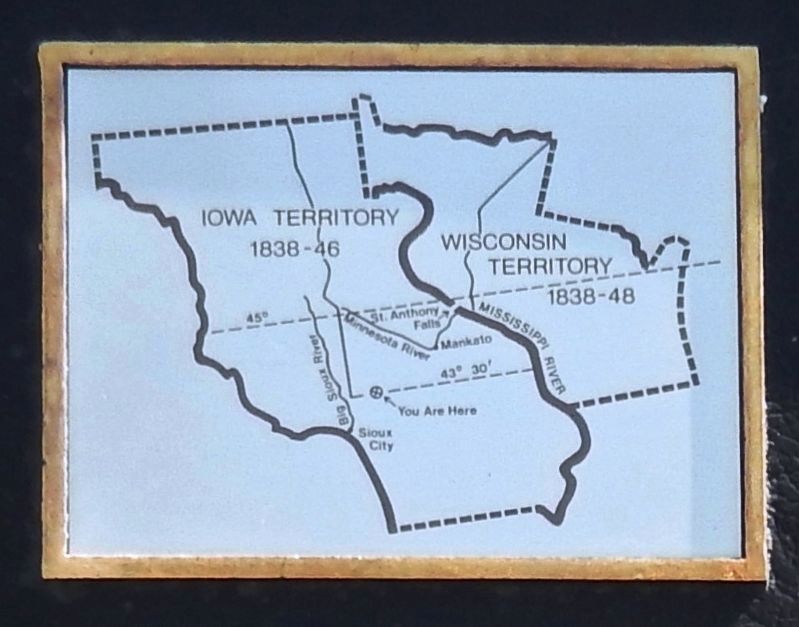
3. Marker detail: Territory & Boundary Diagram
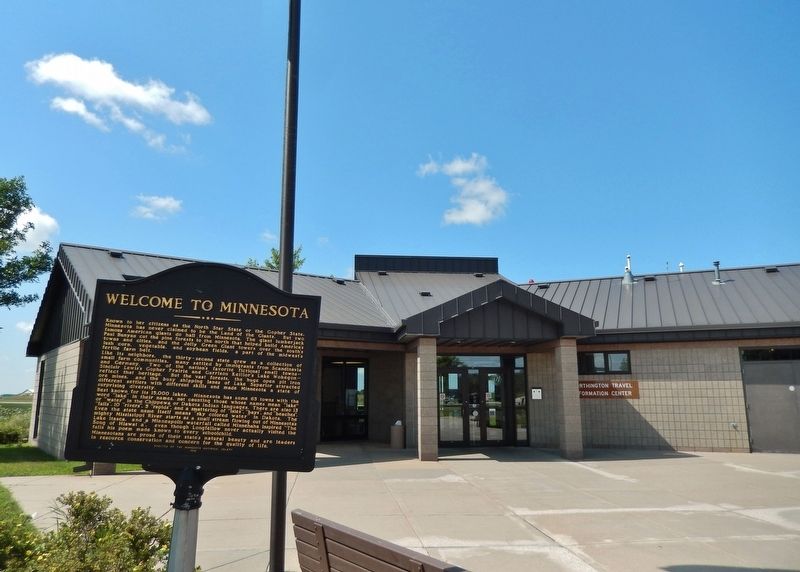
Location. 43° 34.012′ N, 95° 39.113′ W. Marker is near Bigelow, Minnesota, in Nobles County. It can be reached from U.S. 59 (State Highway 60) ¾ mile north of 300th Street (County Highway 6), on the right when traveling north. Marker is located in front of the Travel Information Center at the Minnesota Rest Area. Touch for map. Marker is in this post office area: Worthington MN 56187, United States of America. Touch for directions.

Regionally, this marker is in Southwest Minnesota. It is also in the American Midwest and in the Corn Belt. Globally, it is in North America, the Western Hemisphere, the Western World, and the Anglosphere. Historically, it finds itself in what was once Rupert’s Land, the territory of the Mississippian Culture, and the Louisiana Purchase.
Other nearby markers. At least 8 other markers are within 8 miles of this marker, measured as the crow flies: "Habitat" (about 300 feet away, measured in a direct line); Nobles County WWII Veterans Memorial (approx. 4.3 miles away); Worthington Bandshell
Photographed by Cosmos Mariner, August 19, 2014
4. Welcome to Minnesota (marker east side)
Photographed by Cosmos Mariner, August 19, 2014
5. The Minnesota-Iowa Boundary (marker west side)
Credits. This page was last revised on December 12, 2024. It was originally submitted on October 12, 2020, by Cosmos Mariner of Cape Canaveral, Florida. This page has been viewed 4,708 times since then and 474 times this year. Photos: 1, 2, 3, 4, 5. submitted on October 12, 2020, by Cosmos Mariner of Cape Canaveral, Florida.
