
Near Winchester in Frederick County, Virginia — The American South (Mid-Atlantic)
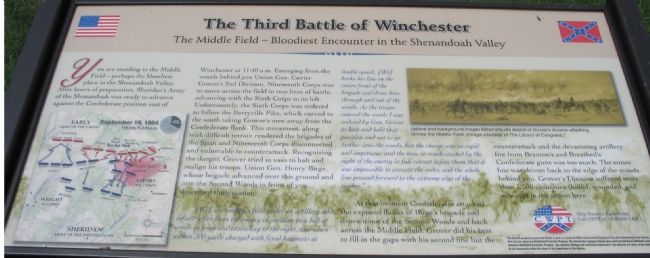
The Third Battle of Winchester
The Middle Field - Bloodiest Encounter in the Shenandoah Valley
Photographed by Craig Swain, August 26, 2007
1. The Third Battle of Winchester Marker
"[We]...crossed this field under an artillery and infantry fire from the enemy in position in a belt of woods in front and extending to the right, and when within 200 yards charged with fixed bayonets at double-quick. [We] broke his line on the entire front of the brigade and drove him through and out of the woods. As the troops entered the woods I was ordered by Gen. Grover to halt and hold that position and not to go farther into the woods, but the charge was so rapid and impetuous and the men so much excited by the sight of the enemy in full retreat before them that it was impossible to execute the order, and the whole line pressed forward to the extreme edge of the timber."
At
this page online
Erected by Civil War Preservation Trust.
Topics. This historical marker is listed in this topic list: War, US Civil.
Location. Marker has been reported permanently removed. It was located near 39° 11.896′ N, 78° 7.638′ W. Marker was near Winchester, Virginia, in Frederick County. It could be reached from Redbud Road (County Route 661), on the right when traveling east. Located at the Middle Field Wayside, along the Battle Trail, inside the CWPT Third Winchester Battlefield site. The closest access site is a trail head on the west side of the Frederick County School complex parking lot. Touch for map.

2. Help Preserve 3rd Winchester
Details of CWPT efforts to save this battlefield.
Click for more information.
Click for more information.
We have been informed that this marker is no longer there and will not be replaced. This page is an archival view of what was.
Regionally, this marker was in Virginia’s Shenandoah Valley. It was also in the American South, specifically in the Upper South, and in the Mid-Atlantic. Globally, it was in North America, the Western Hemisphere, the Western World, and the Anglosphere. Historically, it found itself in what was once the territory of the Mississippian Culture, one of the original Thirteen Colonies, one of the Confederate States of America, and the Antebellum South.

Other nearby markers. At least 8 other markers are within walking distance of this location: Union Breakthrough (about 300 feet away, measured in a direct line); Alabama (about 300 feet away); The Cost of Battle (about 400 feet away); Molineux's Stand (about 400 feet away); Maine (about 500 feet away); The Middle Field (about 500 feet away); A Perfect Sheet Of Lead (about 500 feet away); Ten Thousand Devils (about 800 feet away). Touch for a list and map of all
Photographed by Craig Swain, August 26, 2007
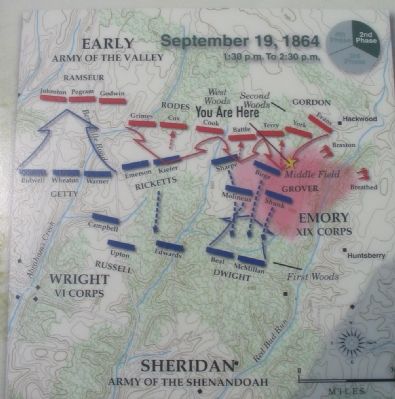
3. The Battle Map
Other markers no longer nearby. The Third Battle of Winchester (was about 300 feet away but has been permanently removed); a different marker also named The Third Battle of Winchester (was about 400 feet away but has been permanently removed); a different marker also named The Third Battle of Winchester (was about 500 feet away but has been permanently removed).
More about this marker. On the left of the marker is a battle map showing the tactical situation between 1:30 and 2:30 p.m. on September 19, 1864. On the right is an "Alfred Waud's sketch of Grover's division attacking across the Middle Field." The sketch is also used as the background image for the marker.
Also see . . .
1. Third Winchester - Opequon. American Battlefield Trust website entry (Submitted on October 27, 2007, by Craig Swain of Leesburg, Virginia.)
2. Summary of the Battle of Third Winchester. The action described on the marker is covered under phase 4 of this National Parks Service summary (Submitted on October 27, 2007, by Craig Swain of Leesburg, Virginia.)
3. CWPT Walking Tour of The Third Battle of Winchester.
Photographed by Craig Swain, August 26, 2007
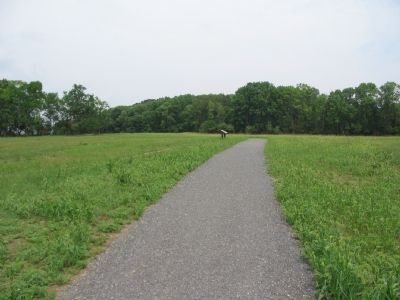
4. Middle Field Wayside
The Federal advance crossed this spot moving from the right to the left (northeast) toward the Second Woods.
Additional commentary.
1. A passage from my ancestor's diary
September the 19, 1864: Wee took up line of march, marching som distance. The cannons begun to rore (roar), the musketry the same. Wee marching don (down) in the direction of Winchester, stopping a while, then wee was ordered on crossing Opequan Creek near Winchester. Then wee was ordered on double quick for some distance, then ordered into line of battle, and fixed baynetts (bayonets) then ordered on a charge through a piece of thick pine brush, getting through the thicket was ordered to stop and lay down. Laying thare a few minuets (minutes) then was ordered on double quick to charge the enamy out of thare works. The Sixth and nineteenth Corps on our left and Averal’s Cavalry on our right. The whole thing on a charge, chragin gthe enamy out of thare works captuern (capturing) a great many prisssners and som(e) few pieces of canon and a great many
Photographed by Craig Swain, August 26, 2007
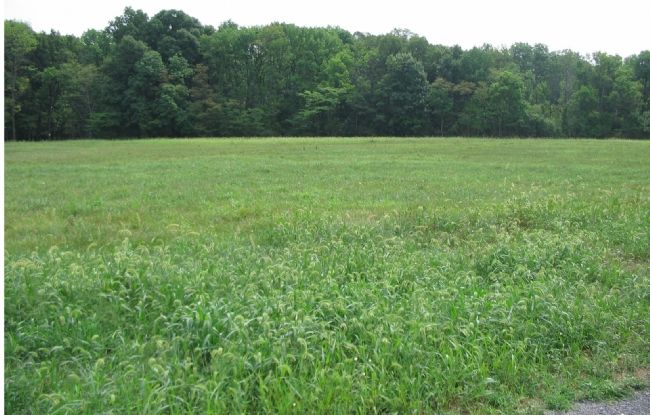
5. The First Woods
Grover's Division emerged from these woods and pressed forward against the Confederate positions on the other side of Middle Field.
— Submitted September 25, 2010, by Rodger Lemley of Mt.morris, Pennsylvania.
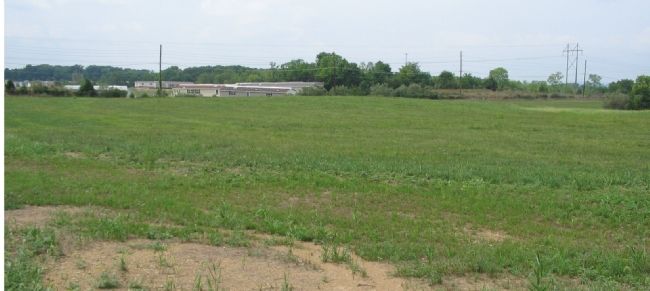
Photographed by Craig Swain, August 26, 2007
6. Looking from Middle Field Towards the Second Woods
Visible in the distance are the power lines and the trees screening the I-81 bypass. The forward elements of Grover's Division reached positions there before being driven back by the Confederate counterattack.
Credits. This page was last revised on June 7, 2024. It was originally submitted on October 27, 2007. This page has been viewed 2,253 times since then and 18 times this year. Last updated on November 9, 2020. Photos: 1. submitted on October 27, 2007, by Craig Swain of Leesburg, Virginia. 2. submitted on March 13, 2009, by Craig Swain of Leesburg, Virginia. 3, 4, 5, 6. submitted on October 27, 2007, by Craig Swain of Leesburg, Virginia. • J. Makali Bruton was the editor who published this page.
