Zittlestown in Frederick County, Maryland — The American Northeast (Mid-Atlantic)
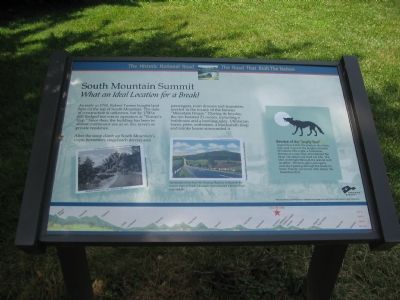
South Mountain Summit
What an Ideal Location for a Break!
| — | The Historic National Road - The Road That Built The Nation | — |
Photographed by Craig Swain, June 9, 2007
1. South Mountain Summit Marker
As early as 1750, Robert Turner bought land here on the top of South Mountain. The date of construction is unknown, but by 1790 a full-fledged inn was in operation at “Turner’s Gap.” Since then, the building has been in almost continuous use as an inn, tavern or private residence.
After the steep climb up South Mountain’s slope, horsemen, stagecoach drivers and passengers, even drover and teamsters, reveled in the luxury of the famous “Mountain House.” During its heyday, the inn boasted 21 rooms, including a bathhouse and a bowling alley. Utilitarian barns, pens, outhouses, a blacksmith shop, and smoke house surrounded it.
[Sidebar:]
Beware of the “Snarly Yow.” Legend has it that the shadow of a black dog used to prowl the heights of South Mountain. One night, a huntsman, famous as a sure shot, encountered the beast. He aimed and fired his rifle. The shot went right through the animal with no effect. He fired again and again, each shot passing through the shadowy beast. Finally overcome with dread, the huntsman fled.
Erected by America's Byways.
Topics and series. This historical marker is listed in
this page online
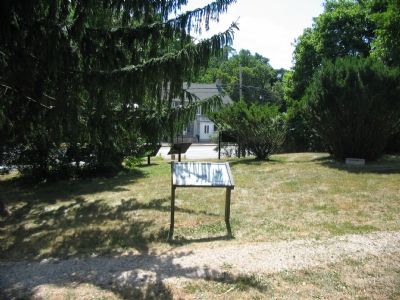
Location. This marker has been replaced by another marker nearby. It was located near 39° 29.067′ N, 77° 37.161′ W. Marker was in Zittlestown, Maryland, in Frederick County. It was at the intersection of Old National Road (Alternate U.S. 40) and Washington Monument Road, on the right when traveling west on Old National Road. Located at a pull off from the Washington Monument Road, along side the Old National Road. Across the highway from the Old South Mountain Inn. Very close to the Frederick and Washington County line. The Appalachian Trail passes a few feet from the marker. Touch for map. Marker was in this post office area: Myersville MD 21773, United States of America. Touch for directions.

Regionally, this marker was in the Washington Metropolitan Area and in Central Maryland. It was also in the American Mid-Atlantic. Globally, it was in North America, the Western Hemisphere, the Western World,
Photographed by Craig Swain, July 21, 2007
2. The Marker with the Inn as a Backdrop
Other nearby markers. At least 10 other markers are within walking distance of this location: A different marker also named South Mountain Summit (here, next to this marker); Turner's Pass Tablet T. P. 1 (within shouting distance of this marker); Turner's Pass Tablet T. P. 2 (within shouting distance of this marker); Turner's Pass Tablet T. P. 3 (within shouting distance of this marker); Turner's Pass Tablet T. P. 4 (within shouting distance of this marker); Turner's Pass Tablet T. P. 5 (within shouting distance of this marker); Turner's Pass Tablet T. P. 6 (within shouting distance of this marker); a different marker also named 19th Century Backpacker (within shouting distance of this marker); Battle at South Mountain (within shouting distance of this marker); 1862 Antietam Campaign (within shouting distance of this marker). Touch for a list and map of all markers in Zittlestown.
Other markers no longer nearby. Dalgren Chapel (was within shouting distance of this marker but has been replaced
Photographed by Craig Swain, July 21, 2007
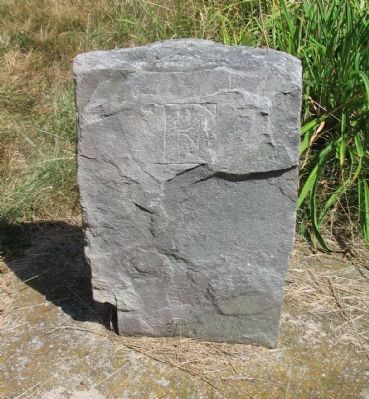
3. Boundry Stone near the Marker?
19th century marker, probably slate, of unknown origin. It may have been used to indicate the boundary between Frederick and Washington Counties, as it is placed such that travelers heading east would see the "F", indicating that they were entering Frederick County.
Thanks to Christopher Busta-Peck for the investigative work.
Thanks to Christopher Busta-Peck for the investigative work.
More about this marker. The marker features two pictures of the roadway along the gap, with the caption, “Spectacular views from the National Road as it descends the eastern slope of South Mountain have attracted travelers from near and far.”
Related marker. Click here for another marker that is related to this marker. This marker has been replaced with the linked marker.
Also see . . . History of the Old South Mountain Inn. (Submitted on July 9, 2007, by Craig Swain of Leesburg, Virginia.)
Photographed by Craig Swain, February 9, 2008
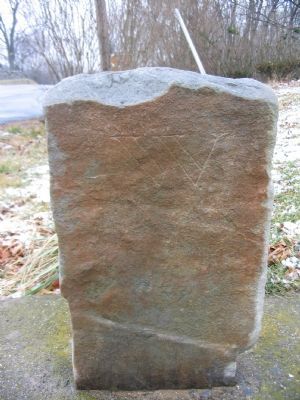
4. Reverse of the Stone
The "W" seen on the reverse should seal the case. This is a county boundary stone.
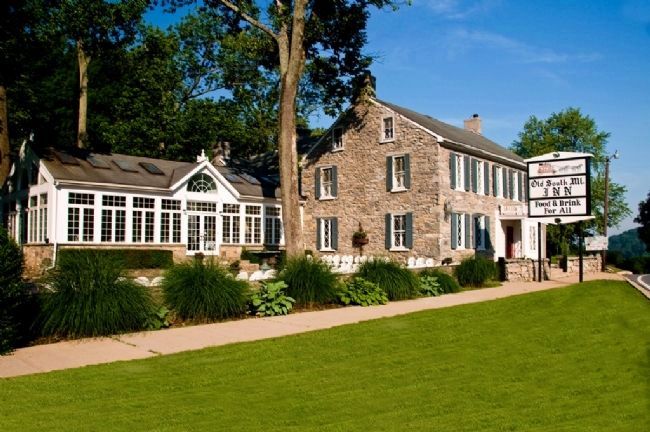
Photographed by George Constable, June 7, 2008
5. South Mountain Inn
Credits. This page was last revised on May 29, 2024. It was originally submitted on July 9, 2007, by Craig Swain of Leesburg, Virginia. This page has been viewed 3,299 times since then and 33 times this year. Photos: 1. submitted on July 9, 2007, by Craig Swain of Leesburg, Virginia. 2, 3. submitted on July 29, 2007, by Craig Swain of Leesburg, Virginia. 4. submitted on February 10, 2008, by Craig Swain of Leesburg, Virginia. 5. submitted on June 12, 2008, by George . Constable of Hagerstown, Maryland. • J. J. Prats was the editor who published this page.
