Dove Creek in Dolores County, Colorado — The American Mountains (Southwest)
Community and Conflict
Photographed by William Fischer, Jr., October 14, 2020
1. Community and Conflict Marker
Ancestral Puebloans
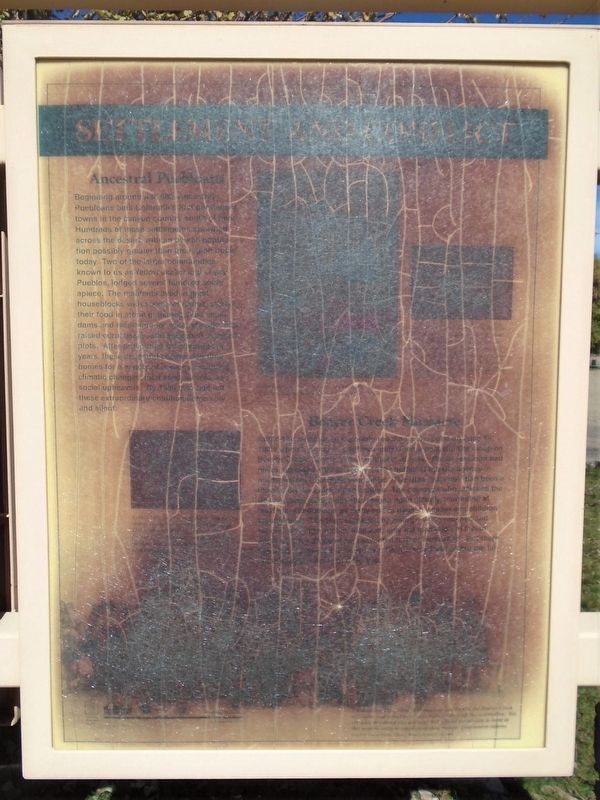
Beginning around A.D. 600, Ancestral Puebloans built Colorado's first permanent towns in the canyon country south of here. Hundreds of these settlements sprawled across the desert, with an overall population possibly greater than the region holds today. Two of the larger communities, known to us as Yellow Jacket and Lowry Pueblos, lodged several hundred souls apiece. The residents lived in great houseblocks with scores of rooms, stored their food in stone granaries, built small dams and reservoirs for water storage, and raised corn, beans, and squash in terraced plots. After prospering for hundreds of years, these ancestral peoples left their homes for a variety of reasons, including climatic changes, increased warfare, and social upheavals. By 1300 they had left these extraordinary communities empty and silent.
Beaver Creek Massacre
Anglo-Ute [relations?] in Colorado reached a low point on June 19, 1885, when a group of cowboys ambushed a peaceful Ute camp on Beaver Creek [illegible] miles southeast of here. Racial tensions had never [illegible] after a bloody 1879 conflict at the Ute agency in
this page online
[Photos and their captions are illegible, except for bottom right caption, which reads]
Unidentified Utes, 1880. The cowboys involved in the Beaver Creek Massacre had vowed to kill any Indian found off the reservation. Yet, the Utes murdered that morning had official permission to hunt in this area in order to supplement their meager government rations.
Erected by Colorado Historical Society, CO DOT, Federal Highway Administration, and CO Division of Wildlife.
Topics. This historical marker is listed in these topic lists: Anthropology & Archaeology • Disasters • Indigenous Peoples and Communities • Settlements & Settlers. A significant historical year for this entry is 1300.
Location. 37° 45.896′ N,

Photographed by William Fischer, Jr., October 14, 2020
2. Community and Conflict wayside (right)
Waysides in pristine condition:
Untraveled Road website entry
Click for more information.
Click for more information.

Regionally, this marker is in the Western Slope. It is also in the American Mountain West, on the Colorado Plateau, and at the Four Corners. Globally, it is in North America, the Rocky Mountains, the Western Hemisphere, the Western World, and the Anglosphere. Historically, it finds itself in what was once the territory of the Ancestral Puebloans and also Mexico’s Alta California.
Other nearby markers. At least 8 other markers are within 13 miles of this marker, measured as the crow flies: Dove Creek Country (here, next to this marker); Dove Creek (here, next to this marker); Gunnison Sage Grouse (here, next to this marker); War Memorial (here, next to this marker); Why East? / Who Were The Franciscans? (a few steps from this marker); Dove Creek Memorial Hall (approx.
Photographed by William Fischer, Jr., October 14, 2020
3. Community and Conflict Marker
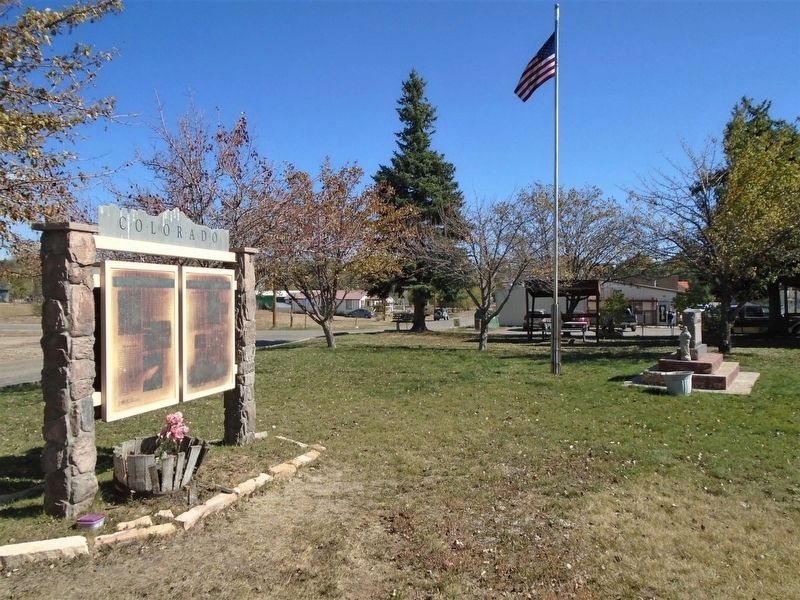
More about this marker. The marker is heavily deteriorated and needs replaced.
Also see . . .
1. Beaver Creek Massacre. Colorado Encyclopedia website entry (Submitted on November 15, 2020, by William Fischer, Jr. of Reynoldsburg, Ohio.)
2. Beaver Creek Massacre Site. History Colorado website entry (Submitted on November 15, 2020, by William Fischer, Jr. of Reynoldsburg, Ohio.)
Credits. This page was last revised on December 23, 2024. It was originally submitted on November 15, 2020, by William Fischer, Jr. of Reynoldsburg, Ohio. This page has been viewed 519 times since then and 36 times this year. Photos: 1, 2, 3. submitted on November 15, 2020, by William Fischer, Jr. of Reynoldsburg, Ohio.
