
Near Chester in Chesterfield County, Virginia — The American South (Mid-Atlantic)
Dutch Gap Canal
Butler's Bypass
| — | Bermuda Hundred Campaign | — |
Photographed by Bernard Fisher, February 9, 2009
1. Dutch Gap Canal Civil War Trails Marker
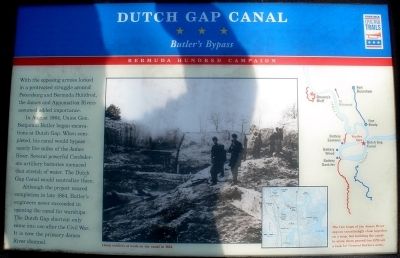
In August 1864, Union Gen. Benjamin Butler began excavations at Dutch Gap. When completed, his canal would bypass nearly five miles of the James River. Several powerful Confederate artillery batteries menaced that stretch of water. The Dutch Gap Canal would neutralize them.
Although the project neared completion in late 1864, Butler’s engineers never succeeded in opening the canal for warships. The Dutch Gap shortcut only came into use after the Civil War. It is now the primary James River channel.
Erected by Virginia Civil War Trails.
Topics and series. This historical marker is listed in these topic lists: War, US Civil • Waterways & Vessels. In addition, it is included in the Virginia Civil War Trails series list. A significant historical month for this entry is August 1864.
Location. 37° 22.592′ N, 77° 21.617′ W. Marker is near Chester, Virginia, in Chesterfield County. It can be reached from Henricus Park Road 1.3 miles east of Coxendale Road (County Route 615). The
this page online

Regionally, this marker is in Virginia’s Piedmont, in Central Virginia, and in the Richmond Metropolitan Area. It is also in the American South, specifically in the Upper South, and on the Eastern Seaboard. Globally, it is in the North Atlantic Region, North America, the Western Hemisphere, the Western World, and the Anglosphere. Historically, it finds itself in what was once the territory of the Mississippian Culture, one of the original Thirteen Colonies, one of the Confederate States of America, and the Antebellum South.
Other nearby markers. At least 8 other markers are within walking distance of this marker: USCTs At Dutch Gap (here, next to this marker); The Bermuda Hundred Campaign (here, next to this marker); Mortar Pit (a few steps from this marker); The Lightkeeper’s House (within shouting
Photographed by Bernard Fisher, February 9, 2009
2. James River Defenses near Dutch Gap
Other markers no longer nearby. The James River...Floating Through The Centuries (was a few steps from this marker but has been permanently removed); Dutch Gap (was a few steps from this marker but has been permanently removed); The Tides (was within shouting distance of this marker but has been permanently removed); Mount Malady (was within shouting distance of this marker but has been permanently removed).
More about this marker. In the center is a photo of “Union soldiers at work on the canal in 1864.”
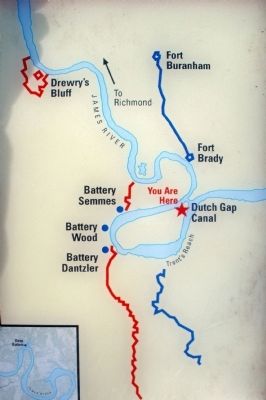
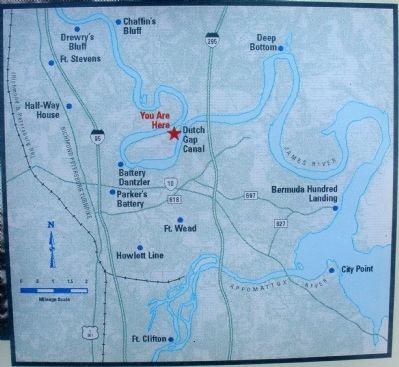
On the right is a map detailing the river defenses at Dutch Gap. The smaller inset map shows the position of Dutch Gap relative to the modern interstate highways, I-95 and I-295. The map carries the caption, “The two loops of the James River appear tantalizingly close together on a map, but building the canal to unite them proved too difficult a task for General Butler’s army.”
Also see . . . Henricus Historical Park.
Photographed by Bernard Fisher, February 9, 2009
3. Location of Dutch Gap Canal
Photographed by Bernard Fisher, February 9, 2009
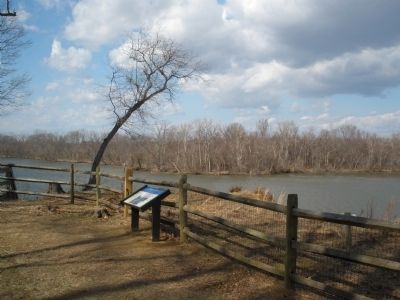
4. Dutch Gap Canal CWT Marker looking upriver
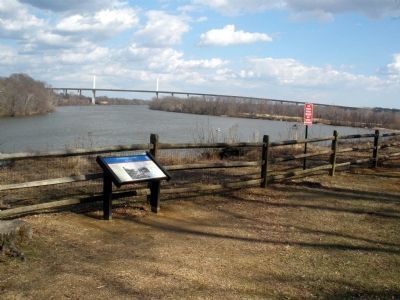
Photographed by Bernard Fisher, February 9, 2009
5. Dutch Gap Canal CWT Marker looking downriver towards the Varina-Enon bridge.
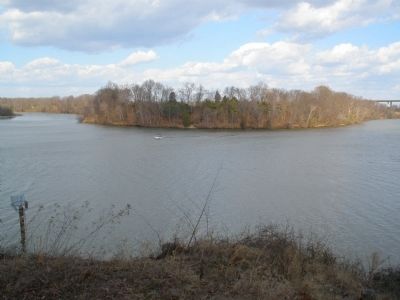
Photographed by Bernard Fisher, February 9, 2009
6. Butler's Dutch Gap Canal

Photographed by Bernard Fisher, February 9, 2009
7. Dutch Gap Canal Panorama
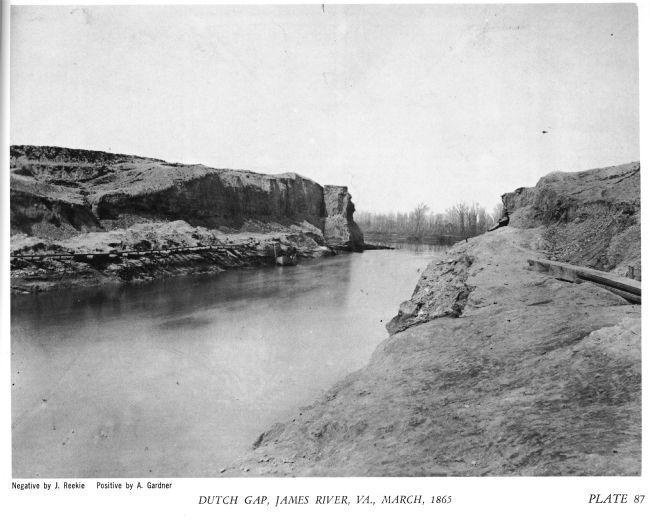
Photographed by Alexander Gardner, March 1865
8. Dutch Gap, James River, Virginia, March 1865 (Plate 87)
In 1866,Alexander Gardner, a photographer who had been in Matthew Brady's employ, published his Photographic Sketchbook of the War, the first published collection of Civil War photographs, of which this plate was one.
Gardner's accompanying text makes clear the achievement that the canal represented and the difficult conditions under which it was built:
"...The work of excavation commenced on the 9th of August, 1864. The rebels opened their formidable batteries on the laborers, on the 13th, and with few intervals maintained a fire from mortars and rifled guns until the conclusion of the enterprise. The regiments employed on the work were the 116th and 169th New York volunteers, and the 4th, 6th, 10th, 36th, 38th, and 100th United States colored regiments....The labors of these troops averaged one hundred and twenty men for a period of ten hours each day, working eighteen days in August, twenty-five days in September, and twenty-six in October. From the first of November until the time of completion, the average consisted of one hundred and thirty men, working eleven and a half hours each day...."
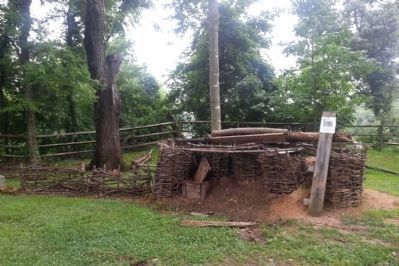
Photographed by Bernard Fisher, June 27, 2013
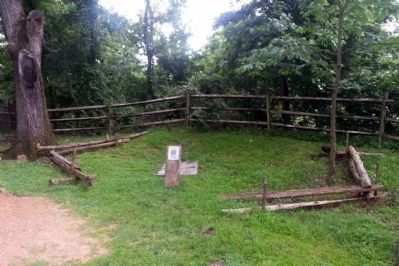
9. Dutch Gap Picket Post Exhibit
Photographed by Bernard Fisher, June 27, 2013
10. Dutch Gap 1864 Mortar Position
Credits. This page was last revised on September 2, 2021. It was originally submitted on February 11, 2009, by Bernard Fisher of Richmond, Virginia. This page has been viewed 4,750 times since then and 74 times this year. Last updated on February 15, 2009, by Bernard Fisher of Richmond, Virginia. Photos: 1, 2, 3, 4, 5, 6, 7. submitted on February 11, 2009, by Bernard Fisher of Richmond, Virginia. 8. submitted on February 13, 2009. 9, 10. submitted on June 27, 2013, by Bernard Fisher of Richmond, Virginia. • Craig Swain was the editor who published this page.
