The National Mall in Southwest Washington in Washington, District of Columbia — The American Northeast (Mid-Atlantic)
Rick Bartow
Wiyot, 1946-2016
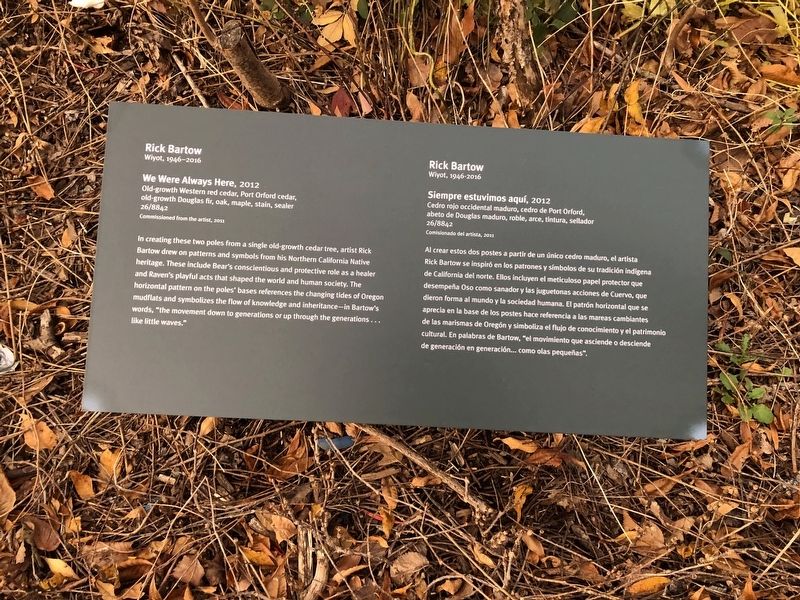

We Were Always Here, 2012
Old-growth Western red cedar, Port Orford cedar, old-growth Douglas fir, oak, maple, stain, sealer
26/8842
Commissioned from the artist, 2011
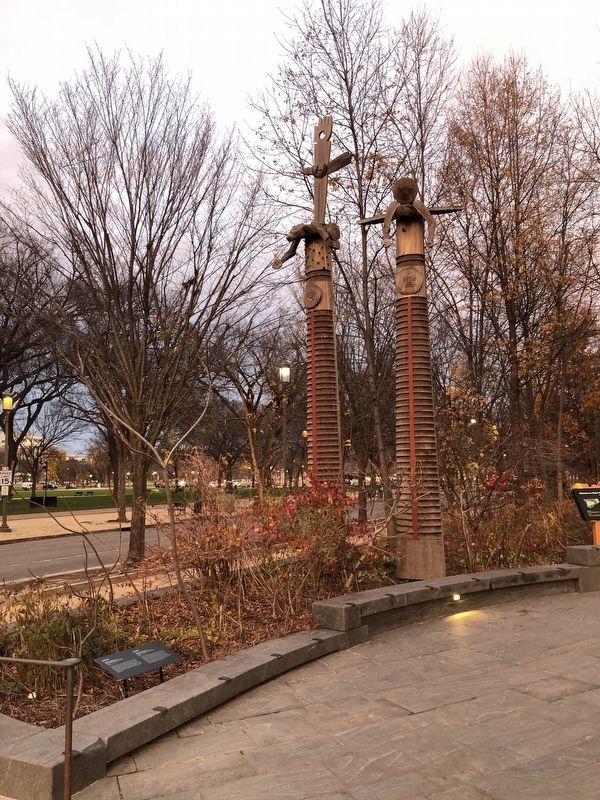
In creating these two poles from a single old-growth cedar tree, artist Rick Bartow drew on patterns and symbols from his Northern California Native heritage. These include Bear's conscientious and protective role as a healer and Raven's playful acts that shaped the world and human society. The horizontal pattern on the poles' bases references the changing tides of Oregon mudflats and symbolizes the flow of knowledge and inheritance—in Bartow's words, "the movement down to generations or up through generations… little waves."
[Spanish translation:]
Wiyot, 1946-2016
Siempre estuvimos aquí, 2012
Cedro rojo occidental maduro, cedro de Port Orford, abeto de Douglas maduro, roble, arce, tintura, sellador
26/8842
Comisionado del artista, 2011
Al crear estos dos postes a partir de un único cedro maduro, el artista Rick Bartow se inspiró en los patrones y símbolos de su tradición indígena de California del norte.
this page online
Erected 2020 by Smithsonian Institution. (Marker Number 26/8842.)
Topics. This historical marker is listed in these topic lists: Anthropology & Archaeology • Arts, Letters, Music • Horticulture & Forestry • Indigenous Peoples and Communities. A significant historical year for this entry is 2012.
Location. 38° 53.323′ N, 77° 1.027′ W. Marker is in Southwest Washington in Washington, District of Columbia. It is in The National Mall. It is on Jefferson Drive Southwest just west of 4th Street Southwest, on the right when traveling east. Touch for map. Marker is at or near this postal address: 482 Independence Ave SW, Washington DC 20024, United States of America.

Regionally, this marker is in the Washington Metropolitan Area. It is also in the American Northeast, in the Upper South, in the Mid-Atlantic, in the Tidewater, and in the Chesapeake Bay Region. Globally, it is in North America, the Western Hemisphere, the Western World, and the Anglosphere.
Other nearby markers. At least 4 other markers are within walking distance of this marker: A different marker also named Cardinal Direction Marker: West (within shouting distance of this marker); Cardinal Direction Marker: North (within shouting distance of this marker); George Rivera (about 300 feet away); a different marker also named Traditional Croplands (about 300 feet away). Touch for a list and map of all markers in Southwest Washington.
Other markers no longer nearby. Wingapo (was here, next to this marker but has been permanently removed); Rick Bartow (1946-2016) (was a few steps from this marker but has been replaced with another marker now near it); Can you hear the echo of the water bouncing off the rock? (was a few steps from this marker but has been permanently removed); Upland Hardwood Forest (was within shouting distance of this marker but has been replaced with another marker now near it); Sassafras • Wináhk (Wee-nock) (was within shouting distance of this marker but has been permanently removed); Cardinal Direction Marker: West (was within shouting distance of this marker but has been replaced with another marker now near it); Eastern Redcedar • Muráhk (mah-dok) (was within shouting distance of this marker but has been permanently removed); Cardinal Direction Markers (was within shouting distance of this marker but has been permanently removed); Meadow (was about 300 feet away, measured in a direct line but has been replaced with another marker now near it); Traditional Croplands (was about 300 feet away but has been replaced with another marker now near it); What is a Grandfather Rock? (was about 300 feet away but has been permanently removed); a different marker also named George Rivera (was about 300 feet away but has been replaced with another marker now near it).
Related marker. Click here for another marker that is related to this marker. This marker has replaced the linked marker.
Credits. This page was last revised on January 30, 2023. It was originally submitted on December 3, 2020, by Devry Becker Jones of Washington, District of Columbia. This page has been viewed 280 times since then and 17 times this year. Photos: 1, 2. submitted on December 3, 2020, by Devry Becker Jones of Washington, District of Columbia.
