Hilton Head Island in Beaufort County, South Carolina — The American South (South Atlantic)
Battle of Port Royal
Photographed by Mike Stroud, February 6, 2009
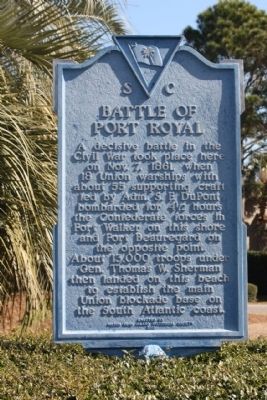
1. Battle of Port Royal Marker
A decisive battle in the Civil War took place here on Nov. 7, 1861, when 18 Union warships with about 55 supporting craft led by Adm. S.E. DuPont bombarded for 4½ hours the Confederate forces in Fort Walker on this shore and Fort Beauregard on the opposite point. About 13,000 troops under Gen. Thomas W. Sherman then landed on this beach to establish the main Union blockade base on the South Atlantic coast.
Erected 1961 by South Carolina Department of Archives and History; sponsored by Hilton Head Island Historical Society. (Marker Number 7-7.)
Topics. This historical marker is listed in this topic list: War, US Civil. A significant historical date for this entry is October 7, 1861.
Location. 32° 14.103′ N, 80° 40.696′ W. Marker is on Hilton Head Island, South Carolina, in Beaufort County. It is at the intersection of Fort Walker Drive and Circle at Catesby Lane, in the median on Fort Walker Drive. Located in Port Royal Plantation - a Secure Gated Community,Restricted Access. Touch for map. Marker is in this post office area: Hilton Head Island SC 29928, United States of America. Touch for directions.

Regionally, this marker is in the Lowcountry and on the Sea Islands. It is also in the American South, specifically in the Deep South, and on the Eastern Seaboard. Globally, it is in the North Atlantic Region, North America, the Western Hemisphere, the Western World, and the Anglosphere. Historically, it finds itself in what was once New Spain, the territory of the Mississippian Culture, one of the original Thirteen Colonies, one of the Confederate States of America, and the Antebellum South.
Other nearby markers. At least 8 other markers are within walking distance of this marker: Hilton Head (a few steps from this marker); Two Gallant Gentlemen from South Carolina (within shouting distance of this
this page online
Also see . . .
1. Samuel Francis Du Pont. made significant contributions to the modernization of the U.S. Navy. (Submitted on February 27, 2009, by Mike Stroud of Bluffton, South Carolina.)
2. The Battle of Port Royal. was one of the earliest amphibious operations of the American Civil War (Submitted on February 27, 2009, by Mike Stroud of Bluffton, South Carolina.)
Photographed by Mike Stroud, February 2009
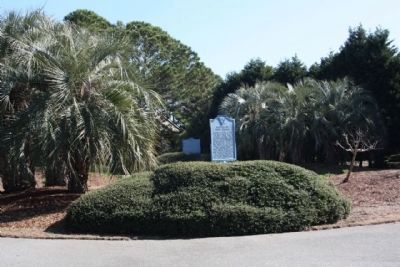
2. Battle of Port Royal Marker, shares location with Hilton Head Marker
Photographed by Mike Stroud, February 6, 2009
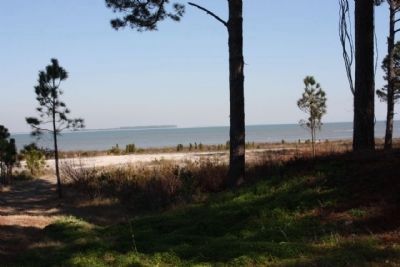
3. Battle of Port Royal Marker
About 13,000 troops under Gen. Thomas W. Sherman landed on this beach- Fort Beauregard on the opposite point, in background
Photographed by National Portrait Gallery, Washington, DC (Wikipedia)
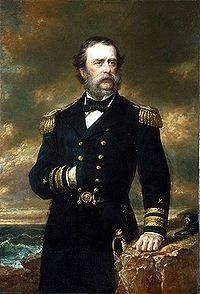
4. Adm. S.E. DuPont
Photographed by Mike Stroud, 2009
5. Interpretive marker at Ft.Walker Dr.
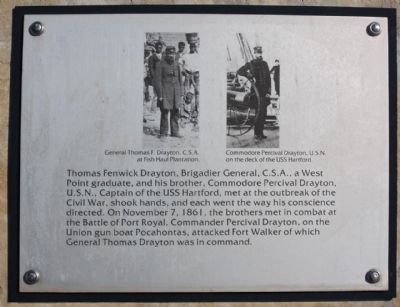
Left- General Thomas F. Drayton,C.S.A .
at Fish Hall Plantation
Right- Commodore Percival Drayton, U.S.N. on the deck of the USS Hartford.
Thomas Fenwick Drayton, Brigadier General, C.S.A., a West Point graduate, and his brother, Commodore Percival Drayton, U.S.N., Captain of the USS Hartford, met at the outbreak of the Cival War, shook hands, and each went the way his conscience directed. On November 7, 1861, the brothers met in combat at the Battle of Port Royal. Commander Percival Drayton, on the Union gun boat Pocahontas, attacked Fort Walker of which General Thomas Drayton was in command.
Right- Commodore Percival Drayton, U.S.N. on the deck of the USS Hartford.
Thomas Fenwick Drayton, Brigadier General, C.S.A., a West Point graduate, and his brother, Commodore Percival Drayton, U.S.N., Captain of the USS Hartford, met at the outbreak of the Cival War, shook hands, and each went the way his conscience directed. On November 7, 1861, the brothers met in combat at the Battle of Port Royal. Commander Percival Drayton, on the Union gun boat Pocahontas, attacked Fort Walker of which General Thomas Drayton was in command.
Photographed by Mike Stroud
6. "The Hilton Head Island Historical Society , Port Royal Interpretive Markers"
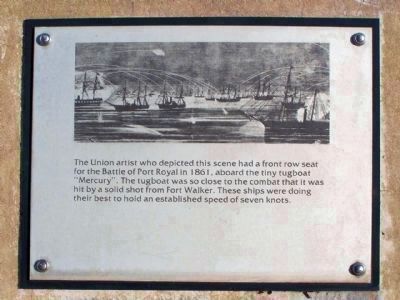
The Union artist who depicted this scene had a front row seat for the Battle of Port Royal in 1861, abourd the tiny tugboat "Mercury". The tugboat was so close to the combat that it was hit by solid shot from Fort Walker. These ships were doing their best to hold an established speed of seven knots.
The Hilton Head Island Historical Society , Port Royal Interpretive Markers
7. Battle of Port Royal Marker
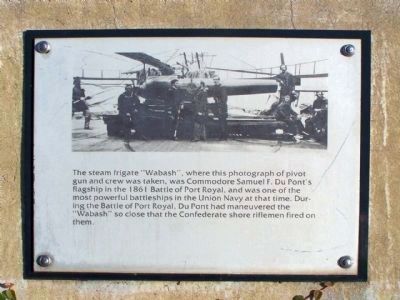
The steam frigate "Wabash", where this photograph of pivot gun and crew was taken, was Commodore Samuel F. Du Pont's flagship in the 1861 Battle of Port Royal, and was one of the most powerful battleships in the Union Navy at the time. During the battle of Port Royal, Du Pont had maneuvered the "Wabash" so close that the Confederate shore riflemen fired on them.
The Hilton Head Island Historical Society , Port Royal Interpretive Markers
8. Battle of Port Royal Marker
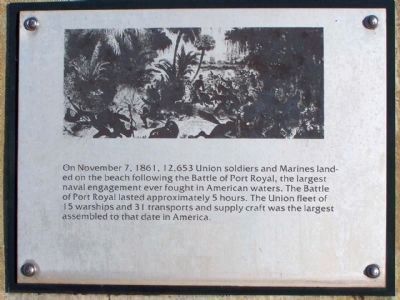
On November 7, 1861, 12,653 Union soldiers and Marines landed on the beach following the battle of Port Royal, the
largest naval engagement ever fought in American waters. The battle of Port Royal lasted approximately 5 hours. The
Union fleet of 15 war ships and 31 transports and supply craft was the largest assembled to that date in America.
Photographed by Mike Stroud, August 29, 2009
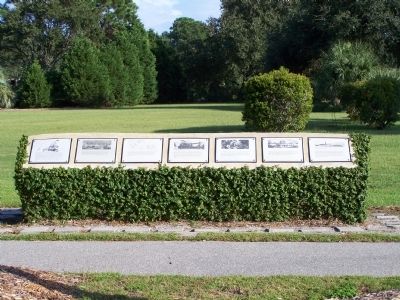
9. The Hilton Head Island Historical Society , Port Royal Interpretive Markers
Along S.Port Royal Drive and Beach House Drive in Port Royal Plantation, Hilton Head Island
Coordinates: 32.219908,-80.67118
Coordinates: 32.219908,-80.67118
Credits. This page was last revised on May 30, 2026. It was originally submitted on February 27, 2009, by Mike Stroud of Bluffton, South Carolina. This page has been viewed 6,829 times since then and 396 times this year. Photos: 1, 2, 3, 4, 5. submitted on February 27, 2009, by Mike Stroud of Bluffton, South Carolina. 6, 7, 8, 9. submitted on August 30, 2009, by Mike Stroud of Bluffton, South Carolina. • Craig Swain was the editor who published this page.
