Portsmouth in Scioto County, Ohio — The American Midwest (Great Lakes)
Scioto County, Experience Our Heritage
Photographed by William Fischer, Jr., September 2, 2012
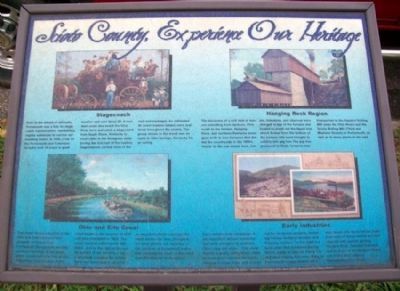
1. Scioto County, Experience Our Heritage Marker
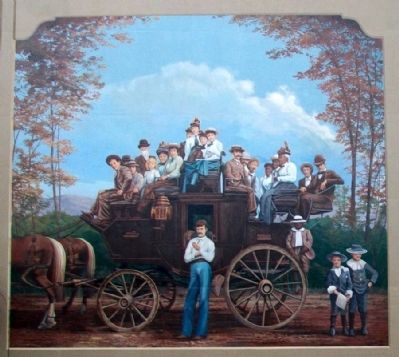
Stagecoach
Prior to the advent of railroads, Portsmouth was a hub for stagecoach transportation, maintaining regular schedules to various surrounding towns. In 1830, a trip on the Portsmouth and Columbus turnpike took 18 hours in good weather and cost about $5. A resident could also board the Ohio River ferry and catch a stagecoach from South Shore, Kentucky to most cities in the Bluegrass state. During the first half of the century, stagecoaches carried most of the mail and packages. An estimated 50 coach houses (stops) were scattered throughout the county. The group shown in the mural was en route to Glen Springs, Kentucky for an outing.
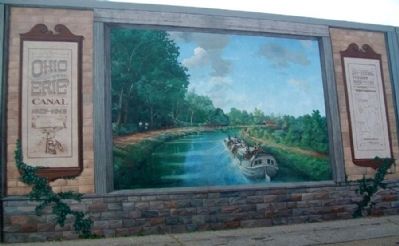
Ohio and Erie Canal
This mural shows a section of the Ohio and Erie Canal as it progressed northward from Portsmouth. Portsmouth was the southern terminus of the canal, which connected Lake Erie to the Ohio River. Construction of the canal began in the summer of 1825 and was completed in 1832. The canal covered a distance of 306 miles. Just to the right of the center portion of the mural is a covered bridge crossing the Scioto River and immediately adjacent to an aqueduct which conveyed
this page online
Hanging Rock Region
The discovery of a rich vein of iron ore extending from Jackson, Ohio south to the Ironton, Hanging Rock, and northern Kentucky areas gave birth to iron furnaces that dotted the countryside in the 1800's similiar to the one shown here. Iron ore, limestone, and charcoal were charged in top of the furnace and heated to smelt out the liquid iron which flowed from the bottom of the furnace into sand troughs to solidify into pig iron. The pig iron produced in these furnaces was transported to the Gaylord Rolling Mill (near the Ohio River) and the Scioto Rolling Mill (Third and Madison Streets) in Portsmouth, as well as to many plants in the east.
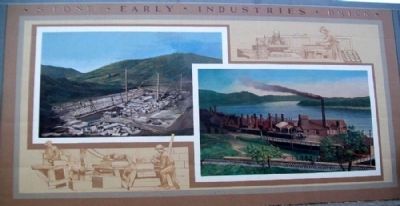
Early Industries
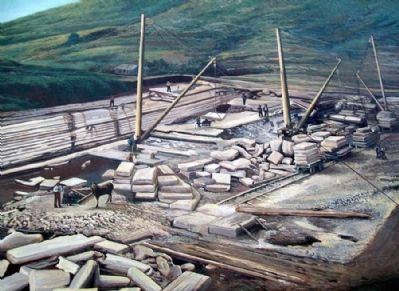
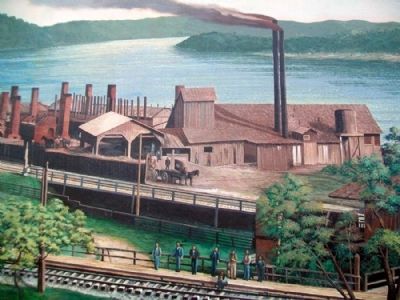
Early settlers took advantage of two important natural resources that were prevalent in Southern Ohio - clay and stone. This mural depicts a quarry (left), where slabs of stones were cut from the earth, shipped to stone mills, and custom cut for numerous projects, including homes, building
Photographed by William Fischer, Jr., September 2, 2012
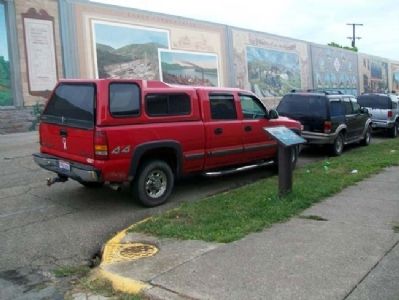
2. Scioto County, Experience Our Heritage Marker
Erected by Portsmouth Area Convention & Visitors Bureau.
Topics and series. This historical marker is listed in these topic lists: Industry & Commerce • Roads & Vehicles • Settlements & Settlers • Waterways & Vessels. In addition, it is included in the Ohio and Erie Canal, and the Ohio, Scioto County, Experience Our Heritage series lists. A significant historical year for this entry is 1830.
Location. This marker has been replaced by another marker nearby. It was located near 38° 43.846′ N, 83° 0.102′ W. Marker was in Portsmouth, Ohio, in Scioto County. It was on Front Street west of Court Street, on the right when traveling west. Touch for map. Marker was at or near this postal address: 531 Front St, Portsmouth
Photographed by William Fischer, Jr., September 2, 2012
3. Stagecoach Mural

Regionally, this marker was in Southern Ohio Hill Country. It was also in the American Midwest, in the Ohio River Valley, in Appalachia, and specifically in Northern Appalachia. Globally, it was in North America, the Western Hemisphere, the Western World, and the Anglosphere. Historically, it found itself in what was once the Haudenosaunee (Iroquois) Confederacy, the territory of the Mississippian Culture, and the Northwest Territory.
Other nearby markers. At least 8 other markers are within walking distance of this location: Stagecoach / Hanging Rock Region / Ohio and Erie Canal / Early Industries (here, next to this marker); Platting of Portsmouth, 1803 / The 1810 House / The 1812 Era / Flood Gate House / Early Boneyfiddle (within shouting distance of this marker); Portsmouth and the Ohio River (within shouting distance of this marker); Tenth Street Station / Market Square / Portsmouth 1903 (about 300 feet away); Introduction / The Mound Builders / Early Shawnee Village, 1730 / Celeron de Blainville, 1749 (about 300 feet away); James M. Ashley and the Abolition of Slavery
Photographed by William Fischer, Jr., September 2, 2012
4. Ohio and Erie Canal Mural
Other markers no longer nearby. Scioto County, Experience Our Heritage (was within shouting distance of this marker but has been replaced with another marker now near it); a different marker also named Scioto County, Experience Our Heritage (was within shouting distance of this marker but has been replaced with another marker now near it); a different marker also named Scioto County, Experience Our Heritage (was about 300 feet away, measured in a direct line but has been replaced with another marker now near it); a different marker also named Scioto County, Experience Our Heritage (was about 400 feet away but has been replaced with another marker now near it); a different marker also named Scioto County, Experience Our Heritage (was about 400 feet away but has been replaced with another marker now near it).
Also see . . . Portsmouth, Ohio, Flood Wall Murals. (Submitted on February 21, 2013, by William Fischer, Jr. of Reynoldsburg, Ohio.)
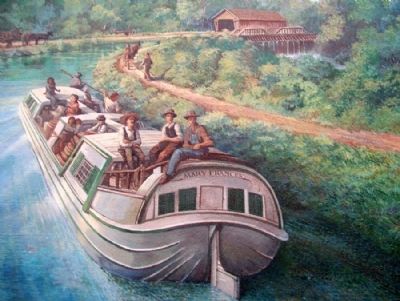
Photographed by William Fischer, Jr., September 2, 2012
5. Ohio and Erie Canal Mural Detail
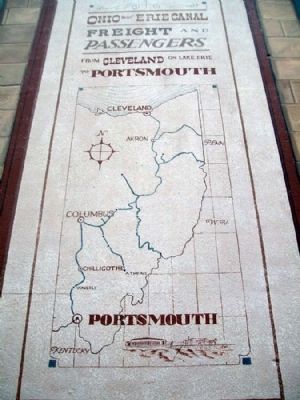
Photographed by William Fischer, Jr., September 2, 2012
6. Ohio and Erie Canal Mural Map
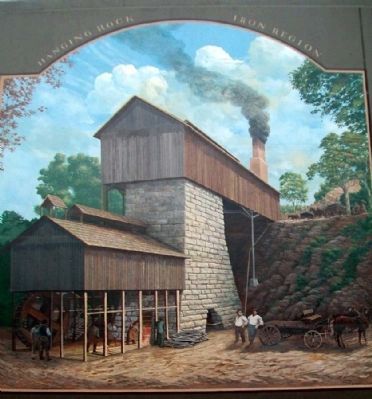
Photographed by William Fischer, Jr., September 2, 2012
7. Hanging Rock Region Mural
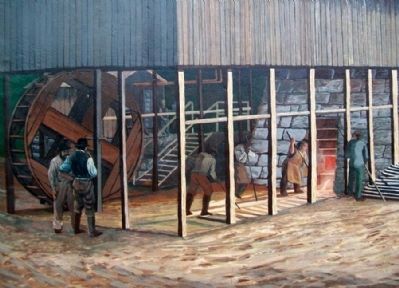
Photographed by William Fischer, Jr., September 2, 2012
8. Hanging Rock Region Mural Detail
Photographed by William Fischer, Jr., September 2, 2012
9. Early Industries Mural
Photographed by William Fischer, Jr., September 2, 2012
10. Early Industries Mural Detail - Stone Quarry
Photographed by William Fischer, Jr., September 2, 2012
11. Early Industries Mural Detail - Brick Plant
Credits. This page was last revised on February 5, 2021. It was originally submitted on February 21, 2013, by William Fischer, Jr. of Reynoldsburg, Ohio. This page has been viewed 965 times since then and 35 times this year. Last updated on January 27, 2021, by Craig Doda of Napoleon, Ohio. Photos: 1, 2, 3, 4, 5, 6, 7, 8, 9, 10, 11. submitted on February 21, 2013, by William Fischer, Jr. of Reynoldsburg, Ohio. • Devry Becker Jones was the editor who published this page.
