Near McDowell in Highland County, Virginia — The American South (Mid-Atlantic)
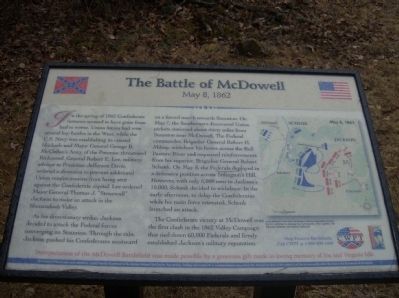
The Battle of McDowell
May 8, 1862
Photographed by Robert H. Moore, II, February 27, 2009
1. The Battle of McDowell Marker
As his diversionary strike, Jackson decided to attack the Federal forces converging on Staunton. Through the rain, Jackson pushed his Confederates westward on a forced march towards Staunton. On May 7, the Southerners discovered Union pickets about thirty miles from Staunton near McDowell. The Federal commander, Brigadier General Robert H. Milroy, withdrew his forces across the Bull Pasture River and requested reinforcements from his superior, Brigadier General Robert Schenk. On May 8, the Federals deployed in a defensive position across Sitlington’s Hill. However, with only
this page online
The Confederate victory at McDowell was the first clash in the 1862 Valley Campaign that tied down 60,000 Federals and firmly established Jackson’s military reputation.
Erected by Civil War Preservation Trust and Shenandoah Valley Battlefields Foundation.
Topics. This historical marker is listed in this topic list: War, US Civil. A significant historical month for this entry is May 1835.
Location. This marker has been replaced by another marker nearby. It was located near 38° 19.718′ N, 79° 28.542′ W. Marker was near McDowell, Virginia, in Highland County. It could be reached from U.S. 250, on the right when traveling east. Located in the Civil War Preservation's Trust McDowell Battlefield. Touch for map. Marker was in this post office area: Mc Dowell VA 24458, United States of America. Touch for directions.

Regionally, this marker was in the Shenandoah Valley, in the Alleghany Highlands, and specifically in the Potomac Highlands. It was also in the American South,

2. Civil War Preservation Trust
Other nearby markers. At least 8 other markers are within walking distance of this location: Commemorating The Battle Of McDowell (about 600 feet away, measured in a direct line); a different marker also named Battle of McDowell (about 700 feet away); The Ravines (approx. 0.3 miles away); The 12th Georgia (approx. 0.3 miles away); Hometown Foes (approx. 0.4 miles away); The Confederate Right (approx. 0.4 miles away); The Battle Rages (approx. 0.4 miles away); Moving Uphill (approx. 0.4 miles away). Touch for a list and map of all markers in McDowell.
Other markers no longer nearby. The Battle of McDowell (was approx. 0.2 miles away but has been replaced with another marker now near it); Battle Of McDowell (was approx. 0.3 miles away but
Photographed by Robert H. Moore, II, February 27, 2009
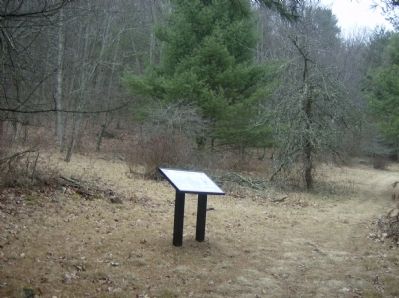
3. The Battle of McDowell Marker
More about this marker. On the left is a map captioned, In an attempt to buy time, the Federal infantry repeatedly stormed the hill and failed to dislodge the Confederates. After nightfall, the Federals retreated west beyond McDowell.
Related markers. Click here for a list of markers that are related to this marker. To better understand the relationship, study each marker in the order shown.
Credits. This page was last revised on August 8, 2026. It was originally submitted on March 4, 2009, by Robert H. Moore, II of Winchester, Virginia. This page has been viewed 1,832 times since then and 24 times this year. Last updated on January 29, 2021, by Bradley Owen of Morgantown, West Virginia. Photos: 1. submitted on March 4, 2009, by Robert H. Moore, II of Winchester, Virginia. 2. submitted on March 30, 2009. 3. submitted on March 4, 2009, by Robert H. Moore, II of Winchester, Virginia. • Bernard Fisher was the editor who published this page.
