South Trenton in Mercer County, New Jersey — The American Northeast (Mid-Atlantic)
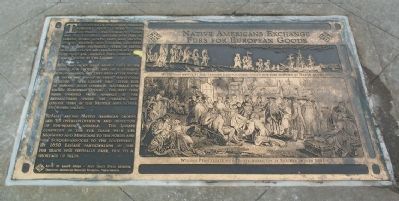
Native Americans Exchange Furs for European Goods
Photographed by Gary Nigh, November 2007
1. Native Americans Exchange Furs for European Goods Marker
The lifestyle of the Lenape changed forever upon contact with Europeans. One source of change was the European appetite for furs in making robes, coats, hats and gloves. Dutch, Swedish and English explorers and traders exchanged items of metal, glass and cloth and trinkets of all kinds for pelts or animals like beaver and otter caught by the Lenape.
Furs and hides were widely used by the Lenape for clothing and as a covering for dwellings, but they held little social or economic value in their traditional culture. The Lenape saw little risk in trading such common materials for exotic European goods. The best furs were derived from animals in the Appalachians where the climate was colder than in the Middle and Lower Delaware Valley.
Rivalry among Native American groups led to overexploitation and depletion of fur-bearing animals. The Lenape competed in the fur trade with the Mohawks and Mahicans to the north and the Susquenannocks to the southwest. By 1659 Lenape participation in the fur trade was virtually over, due to a shortage of pelts.
Links to learn more – New Jersey State Museum, Trenton; American Swedish
this page online
Erected 2004 by New Jersey Department of Transportation.
Topics. This historical marker is listed in these topic lists: Colonial Era • Indigenous Peoples and Communities • Industry & Commerce. A significant historical year for this entry is 1659.
Location. 40° 11.888′ N, 74° 45.499′ W. Marker is in Trenton, New Jersey, in Mercer County. It is in South Trenton. It can be reached from New Jersey Route 29. This marker is part of South River Walk Park which is built over Route 29. Touch for map. Marker is in this post office area: Trenton NJ 08611, United States of America. Touch for directions.

Regionally, this marker is in Central Jersey and in Greater Princeton. It is also in the American Northeast and in the Mid-Atlantic. Globally, it is in North America, the Western Hemisphere, the Western World, and the Anglosphere. Historically, it finds itself in what was once New Netherland and also one of the original Thirteen Colonies.
Other nearby markers. At least 8 other markers are within walking distance of this marker: Who, What and Where were Sanhickans? (here, next to this marker); What happened to the Lenape?
Photographed by Gary Nigh, November 2007
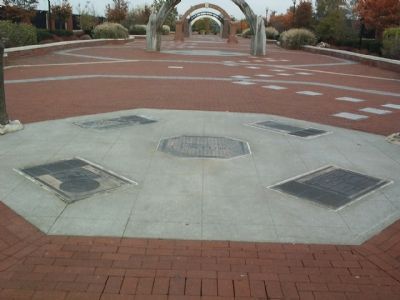
2. The four subject markers under the Pre-17th Century Arch
More about this marker. This is one of 4 subject markers under the pre-17th Century Arch.
Credits. This page was last revised on February 16, 2023. It was originally submitted on December 15, 2007, by Gary Nigh of Trenton, New Jersey. This page has been viewed 1,544 times since then and 48 times this year. Last updated on February 2, 2021, by Carl Gordon Moore Jr. of North East, Maryland. Photos: 1, 2. submitted on December 15, 2007, by Gary Nigh of Trenton, New Jersey. • Devry Becker Jones was the editor who published this page.
