North Downtown in Charlottesville, Virginia — The American South (Mid-Atlantic)
Lynching in America
⎯⎯⎯
Lynching of John Henry James
Community Remembrance Project
Photographed by Tim Fillmon, July 22, 2020
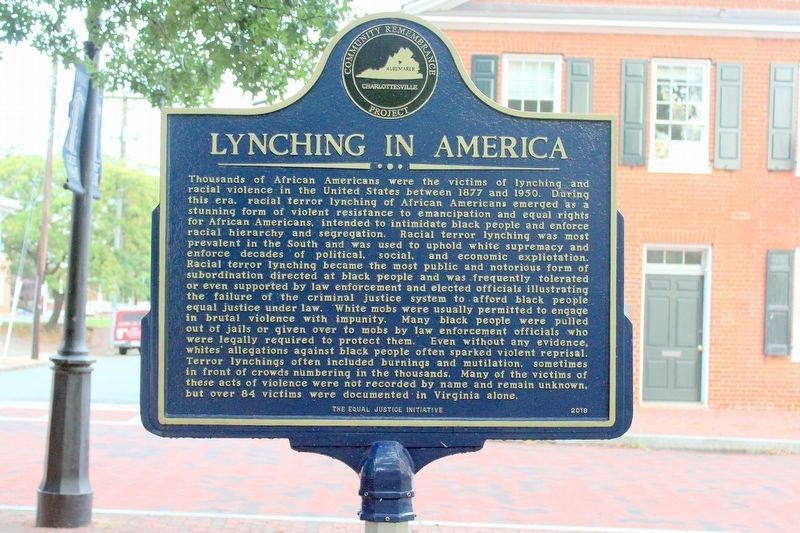
1. Lynching in America side of Marker
Lynching in America. Thousands of African Americans were the victims of lynching and racial violence in the United States between 1877 and 1950. During this era, racial terror lynching of African Americans emerged as a stunning form of violent resistance to emancipation and equal rights for African Americans, intended to intimidate black people and enforce racial hierarchy and segregation. Racial terror lynching was most prevalent in the South and was used to uphold white supremacy and enforce decades of political, social, and economic exploitation. Racial terror lynching became the most public and notorious form of subordination directed at black people and was frequently tolerated or even supported by law enforcement and elected officials illustrating the failure of the criminal justice system to afford black people equal justice under law. White mobs were usually permitted to engage in brutal violence with impunity. Many black people were pulled out of jails or given over to mobs by law enforcement officials who were legally required to protect them. Even without any evidence, whites' allegations against black people
this page online
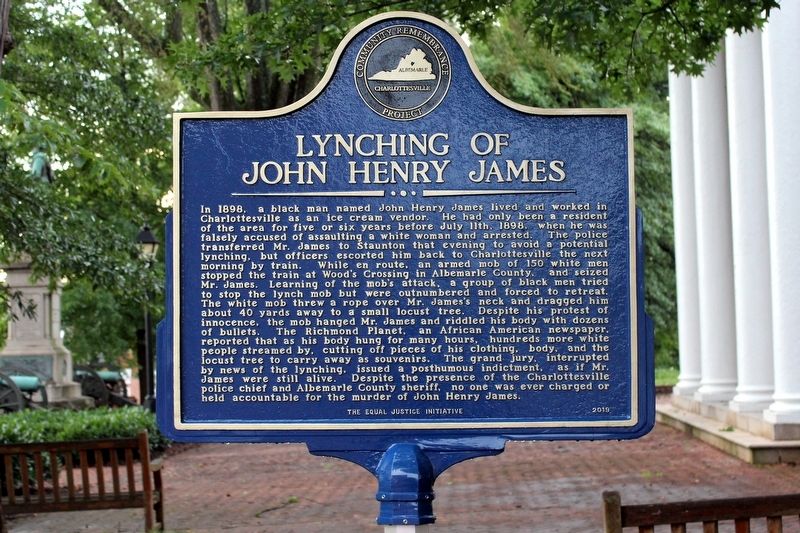
Lynching of John Henry James. In 1898, a black man named John Henry James lived and worked in Charlottesville as an ice cream vendor. He had only been a resident of the area for five or six years before July 11th, 1898, when he was falsely accused of assaulting a white woman and arrested. The police transferred Mr. James to Staunton that evening to avoid a potential lynching, but officers escorted him back to Charlottesville the next morning by train. While en route, an armed mob of 150 white men stopped the train at Wood's Crossing in Albemarle County, and seized Mr. James. Learning of the mob's attack, a group of black men tried to stop the lynch mob but were outnumbered and forced to retreat. The white mob threw a rope over Mr. James's neck and dragged him about 40 yards away to a small locust tree. Despite his protest of innocence, the mob
Photographed by Tim Fillmon, July 22, 2020
2. Lynching of John Henry James side of Marker
Erected 2019 by The Equal Justice Initiative.
Topics and series. This historical marker is listed in these topic lists: African Americans • Civil Rights • Law Enforcement. In addition, it is included in the Lynching in America series list. A significant historical date for this entry is July 11, 1898.
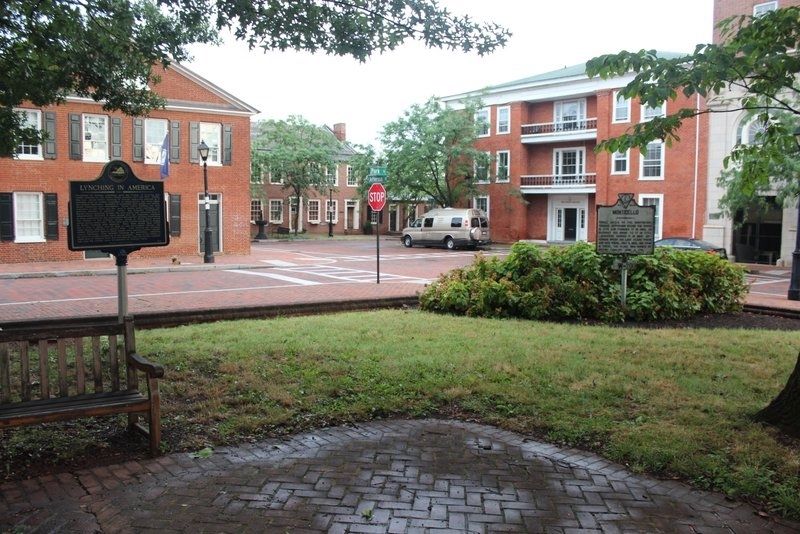
Location. 38° 1.887′ N, 78° 28.636′ W. Marker is in Charlottesville, Virginia. It is in North Downtown. It is at the intersection of Park Street and Jefferson Street, on the left when traveling north on Park Street. Marker is in courthouse square. Touch for map. Marker
Photographed by Tim Fillmon, July 22, 2020
3. Lynching of John Henry James/Lynching in America Marker

Regionally, this marker is in Central Virginia. It is also in the American South and specifically in the Upper South. Globally, it is in North America, the Western Hemisphere, the Western World, and the Anglosphere. Historically, it finds itself in what was once the territory of the Mississippian Culture, one of the original Thirteen Colonies, one of the Confederate States of America, and the Antebellum South.
Other nearby markers. At least 8 other markers are within walking distance of this marker: A Bicentennial Tribute (a few steps from this marker); Mercantile Business (a few steps from this marker); Historic Courthouse Square (a few steps from this marker); Albemarle County Court House (a few steps from this marker); Site of Old Swan Tavern (a few steps from this marker); Albemarle County (a few steps from this marker); Monticello (within shouting distance of this marker); First Post Office (within shouting distance of this marker). Touch for a list and map of all markers in Charlottesville.
Also see . . . Lynching of John Henry James.

Photographed by Brandon D Cross
4. Lynching of John Henry James Marker
“A Replica marker of one side is located at the Equal Justice Initiatives' National Memorial for Peace and Justice in Montgomery, Alabama. The Equal Justice Initiative supports efforts to locally memorialize documented victims of racial violence and to educate communities about the history of racial injustice.” Mark Hilton
Credits. This page was last revised on October 28, 2024. It was originally submitted on February 4, 2021, by Tim Fillmon of Webster, Florida. This page has been viewed 1,133 times since then and 56 times this year. Photos: 1, 2, 3. submitted on February 4, 2021, by Tim Fillmon of Webster, Florida. 4. submitted on October 27, 2024, by Brandon D Cross of Flagler Beach, Florida.
