Kitchen and Laundry
18th Century
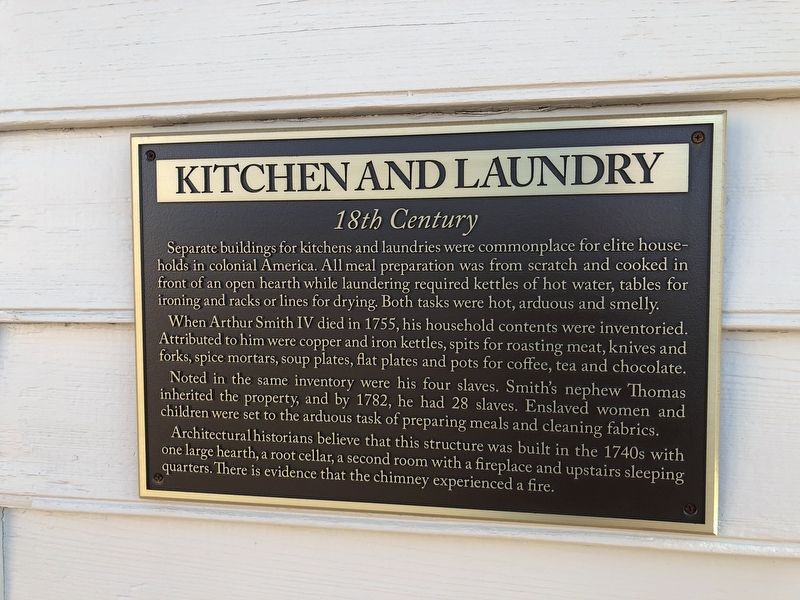
Separate buildings for kitchens and laundries were commonplace for elite households in colonial America. All meal preparation was from scratch and cooked in front of an open hearth while laundering required kettles of hot water, tables for ironing and racks or lines for drying. Both tasks were hot, arduous and smelly.
When Arthur Smith IV died in 1755, his household contents were inventories. Attributed to him were copper and iron kettles, spits for roasting meat, knives and forks, spice mortars, soup plates, flat plates and pots for coffee, tea and chocolate.
Noted in the same inventory were his four slaves. Smith's nephew Thomas inherited the property, and by 1782, he had 28 slaves. Enslaved women and children were set to the arduous task of preparing meals and cleaning fabrics.
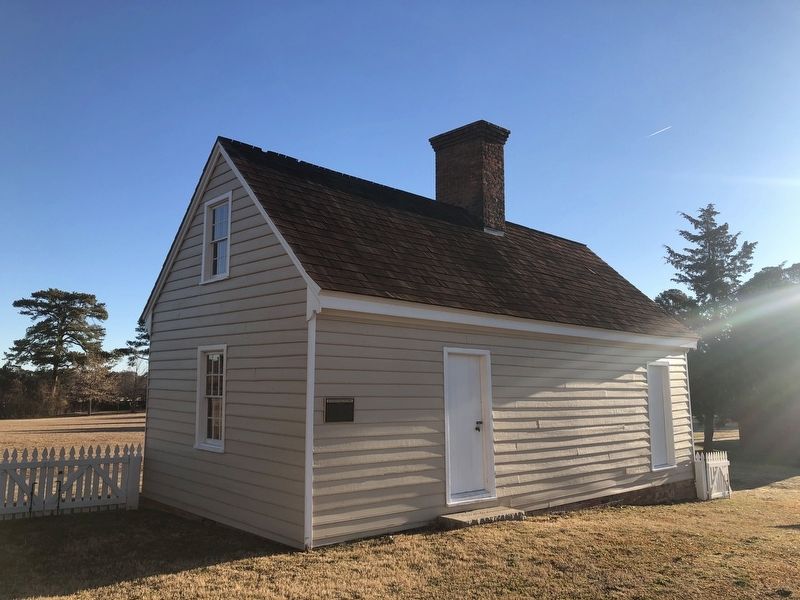
Architectural historians believe that this structure was built in the 1740s with one large hearth, a root cellar, a second room with a fireplace and upstairs sleeping quarters. There is evidence that the chimney experienced a fire.
Erected by Smithfield Parks & Recreation.
Topics. This historical marker is listed in these
this page online
Location. 36° 58.725′ N, 76° 37.452′ W. Marker is in Smithfield, Virginia, in Isle of Wight County. It is on Jericho Road 0.2 miles north of Kayak Lane, on the right when traveling north. Touch for map. Marker is at or near this postal address: 301 Jericho Rd, Smithfield VA 23430, United States of America. Touch for directions.

Regionally, this marker is in Coastal Virginia and in the Hampton Roads Metropolitan Area. It is also in the American South, specifically in the Upper South, in the Tidewater, and on the Eastern Seaboard. Globally, it is in the North Atlantic Region, North America, the Western Hemisphere, the Western World, and the Anglosphere. Historically, it finds itself in what was once the territory of the Mississippian Culture, one of the original Thirteen Colonies, one of the Confederate States of America, and the Antebellum South.
Other nearby markers. At least 8 other markers are within walking distance of this marker: Smokehouse (within shouting distance of this marker);
Other markers no longer nearby. Smithfield (was approx. ¼ mile away but has been reported to have been replaced with another marker now near it); Battle of Smithfield (was approx. ¼ mile away but has been confirmed missing).
Credits. This page was last revised on February 7, 2021. It was originally submitted on February 7, 2021, by Devry Becker Jones of Washington, District of Columbia. This page has been viewed 352 times since then and 22 times this year. Photos: 1, 2. submitted on February 7, 2021, by Devry Becker Jones of Washington, District of Columbia.
