Near Jackson in Jackson County, Minnesota — The American Midwest (Upper Plains)
Government Ditches
The Draining of Minnesota
Photographed by Phyllis Prats, May 4, 2015
1. Government Ditches Marker
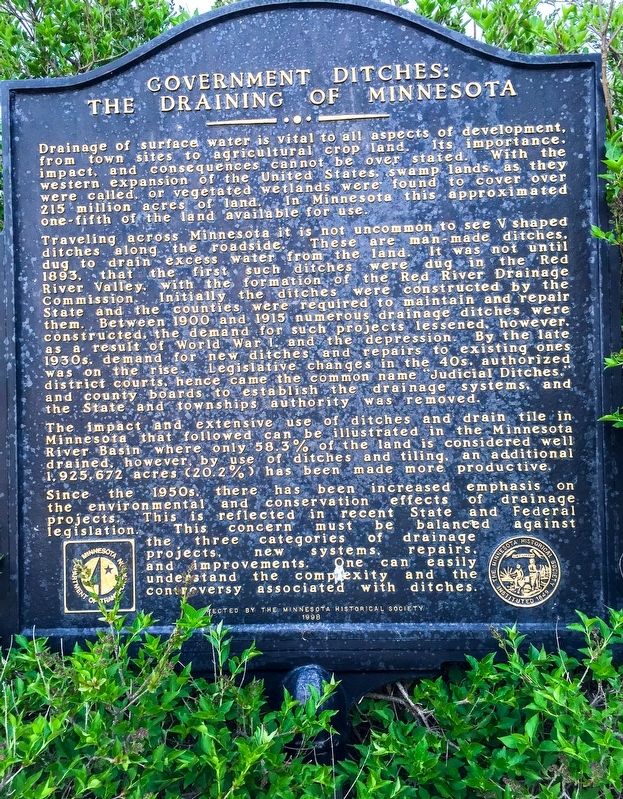
Drainage of surface water is vital to all aspects of development, from town sites to agricultural crop land. Its importance, impact, and consequences cannot be over stated. With the western expansion of the United States, swamp lands. as they were called, or vegetated wetlands were found to cover over 215 million acres of land. In Minnesota this approximated one-fifth of the land available for use.
Traveling across Minnesota it is not uncommon to see V shaped ditches along the roadside. These are ma-made ditches, dug to drain excess water from the land. It was not until 1893, that the first such ditches were dug in the Red River Valley, with the formation of the Red River Drainage Commission. Initially the ditches were constructed by the State and the counties were required to maintain and repair them. Between 1900 and 1915 numerous drainage ditches, were constructed, the demand for such projects lessened, however, as a result of World War I. and the depression. By the late 1930s, demand for new ditches and repairs to existing ones was on the rise. Legislative changes in the 40s, authorized by district courts, hence
this page online
The impact and extensive use of ditches and drain tile in Minnesota that followed can be illustrated in the Minnesota River Basin where only 58.3% of the land is considered well drained, however, by use of ditches and tiling, an additional 1,925,672, acres (20.2%) has been made more productive.
Since the 1950s, there has been increased emphasis on the environmental and conservation effects of drainage projects. This is reflected in recent State and Federal legislation. This concern must be balanced against the three categories of drainage projects, new systems, repairs, and improvements. One can easily understand the complexity and the controversy associated with ditches.
Erected 1998 by The Minnesota Historical Society.
Topics. This historical marker is listed in these topic lists: Environment • Waterways & Vessels. A significant historical year for this entry is 1893.
Location. 43° 38.418′ N, 95° 1.211′ W. Marker is near Jackson, Minnesota, in Jackson County. It can be reached
Photographed by Phyllis Prats, May 4, 2015
2. Government Ditches Marker

Regionally, this marker is in Southwest Minnesota. It is also in the American Midwest, in the Corn Belt, and on the Great Plains. Globally, it is in North America, the Western Hemisphere, the Western World, and the Anglosphere. Historically, it finds itself in what was once Rupert’s Land, the territory of the Mississippian Culture, and the Louisiana Purchase.
Other nearby markers. At least 8 other markers are within 13 miles of this marker, measured as the crow flies: Birds of a Feather (within shouting distance of this marker); Wood Brothers Trading Post (approx. 1.7 miles away); Olson-Slaabakken Cabin (approx. 1.9 miles away); Olson Slaabakken Cabin / The Jackson County Massacre Monument (approx. 1.9 miles away); Jackson County Massacre Monument (approx. 1.9 miles away); History in the Soil (approx. 3.2 miles away); State Line Congregation
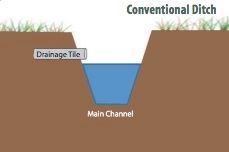
Also see . . . Conventional vs. Two-Stage Drainage Ditch (Wikipedia Entry). Excerpt:
The issue faced by Minnesota’s channel management systems concerns the implementation of traditional ditch systems that were used to straighten what were once headwaters streams, disrupting the fluvial processes of the hydrological system. In fact, more than 25,000 miles of these traditional drainage ditch lines exist along agricultural fields in Minnesota, particularly in the South East in parts of the Upper Mississippi River. The Nature Conservancy’s investigation into the Minnesota region affirmed the above limitations of traditional drainage management above, finding that these deep and wide conventional ditches are highly susceptible to erosion and sedimentation, hindering the stability of the ditch, finding excessive levels of nitrogen and phosphorus in streams which culminate in eutrophication, in addition to increased flooding. [Richard] Biske affirmed [Brad] Hansen’s view that once such ditches are(Submitted on February 7, 2021.)channelized and constructed, attempting to return the channels to their natural fluvial processes and meandering nature results in exacerbated erosion and sediment deposition.Photographed by Phyllis Prats, May 4, 20154. Government Ditches Marker at Rest Stop
Credits. This page was last revised on April 22, 2026. It was originally submitted on February 7, 2021, by J. J. Prats of Powell, Ohio. This page has been viewed 578 times since then and 69 times this year. Photos: 1, 2, 3, 4. submitted on February 7, 2021, by J. J. Prats of Powell, Ohio.
