Staunton, Virginia — The American South (Mid-Atlantic)
The Barger House
The War's Lasting Effects
Photographed by Bill Coughlin, August 20, 2012
1. The Barger House Marker
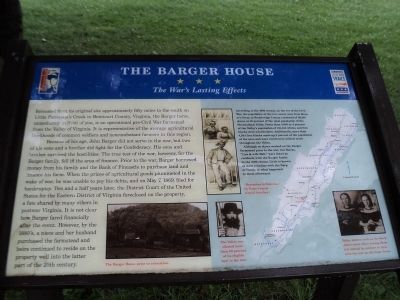
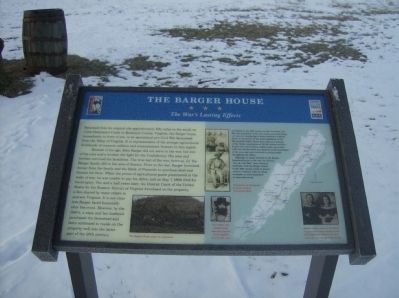
Because of his age, John Barger did not serve in the war, but two of his sons and a brother did fight for the Confederacy. His sons and brother survived the hostilities. The true test of the war, however, for the Barger family, fell in the area of finance. Prior to the war, Barger borrowed money from his family and the bank of Fincastle to purchase land and finance his farm. When t he prices of agricultural goods plummeted in the wake of war, he was unable to pay his debts, and on May 7, 1869, filed for bankruptcy. Two and a half years later, the District Court of the United States for the Eastern District of Virginia foreclosed on the property, a fate shared by many others in postwar Virginia. It is not clear how Barger fared financially after the event. However,
this page online
(Sidebar):
According to the 1860 census, on the eve of the Civil War, the population of the ten county area from Harpers Ferry to Rockbridge County consisted of 26,410 slaves or 18 percent of the total population of the Shenandoah Valley. Fewer than 4,040 or 4 percent of the Valley’s population of 121,194 whites and free blacks were slaveholders. Additionally, more than 4,593 free blacks made up 3 percent of the population of the area and were involved in critical trade throughout the Valley.
Although no slaves worked on the Barger farmstead prior to the war, two blacks, “Law & wife Mell,” were listed as residents with the Barger family in the 1860 census. Little is known of their relations with the Barger family or what happened to them afterward.
Erected 2002 by The Shenandoah Valley Battlefields Foundation, Virginia Civil War Trails, and the Frontier Culture Museum of Virginia.
Topics and series. This historical marker is listed in these topic lists: African Americans
Photographed by Robert H. Moore, II, March 4, 2009
2. The Barger House Marker
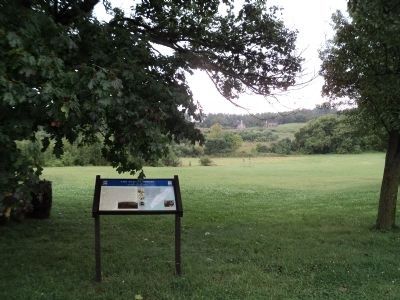
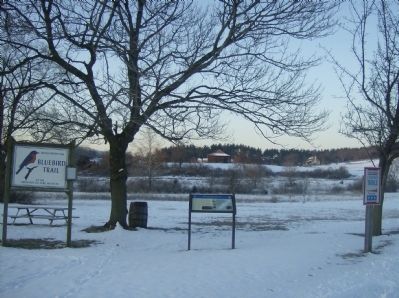
Location. 38° 7.692′ N, 79° 2.645′ W. Marker is in Staunton, Virginia. It is on Avenue of Trees, on the left when traveling south. Marker is located on the grounds of the Frontier Culture Museum of Virginia. While no admission fee is necessary to see the marker, the Barger House and farm is part of the outdoor museum exhibit and requires payment of the admission fee. Touch for map. Marker is in this post office area: Staunton VA 24401, United States of America. Touch for directions.

Regionally, this marker is in Virginia’s Shenandoah Valley. It is also in the American South and specifically in the Upper South. Globally, it is in North America, the Western Hemisphere, the Western World, and the Anglosphere. Historically, it finds itself in what was once the territory of the Mississippian Culture, one of the original Thirteen Colonies, one of the Confederate States of America, and the Antebellum South.
Other nearby markers. At least 8 other markers are within
Photographed by Bill Coughlin, August 20, 2012
3. The Barger House Marker
Regarding The Barger House. In the lower left is a photo of The Barger House prior to relocation. In the center is a drawing titled "Reception in Staunton” by Porte Crayon (David Strother). In the lower center is a photo of a soldier captioned, The Valley contributed more than 60 percent of its eligible men to the war. To the lower right is a photo captioned, Valley women such as the Buck sisters were often among those left behind by soldiers to deal with the war on the home front. Also on the right is a map of the Shenandoah Valley indicating points of interest.
Additional keywords. Frontier Culture Museum of Virginia
Photographed by Robert H. Moore, II, March 4, 2009
4. The Barger House Marker
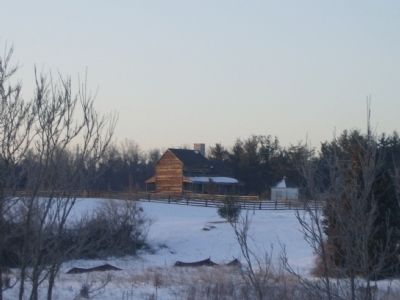
Photographed by Robert H. Moore, II, March 4, 2009
5. The Barger House
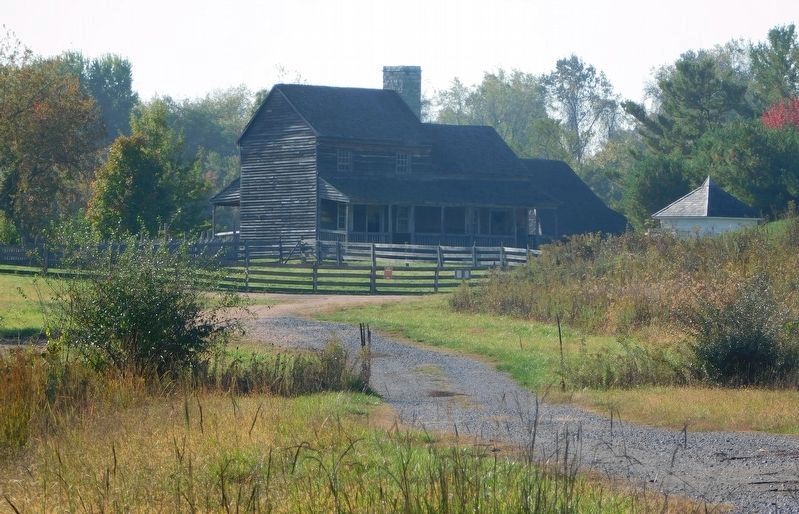
Photographed by Bradley Owen, October 15, 2017
6. The Barger House
Credits. This page was last revised on November 3, 2024. It was originally submitted on March 4, 2009, by Robert H. Moore, II of Winchester, Virginia. This page has been viewed 3,127 times since then and 107 times this year. Photos: 1. submitted on August 24, 2012, by Bill Coughlin of Woodland Park, New Jersey. 2. submitted on March 4, 2009, by Robert H. Moore, II of Winchester, Virginia. 3. submitted on August 24, 2012, by Bill Coughlin of Woodland Park, New Jersey. 4, 5. submitted on March 4, 2009, by Robert H. Moore, II of Winchester, Virginia. 6. submitted on January 30, 2021, by Bradley Owen of Morgantown, West Virginia. • Craig Swain was the editor who published this page.
