Fort Monroe
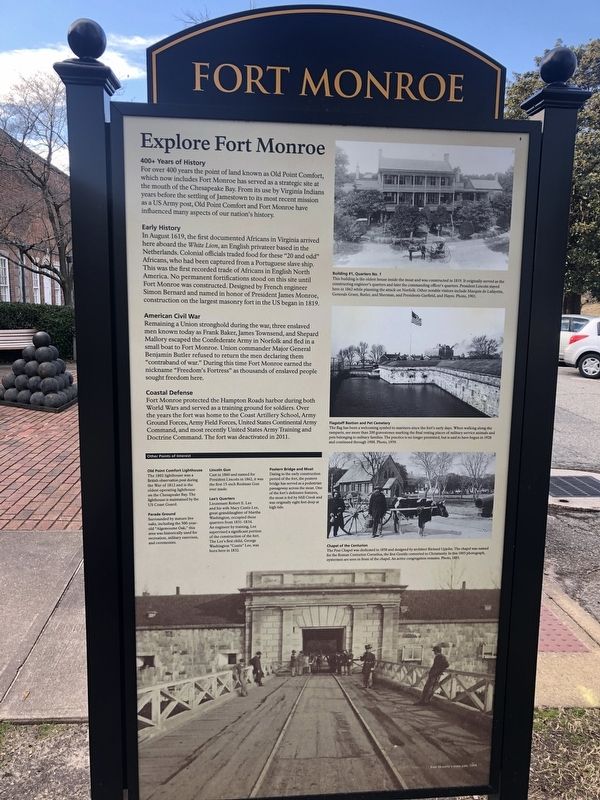
Explore Fort Monroe
400+ Years of History
For over 400 years the point of land known as Old Point Comfort, which now includes Fort Monroe has served as a strategic site at the mouth of the Chesapeake Bay. From its use by Virginia Indians years before the settling of Jamestown to its most recent mission as a US Army post, Old Point Comfort and Fort Monroe have influenced many aspects of our nation's history.
Early History
In August 1619, the first documented Africans in Virginia arrived here aboard the White Lion, an English privateer based in the Netherlands. Colonial officials traded food for these "20 and odd" Africans, who had been captured from a Portuguese slave ship. This was the first recorded trade of Africans in English North America. No permanent fortifications stood on this site until Fort Monroe was constructed. Designed by French engineer Simon Bernard and named in honor of President James Monroe, construction on the largest masonry fort in the US began in 1819.
American Civil War
Remaining a Union stronghold during the war, three enslaved men known today as Frank Baker, James Townsend, and Shepard
this page online
Coastal Defense
Fort Monroe protected the Hampton Roads harbor during both World Wars and served as a training ground for soldiers. Over the years the fort was home to the Coast Artillery School, Army Ground Forces, Army Field Forces, United States Continental Army Command, and most recently United States Army Training and Doctrine Command. The fort was deactivated in 2011.
[Captions:]
Building #1, Quarters No. 1
This building is the oldest house inside the moat and was constructed in 1819. It originally served as the constructing engineer's quarters and later the commanding officer's quarters. President Lincoln stayed here in 1862 while planning the attack on Norfolk. Other notable visitors include Marquis de Lafayette, Generals Grant, Butler, and Sherman, and Presidents Garfield, and Hayes. Photo, 1901.
Flagstaff Bastion and Pet Cemetery
The flag has been a welcoming symbol to mariners since the fort's early days. When walking along the ramparts, see more than 200 gravestones marking the final resting places of military service animals and pets belonging to military families. The practice is no longer permitted, but is said to have begun in 1928 and continued through 1988. Photo, 1959
Chapel of the Centurion
The Post Chapel was dedicated in 1858 and designed by architect Richard Upjohn. The chapel was named for the Roman Centurion Cornelius, the first Gentile converted to Christianity. In this 1885 photograph, oystermen are seen in front of the chapel. An active congregation remains. Photo, 1885.
Other Points of Interest
Old Point Comfort Lighthouse
The 1802 lighthouse was a British observation post during the War of 1812 and is the oldest operating lighthouse on the Chesapeake Bay. The lighthouse is maintained by the US Coast Guard.
Parade Ground
Surrounded by mature live oaks, including the 500-year-old "Algemoume Oak," this area was historically used for recreation, military exercises, and ceremonies.
Lincoln Gun
Cast in 1860 and named for President Lincoln in 1862, it was the first 15-inch Rodman Gun ever made.
Lee's Quarters Lieutenant Robert E. Lee and his wife Mary Custis Lee, great-granddaughter of Martha Washington, occupied these quarters from 1831-1834. An engineer by training, Lee supervised a significant portion of the construction of the fort. The Lee's first child, George Washington "Custis" Lee, was born here in 1832.
Postern Bridge and Moat
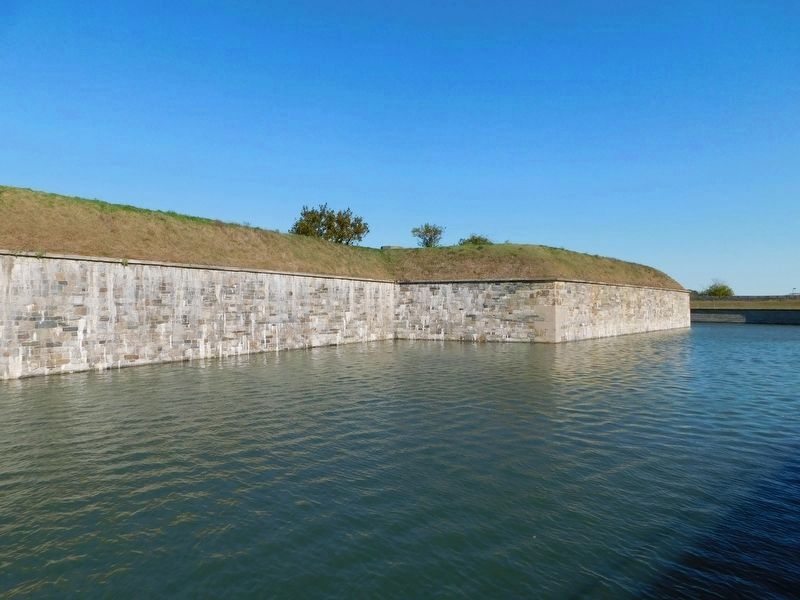
Dating to the early construction period of the fort, the postern bridge has served as a pedestrian passageway across the moat. One of the fort's defensive features, the moat is fed by Mill Creek and was originally eight feet deep at high tide.
Experience Fort Monroe
At

Fort Monroe Today
Deactivated in 2011, 565-acre Fort Monroe is jointly managed by the Fort Monroe Authority, National Park Service, and the US Army. It remains a home and workplace just as it was during the period of active service. Today the fort is a thriving community where people live, work, play, and learn.
Casemate Museum, Fort Monroe
The Casemate Museum chronicles over 400 years of history at Old Point Comfort including that of Fort Monroe, the largest
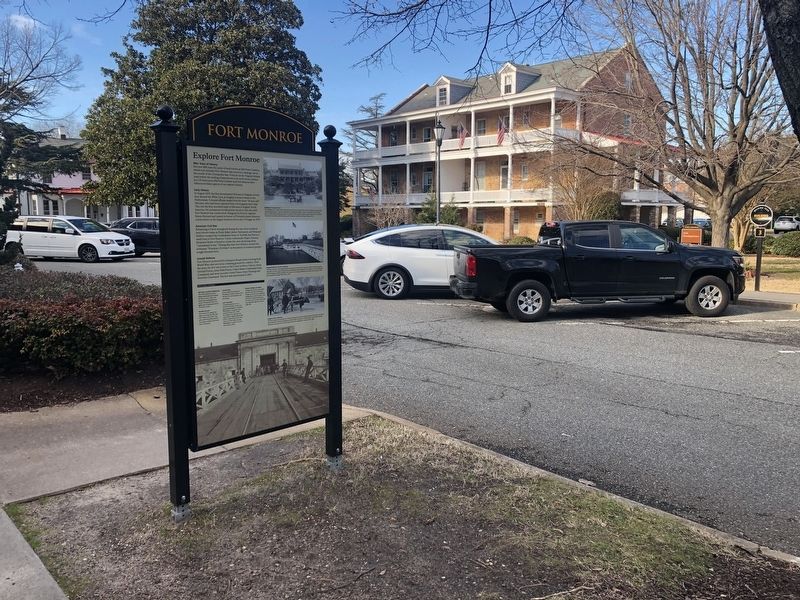
Erected by Fort Monroe Authority.
Topics and series. This historical marker is listed in these topic lists: African Americans • Forts and Castles • War, US Civil • Waterways & Vessels. In addition, it is included in the Former U.S. Presidents: #16 Abraham Lincoln, the Former U.S. Presidents: #18 Ulysses S. Grant, the Former U.S. Presidents: #19 Rutherford B. Hayes, the Former U.S. Presidents: #20 James A. Garfield, and the Lighthouses series lists. A significant historical month for this entry is August 1619.
Location. 37° 0.134′ N, 76° 18.545′ W. Marker is in Hampton, Virginia. It is in Fort Monroe. It is on Bernard Road 0.1 miles east of Mathews Lane, on the right when traveling east. Touch for map. Marker is at or near this postal address: 20 Bernard Rd, Fort Monroe VA 23651, United States of America. Touch for directions.

Regionally, this marker is on Virginia’s Peninsula and in Coastal Virginia. It is also in the American South, specifically in the
Other nearby markers. At least 6 other markers are within walking distance of this marker: Confinement of Jefferson Davis (within shouting distance of this marker); Honoring Dr. John J. Craven (within shouting distance of this marker); Lieutenant John Trout Greble (within shouting distance of this marker); John Mitchel (within shouting distance of this marker); Retreat / Courtesies (within shouting distance of this marker); Notable Locations in the Hampton Roads (within shouting distance of this marker). Touch for a list and map of all markers in Hampton.
Other markers no longer nearby. Lee's Quarters (was a few steps from this marker but has been confirmed missing); 3 – Inch Ordnance Rifle (was within shouting distance of this marker but has been permanently removed); 12-Pounder Howitzer (was within shouting distance of this marker but has been permanently removed); Spanish 1-½-Pounder (was within shouting distance of this marker but has been permanently removed); Lantaka (was within shouting distance of this marker but has been permanently removed); 12-Pounder Gun-Howitzer (was within shouting distance of this marker but has been permanently removed); 14 – Pounder James Rifle (was within shouting distance of this marker but has been permanently removed); Austrian 6-Pounder Gun (was within shouting distance of this marker but has been permanently removed); a different marker also named Austrian 6-Pounder Gun (was within shouting distance of this marker but has been permanently removed); a different marker also named Lantaka (was within shouting distance of this marker but has been permanently removed).
Additional keywords. human trafficking
Credits. This page was last revised on February 1, 2023. It was originally submitted on February 8, 2021, by Devry Becker Jones of Washington, District of Columbia. This page has been viewed 827 times since then and 76 times this year. Photos: 1, 2, 3. submitted on February 8, 2021, by Devry Becker Jones of Washington, District of Columbia. 4. submitted on November 14, 2021, by Bradley Owen of Morgantown, West Virginia.
