North Park in Billings in Yellowstone County, Montana — The American West (Mountains)
Luther Sage "Yellowstone" Kelly

Photographed by Barry Swackhamer, September 16, 2020
1. Luther Sage Kelly, 1870s
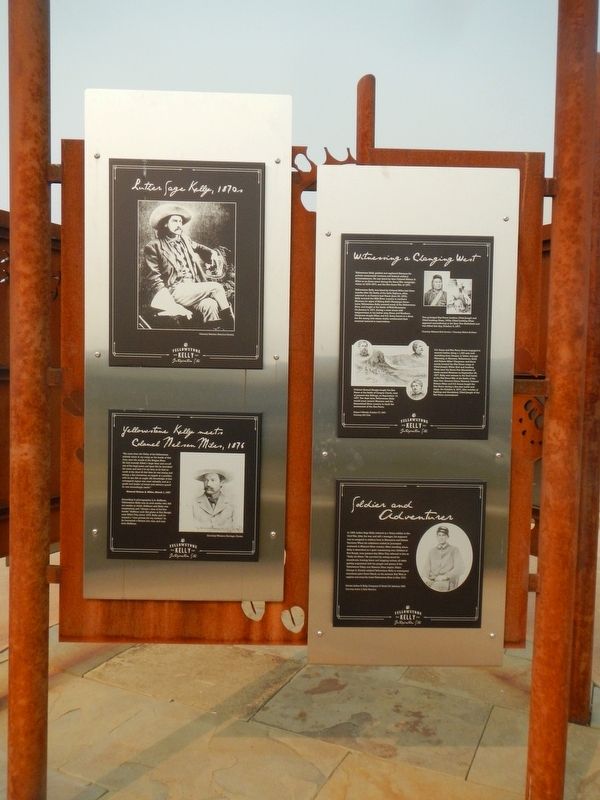
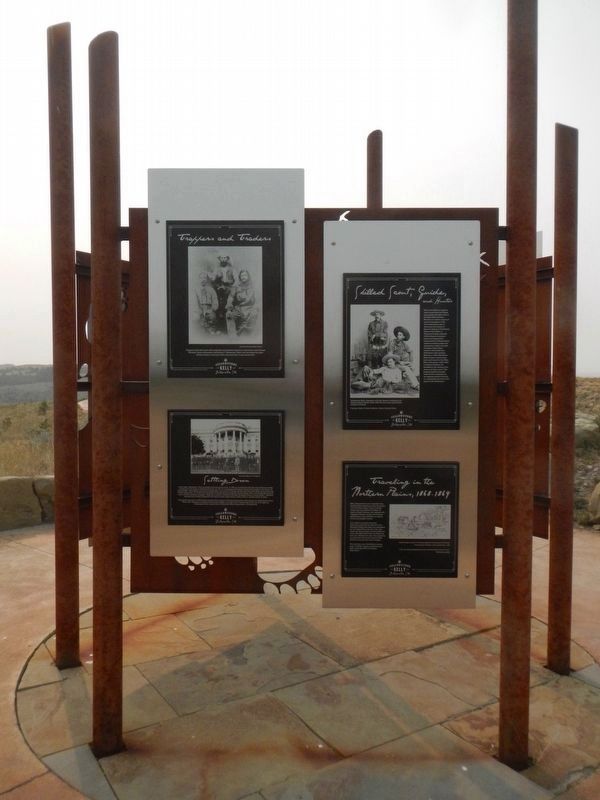
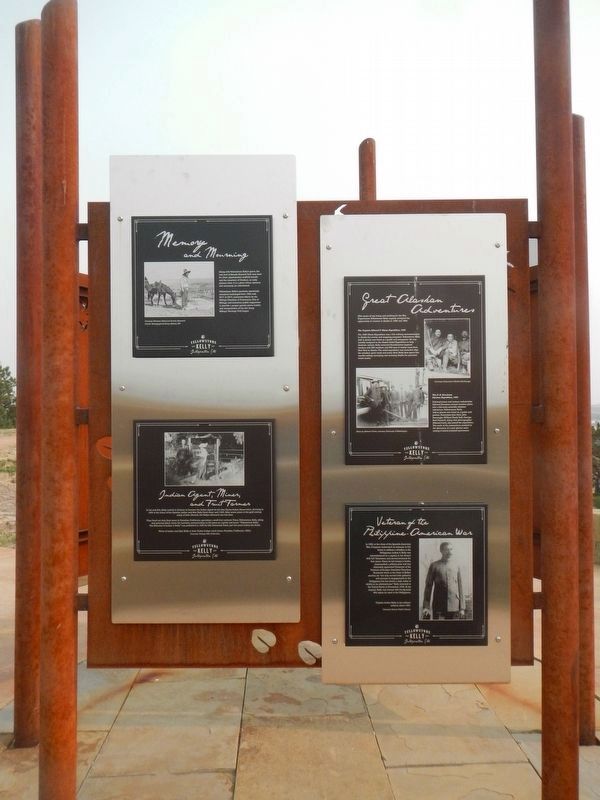
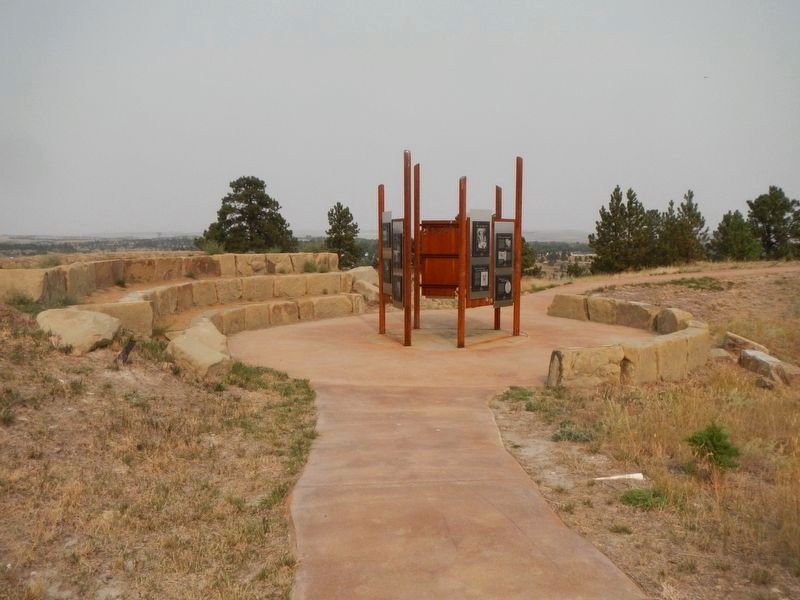
(Twelve panels make-up this marker. The kiosk where this marker is found has three sides. On each side there are four panels. Panels are present clockswise beginning at the upper left.)
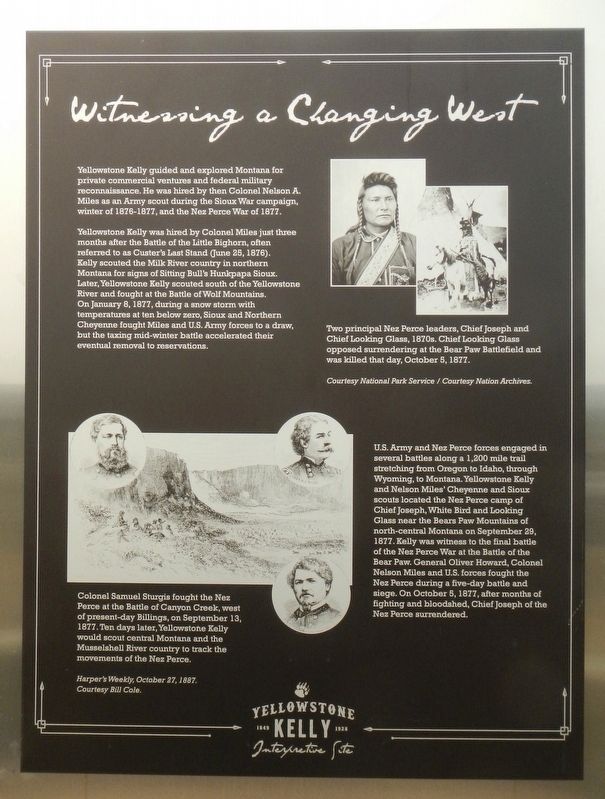
Yellowstone Kelly guided and explored Montana for private commercial ventures and federal military reconnaissance. He was hired by then Colonel Nelson A. Miles as an Army scout during the Sioux War campaign, winter of 1876-1877, and the Nez Perce War of 1877.
Yellowstone Kelly was hired by Colonel Miles just three months after the Battle of the Little Bighorn, often referred to as Custer's Last Stand (June 25, 1876). Kelly scouted the Milk River country in northern Montana for signs of Sitting Bull's Hunkpapa Sioux. Later, Yellowstone Kelly scouted south of the Yellowstone River and fought at the Battle of Wolf Mountains. On January 8, 1877, during a snow storm with temperatures at ten below zero, Sioux and Northern Cheyenne fought Miles and U.S. Army forces to a draw, but the taxing mid-winter battle accelerated their eventual removal to reservations.
U.S. Army
this page online
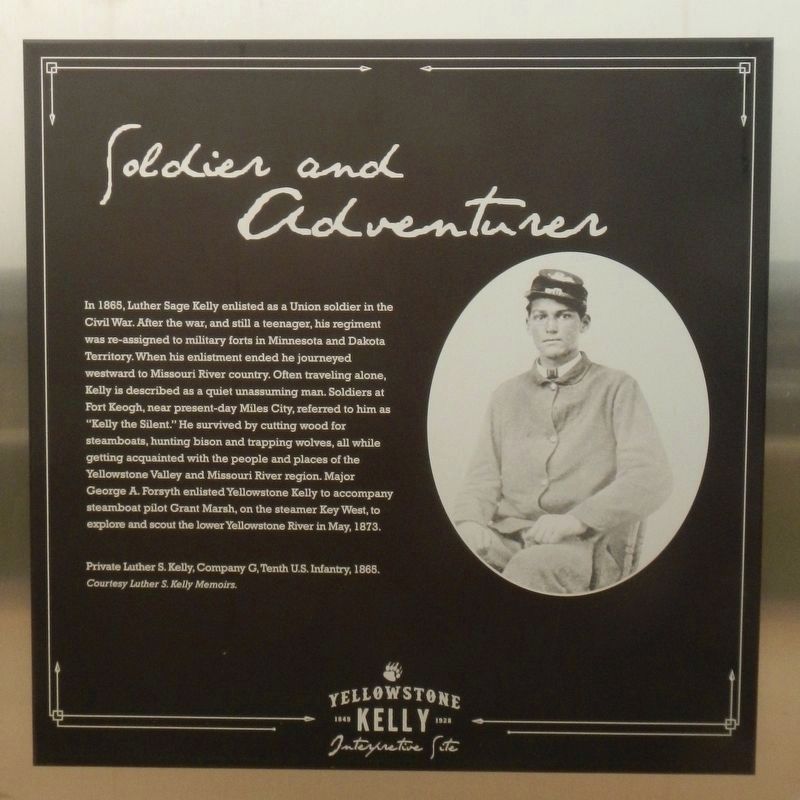
In 1865, Luther Sage Kelly enlisted as a Union soldier in the Civil War. After the war, and still a teenager, his regiment was re-assigned to military forts in Minnesota and Dakota Territory. When his enlistment ended he journeyed westward to Missouri River country. Often traveling alone, Kelly is described as a quiet unassuming man. Soldiers at Fort Keogh, near present-day Miles City, referred to him as "Kelly in Silent." He survived by cutting wood for steamboats, hunting bison and
Photographed by Barry Swackhamer, September 16, 2020
2. Witnessing a Changing West
Captions: (upper right) Two principal Nez Perce leaders, Chief Joseph ad Chief Looking Glass, 1870s. Chief Looking Glass opposed surrendering at the Bear Paw Battlefield and was killed that day, October 5, 1877.; (lower left) Colonel Samuel Sturgis fought the Nez Perce at the Battle of Canyon Creek, west of present-day Billings, on September 13, 1877. Ten days later, Yellowstone Kelly would scout central Montana and the Musselshell River country to track the movement of the Nez Perce. (illustration) Harper's Weekly, October 27, 1887.
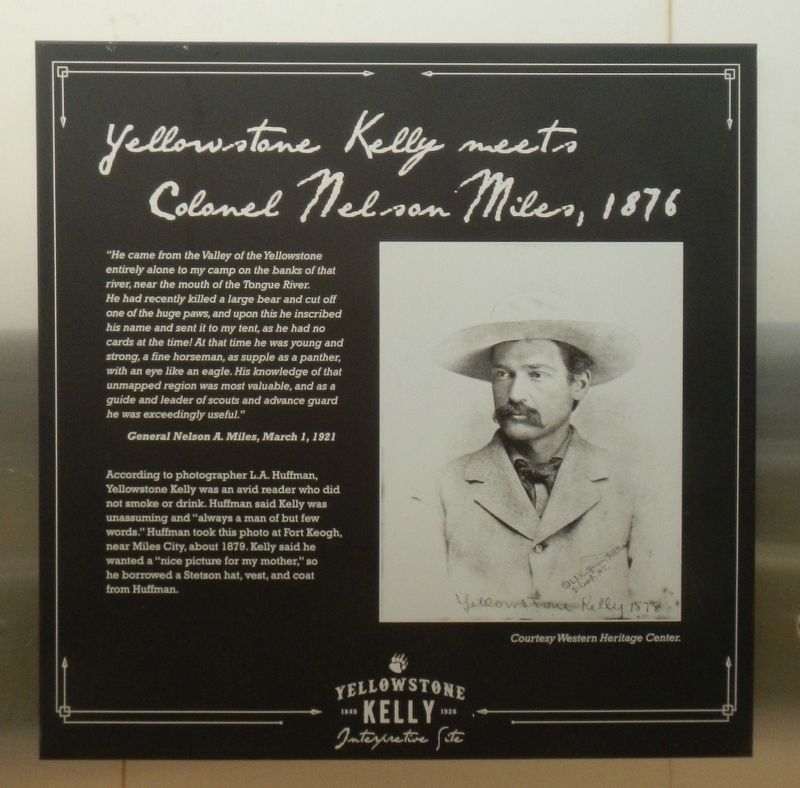
"He came from the Valley of the Yellowstone entirely alone to my camp on the banks of that river, near the mouth of the Tongue River.
He had recently killed a large bear and cut off one of the huge paws, and upon this he inscribed his name and sent it to my tent, as he had no cards at the time! At that time he was young and strong, a fine horseman, as supple as a panther, with an eye like an eagle. His knowledge of that unmapped region was most valuable, and as a guide and leader of scouts and advance guard he was exceedingly useful."
General Nelson A. Miles, March 1, 1921
According to photographer L.A. Huffman, Yellowstone Kelly was an avid reader who did not smoke or drink. Huffman said Kelly was unassuming and "alway a man of but fee words." Huffman took
Photographed by Barry Swackhamer, September 16, 2020
3. Soldier and Adventurer
Caption: Private Luther S. Kelly, Company G, Tenth U.S. Infantry, 1865.
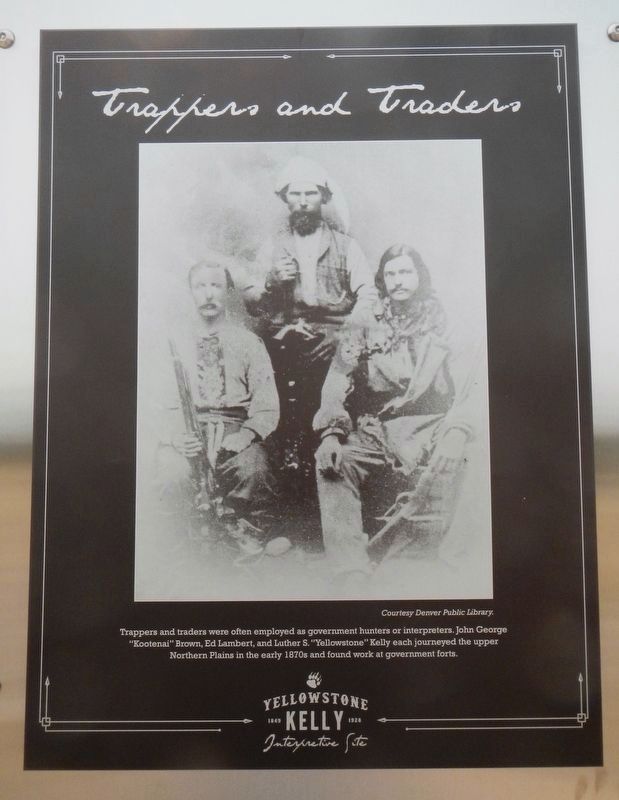
Trappers and traders were often employed as government hunters or interpreters. John George "Kootenai" Brown, Ed Lambert, and Luther S. "Yellowstone" Kelly each journeyed the upper Northern Plains in the early 1870s and found work at government forts.
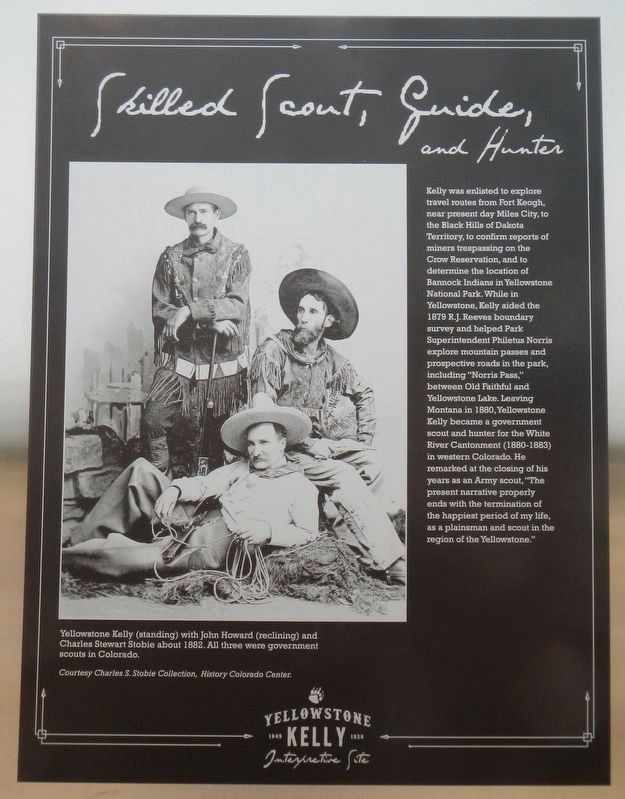
Kelly was enlisted to explore travel routes from Fort Keogh, near present day Miles City, to the Black Hills of Dakota Territory, to confirm reports of miners trespassing on the Crow Reservation, and to determine the location of Bannock Indians in Yellowstone National Park. While in Yellowstone, Kelly aided the 1879 R.J. Reeves boundary survey and helped Park Superintendent Philetus Norris explore mountain passes and prospective roads in the park, including "Norris Pass.' between Old Faithful and Yellowstone Lake. Leaving Montana in 1880, Yellowstone Kelly became a government scout and hunter for the White River Cantonment (1880-1883) in western Colorado.
Photographed by Barry Swackhamer, September 16, 2020
4. Yellowstone Kelly meets Colonel Nelson Miles, 1876
Kelly experienced more hospitality that hostility while traveling among the people of the Northern Plains. Fluent in Plains Indian sign talk, Yellowstone Kelly ate meals, smoked tobacco, and camped with Chippewa, Mandan, Arikara, Gros Ventre, Assiniboine, Crow, and Metis, as well as French and English traders.
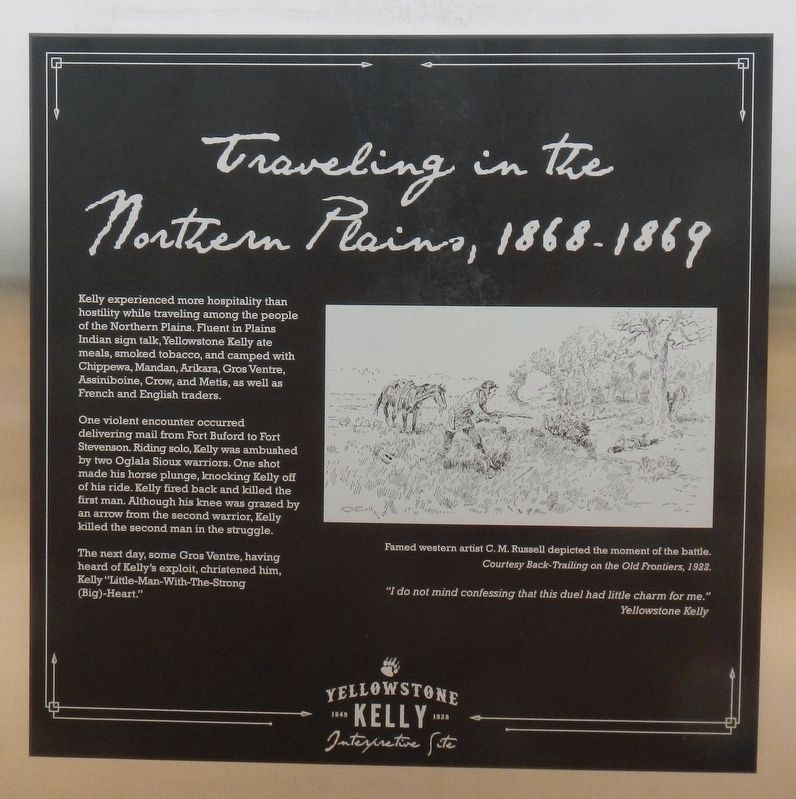
One violent encounter occurred delivering mail from Fort Buford to Fort Stevenson. Riding solo, Kelly was ambushed by two Oglala Sioux warriors. One shot made his horse plunge, knocking Kelley off of his ride. Kelly fired back and killed the first man. Although his knee was grazed by an arrow from the second warrior, Kelly killed the second man in the struggle.
The next day, some Gros Ventre, having heard of Kelly's exploit, christened him, Kelly "Little-Man-With-The-Strong (Big)-Heart."
Luther Sage "Yellowstone" Kelly journeyed back east several
Photographed by Barry Swackhamer, September 16, 2020
5. Luther Sage "Yellowstone" Kelly Marker, side A
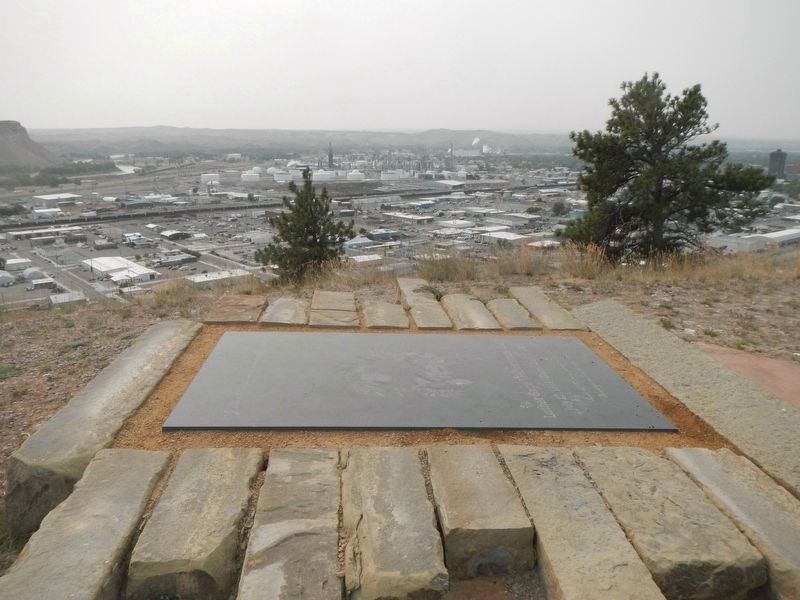
Along with Yellowstone Kelly's grave, the east end of Swords Rimrock Park was used for Crow (Apsáalooke) scaffold burials and the cemetery of Coulson, an early pioneer town. It is a place where memory and mourning are intertwined.
Yellowstone Kelly's gravesite essentially remained unchanged from 1929 until 2017. In 2014, concerted efforts by the Billings Chamber of Commerce, City of Billings, and numerous public supporters to provide
Photographed by Barry Swackhamer, September 16, 2020
6. Trappers and Traders
After years of living and working for the War Department, Yellowstone Kelly eagerly accepted the opportunity to venture to Alaska in 1898 and 1899.
The 1898 Glenn Expedition was a U.S. military reconnaissance to Alaska for survey and mapping purposes. Yellowstone Kelly (left in photo was hired as a guide and interpreter. He was initially assigned to the Alaska Relief Expedition to help destitute miners. Kelly escorted Scandinavian Lapland herders with 539 reindeer and 500 tons of tundra moss from New York to Alaska. The relief expedition was canceled after the reindeer grew week and many died. Kelly then spent four months sailing, surveying and scouting Alaska for potential trade routes.
Railroad baron and eastern industrialist Edward Harriman turned vacation plans into a full-scale scientific Alaskan adventure. Yellowstone Kelly (left in photo) was hired as a guide and packer. Naturalists John
Photographed by Barry Swackhamer, September 16, 2020
7. Skilled Scout, Guide, and Hunter
Caption: Yellowstone Kelly (standing) with John Howard (reclining) and Charles Stewart Stobie about 1882. All three were government scouts in Colorado
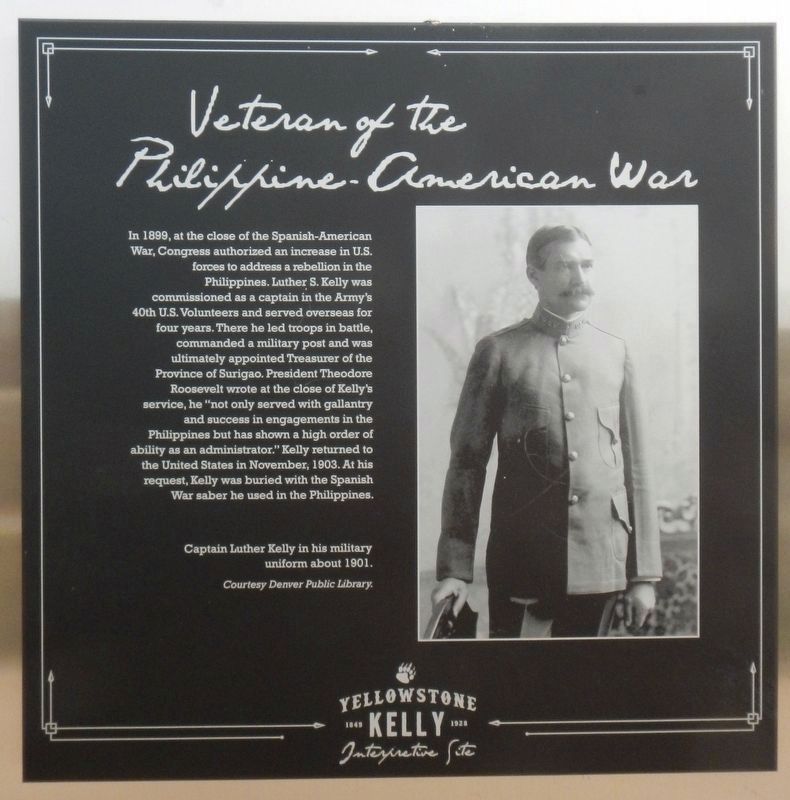
In 1899, at the close of the Spanish-American War, Congress authorized an increase in U.S. forces to address the rebellion in the Philippines. Luther S. Kelly was commissioned as a captain in the Army's 40th U.S. Volunteers and served overseas for four years. There he led troops in battle, commanded a military post and was ultimately appointed Treasurer of the Province of Surigao. President Theodore Roosevelt wrote at the close of Kelly's service, he "not only served with gallantry and success in engagements in the Philippines but also has shown a high order of ability as an administrator." Kelly returned to the United States in November, 1903. At his request, Kelly was buried with the Spanish War saber he used in the Philippines.
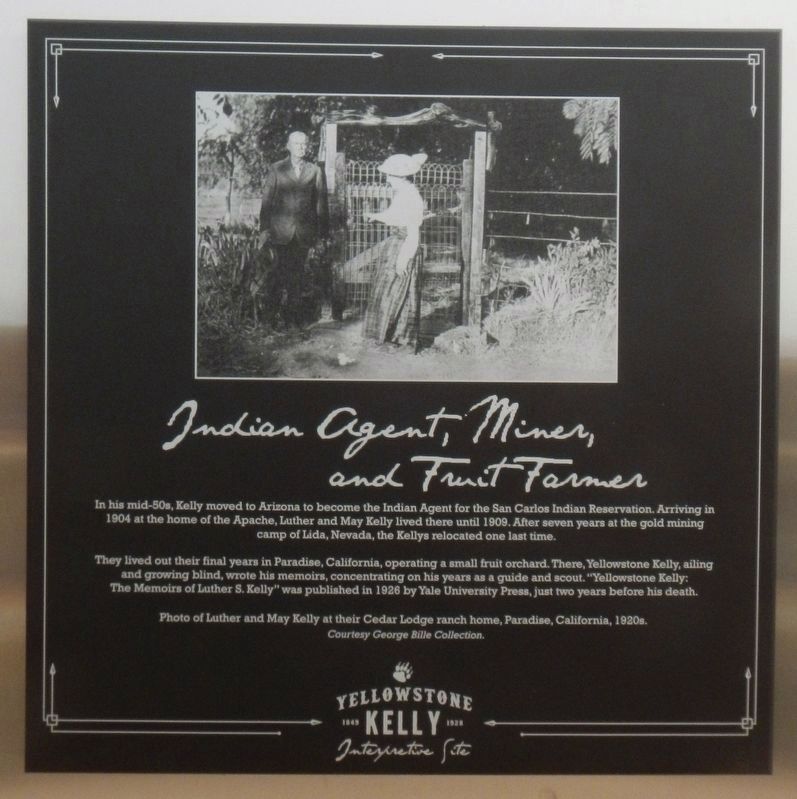
In his mid-50s, Kelly moved to Arizona to become the Indian Agent
Photographed by Barry Swackhamer, September 16, 2020
8. Traveling in the Northern Plains, 1868-1869
Caption: Famed western artist C.M. Russell depicted the moment of the battle. "I do not mind confessing that this duel had little charm for me." Yellowstone Kelly.
They lived out their final years in Paradise, California, operating a small fruit orchard. There Yellowstone Kelly, ailing and growing blind, wrote his memoirs, concentrating on his years as a guide and scout. "Yellowstone Kelly: The Memoirs of Luther S. Kelly" was published in 1926 by Yale University, just two years before his death.
Erected by Yellowstone Kelly Interpretive Site.
Topics. This historical marker is listed in these topic lists: Cemeteries & Burial Sites • Exploration • War, Spanish-American • Wars, US Indian.
Location. 45° 47.893′ N, 108° 29.328′ W. Marker is in Billings, Montana, in Yellowstone County. It is in North Park. It is on Chief Black Otter Trail near Rimtop Drive, on the right when traveling south. The marker is located at the Yellowstone Kelly Interpretive Site in Swords Rimrock Park. Touch for map. Marker is in
Photographed by Barry Swackhamer, September 16, 2020
9. Settling Down
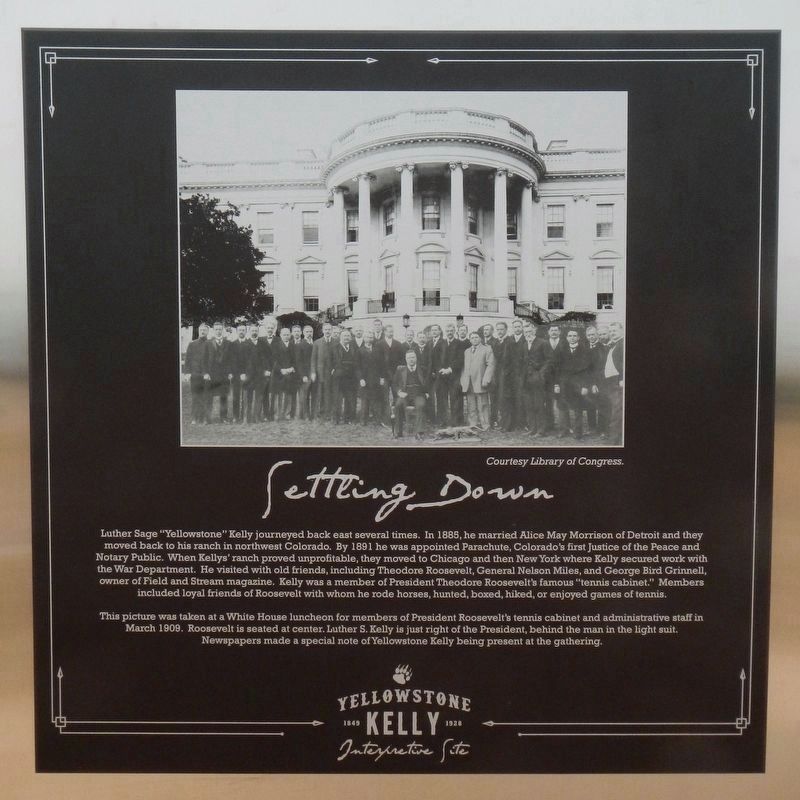
Caption: This picture was taken at a White House luncheon for members of President Roosevelt's tennis cabinet and administrative staff in March 1909. Roosevelt is seated at center. Luther S. Kelly is just right of the President, behind the main the light suit. Newspapers made a special note of Yellowstone Kelly being present at the gathering.

Regionally, this marker is in Yellowstone Country. It is also in the American Mountain West and in the Lewis & Clark Corridor. Globally, it is in North America, the Western Hemisphere, the Western World, and the Anglosphere. Historically, it finds itself in what was once Rupert’s Land and also the Louisiana Purchase.
Other nearby markers. At least 8 other markers are within walking distance of this marker: Yellowstone Kelly's Grave (a few steps from this marker); Surely this spot was meant for Yellowstone Kelley (a few steps from this marker); Who was Luther Sage "Yellowstone" Kelly? (within shouting distance of this marker); The Nomadic Experience (within shouting distance of this marker); Where the River Meets the Rims (about 300 feet away, measured in a direct line); Enjoying Our Parks (approx. 0.2 miles away); Skeleton Cliff (approx. ¼ mile away); Boothill Cemetery (approx. half a mile away). Touch for a list and map of all markers in Billings.
Photographed by Barry Swackhamer, September 16, 2020
10. Luther Sage "Yellowstone" Kelly Marker, side B

Photographed by Barry Swackhamer, September 16, 2020
11. Memory and Mourning

Photographed by Barry Swackhamer, September 16, 2020
12. Great Alaskan Adventures
Photographed by Barry Swackhamer, September 16, 2020
13. Veteran of the Philippine-American War
Caption: Captain Luther Kelly in his military uniform about 1901.
Photographed by Barry Swackhamer, September 16, 2020
14. Indian Agent, Miner, and Fruit Farmer
Caption: Photo of Luther and May Kelly at their Cedar Lodge ranch home, Paradise, California, 1920s.
Photographed by Barry Swackhamer, September 16, 2020
15. Luther Sage "Yellowstone" Kelly Marker, side C
Photographed by Barry Swackhamer, September 16, 2020
16. Luther Sage "Yellowstone" Kelly Marker
Photographed by Barry Swackhamer, September 16, 2020
17. The grave of Luther Sage "Yellowstone" Kelly
Credits. This page was last revised on February 16, 2023. It was originally submitted on February 24, 2021, by Barry Swackhamer of Brentwood, California. This page has been viewed 1,752 times since then and 206 times this year. Photos: 1, 2, 3, 4, 5, 6, 7, 8, 9, 10, 11, 12, 13, 14, 15, 16, 17. submitted on February 24, 2021, by Barry Swackhamer of Brentwood, California.
