Near Winchester in Frederick County, Virginia — The American South (Mid-Atlantic)
The Third Battle of Winchester
Thoburn's Attack
Photographed by Craig Swain, March 15, 2008
1. The Third Battle of Winchester Marker
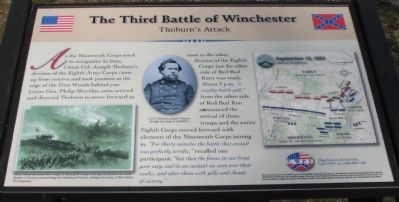
As the Nineteenth Corps tried to reorganize its lines, Union Col. Joseph Thoburn's division of the Eighth Army Corps came up from reserve and took position at the edge of the First Woods behind you. Union Gen. Philip Sheridan soon arrived and directed Thoburn to move forward as soon as the other division of the Eighth Corps (on the other side of Red Bud Run) was ready. About 3 p.m. "a mighty battle yell," from the other side of Red Bud Run announced the arrival of those troops and the entire Eighth Corps moved forward with elements of the Nineteenth Corps joining in. "For thirty minutes the battle that ensued was perfectly terrific," recalled one participant, "but then the forces in our front gave way, and in an instant we were over their works, and after them with yells and shouts of victory."
Erected 2008 by Civil War Preservation Trust.
Topics. This historical marker is listed in this topic list: War, US Civil.
Location. Marker has been reported permanently removed. It was located near 39° 11.907′ N, 78° 7.533′ W. Marker was near Winchester, Virginia, in Frederick
this page online
We have been informed that this marker is no longer there and will not be replaced. This page is an archival view of what was.
Regionally, this marker was in the Shenandoah Valley. It was also in the American South, specifically in the Upper South, and in the Mid-Atlantic. Globally, it was in North America, the Western Hemisphere, the Western World, and the Anglosphere. Historically, it found itself in what was once the territory of the Mississippian Culture, one of the original Thirteen Colonies, one of the Confederate States of America, and the Antebellum South.

Other nearby markers. At least 8 other markers are within walking distance of this location: A Perfect Sheet Of Lead (a few steps from this marker); The Middle Field
Photographed by Craig Swain, March 15, 2008
2. Thoburn Attacks Wayside
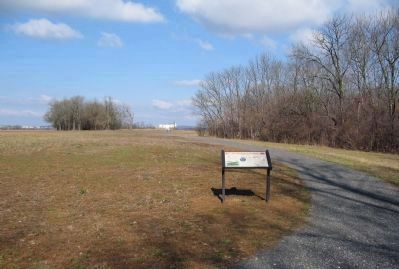
The large white building in the background is roughly northwest from the marker location. Hackwood stands in the same direction, but is just out of view below the ridge lines. Thoburn's attack was along that axis directed against the Confederate left.
Other markers no longer nearby. The Third Battle of Winchester (was about 300 feet away, measured in a direct line but has been permanently removed); a different marker also named The Third Battle of Winchester (was about 400 feet away but has been permanently removed); a different marker also named The Third Battle of Winchester (was about 500 feet away but has been permanently removed).
More about this marker. On the lower left of the marker is a drawing captioned, Alfred Waud sketched this image of the Eighth Corps moving into position to attack Gordon's Division surrounding the Hackwood House. (Image courtesy of the Library of Congres.). In the center is a portrait of Colonel Joseph Thoburn, courtesy of USAMHI.) On the right is a battle map depicting the tactical situation described in
Photographed by Craig Swain, March 15, 2008
3. Confederate View of Thoburn's Attack
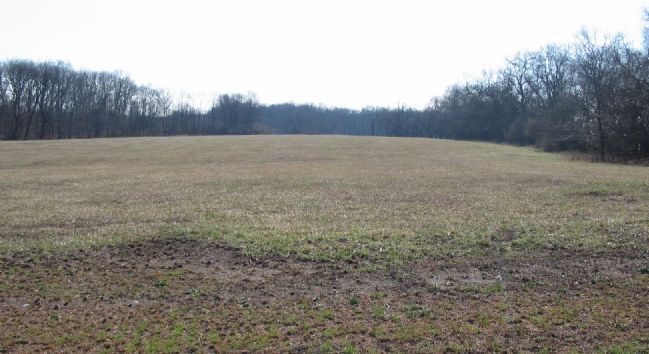
From near the Confederate Defense wayside, looking back towards Thoburn's Attack marker.
Also see . . . Summary of the Battle of Third Winchester. The action described on the marker is covered under phase 8 of this National Parks Service summary. (Submitted on March 16, 2008, by Craig Swain of Leesburg, Virginia.)
Photographed by Craig Swain
4. Blank Marker
A view of the wayside before the marker was placed.
Credits. This page was last revised on September 30, 2022. It was originally submitted on March 16, 2008, by Craig Swain of Leesburg, Virginia. This page has been viewed 3,569 times since then and 21 times this year. Last updated on February 26, 2021, by Bradley Owen of Morgantown, West Virginia. Photos: 1, 2, 3. submitted on March 16, 2008, by Craig Swain of Leesburg, Virginia. 4. submitted on October 27, 2007, by Craig Swain of Leesburg, Virginia. • Bill Pfingsten was the editor who published this page.
