Air Cushion Vehicle, SK-5

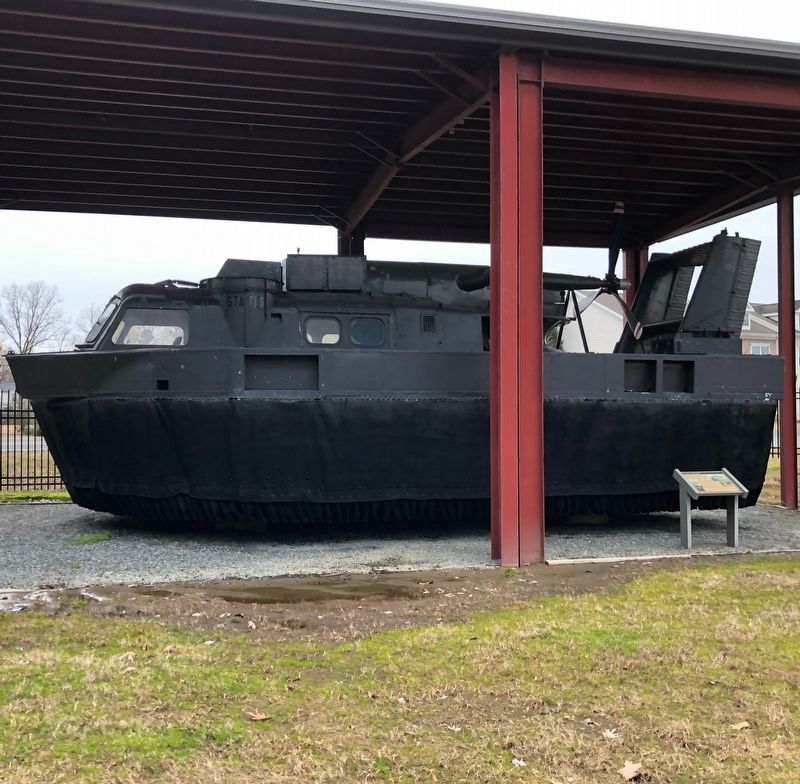
The Air-Cushion Vehicle (ACV) was developed by Bell Aerosystems in the late 1950s. Its ability to move over land and water soon caught the attention of both the Navy and the Army. The first military use of this vehicle was by the Navy and was known as the PACV (Patrol, Air Cushion Vehicle). The PACV first saw use in Vietnam in 1966. A version for the Army came out a short time later. The Army wanted stronger side decks and the front door to be widened to accommodate troops with gear. These changes would result in the Army's version, the SK-5, not arriving in Vietnam until May 1968.
The Army ACV unit deployed to Dong Tam, Vietnam with only three vehicles (901, 902, 903). Two of the vehicles were configured for assault missions with the third to only be transport. The missions for the ACV were many and varied to include training, supply, patrol, reconnaissance, assault, and ambush.
From its inception the unit had difficulties that few others in Vietnam face. As a small (only twenty four men), experimental unit, they had to train their own replacements. One craft had to be set aside for fourteen days every month to
this page online
The SK-5 would see service in Vietnam for only two years. One vehicle was destroyed in January 1970 and a second one was destroyed in August of that same year. In the fall of 1970, the third (No. 903) was shipped back to the United States and is displayed here.
Erected by US Army Transportation Museum.
Topics. This historical marker is listed in these topic lists: Roads & Vehicles • War, Vietnam • Waterways & Vessels. A significant historical month for this entry is January 1970.
Location. 37° 9.999′ N, 76° 34.436′ W. Marker is in Newport News, Virginia. It is in Fort Eustis. It can be reached from Washington Boulevard just south of Madison Avenue, on the right when traveling north. Touch for map. Marker is at or near this postal address: 300 Washington Blvd, Fort Eustis VA 23604, United States of America.

Regionally, this marker is on Virginia’s Peninsula, in Hampton Roads, in Coastal Virginia, and in the Hampton Roads Metropolitan Area. It is also in the American South, specifically in the Upper South, in the Tidewater, and on the Eastern Seaboard. Globally, it is in the North Atlantic Region, North America, the Western Hemisphere, the Western World, and the Anglosphere. Historically, it finds itself in what was once the territory of the Mississippian Culture, one of the original Thirteen Colonies, one of the Confederate States of America, and the Antebellum South.
Other nearby markers. At least 8 other markers are within walking distance of this marker: M1000, Semitrailer, 70 Ton (HET) (a few steps from this marker); Caiman, Mine Resistant Ambush Protected (MRAP), Category II, 6×6 (a few steps from this marker); M872A1, Trailer, Flatbed, 34 Ton (a few steps from this marker); M915A4, Truck, Tractor, 14 Ton, 6×4 (Up-Armored) (within shouting distance of this marker); M1070, Truck, Tractor, 8×8 (HET) (within shouting distance of this marker); M60A3, Main Battle Tank, 105mm "Patton" (within shouting distance of this marker); M747, Semitrailer, Heavy Equipment, 60 Tons (within shouting distance of this marker); Railway Training Caboose (within shouting distance of this marker). Touch for a list and map of all markers in Newport News.
Additional commentary.
1. Marker location
This marker is on the grounds of Fort Eustis. Permission was requested before photographing.
Credits. This page was last revised on February 1, 2023. It was originally submitted on February 27, 2021, by Devry Becker Jones of Washington, District of Columbia. This page has been viewed 631 times since then and 61 times this year. Photos: 1, 2. submitted on February 27, 2021, by Devry Becker Jones of Washington, District of Columbia.
