Triangle in Prince William County, Virginia — The American South (Mid-Atlantic)
Almost Extinct
Prince William Forest Park
| — | National Park Service, U.S. Department of the Interior | — |
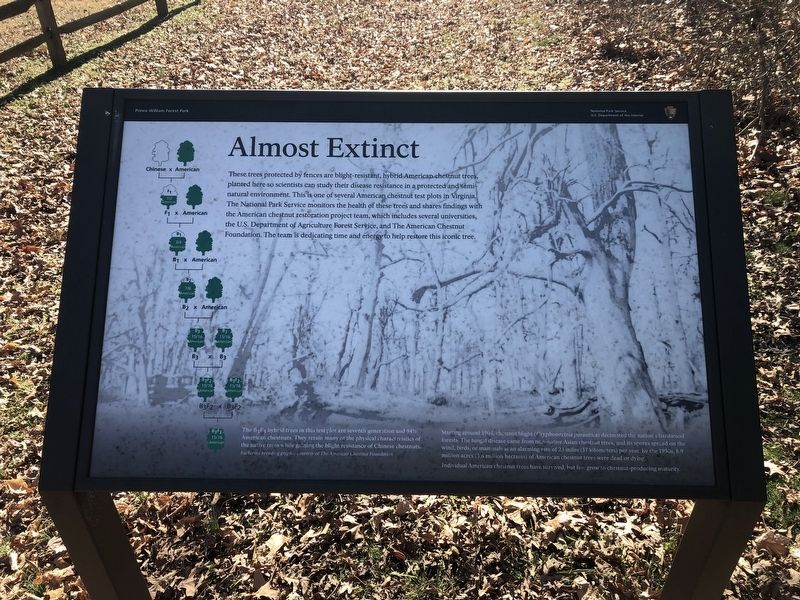
These trees protected by fences are blight-resistant, hybrid American chestnut trees, planted here so scientists can study their disease resistance in a protected and semi-natural environment. This is one of several American chestnut test plots in Virginia. The National Park Service monitors the health of these trees and shares findings with the American chestnut restoration project team, which includes several universities, the U.S. Department of Agriculture Forest Service, and The American Chestnut Foundation. The team is dedicating time and energy to help restore this iconic tree.
[Captions:]
The B3F3 hybrid trees in this test plot are seventh generation and 94% American chestnuts. They retain many of the physical characteristics of the native trees while gaining the blight resistance of Chinese chestnuts.
Starting around 1904, chestnut blight (Cryphonectria parasitica) decimated the nation's hardwood forests. The fungal disease came from non-native Asian chestnut trees, and its spores spread on the wind, birds, or mammals at an alarming rate of 23 miles (37 kilometers) per year. By the 1950s, 8.9 million acres (3.6 million hectares) of American chestnut trees were dead or dying.
Individual American chestnut trees have survived, but few grow to chestnut-producing maturity.
Erected by National
this page online
Topics. This historical marker is listed in these topic lists: Environment • Horticulture & Forestry • Parks & Recreational Areas • Science & Medicine. A significant historical year for this entry is 1904.
Location. 38° 33.547′ N, 77° 20.923′ W. Marker is in Triangle, Virginia, in Prince William County. It is on Park Entrance Road just north of Scenic Drive, on the right when traveling south. Touch for map. Marker is at or near this postal address: 18175 Park Entrance Rd, Triangle VA 22172, United States of America. Touch for directions.

Regionally, this marker is in the Washington Metropolitan Area, in Northern Virginia, and in the Piedmont. It is also in the American South, specifically in the Upper South, in the Mid-Atlantic, and on the Eastern Seaboard. Globally, it is in the North Atlantic Region, North America, the Western Hemisphere, the Western World, and the Anglosphere. Historically, it finds itself in what was once the territory of the Mississippian Culture, one of the original Thirteen Colonies, one of the Confederate States of America, and the
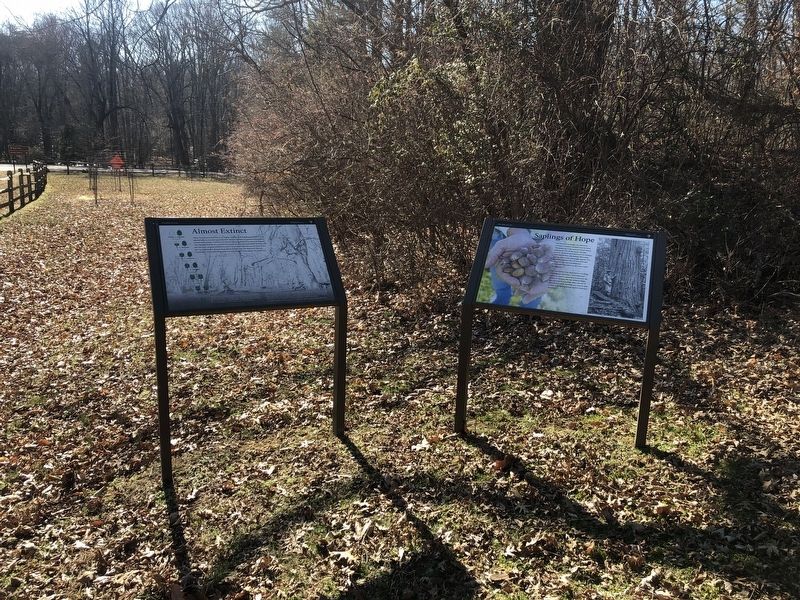
Other nearby markers. At least 8 other markers are within walking distance of this marker: Saplings of Hope (here, next to this marker); Flowering Dogwood (about 400 feet away, measured in a direct line); Piedmont Forest Trail (about 400 feet away); Eastern Red Cedar (about 500 feet away); Historic Preservation and Maintenance (about 500 feet away); Black Gum (about 500 feet away); A Tradition of Conservation (about 500 feet away); Chestnut Oak (about 700 feet away). Touch for a list and map of all markers in Triangle.
Credits. This page was last revised on March 7, 2021. It was originally submitted on March 7, 2021, by Devry Becker Jones of Washington, District of Columbia. This page has been viewed 267 times since then and 24 times this year. Photos: 1, 2. submitted on March 7, 2021, by Devry Becker Jones of Washington, District of Columbia.
