Near Chickamauga in Walker County, Georgia — The American South (South Atlantic)
Owing's Ford and Childress Plantation
Chickamauga Campaign Heritage Trail
Photographed by Duane and Tracy Marsteller, March 6, 2021
1. Owing's Ford and Childress Plantation Marker
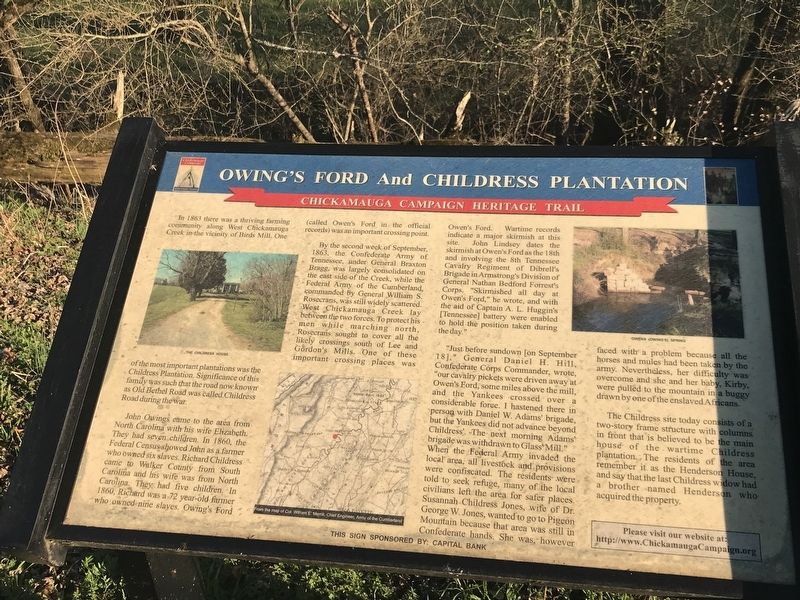
John Owings came to the area from North Carolina with his wife Elizabeth. They had seven children. In 1860, the Federal Census showed John as a farmer who owned six slaves. Richard Childress came to Walker County from South Carolina and his wife was from North Carolina. They had five children. In 1860, Richard was a 72 year-old farmer who owned nine slaves. Owing's Ford (called Owen's Ford in the official records) was an important crossing point.
By the second week of September, 1863, the Confederate Army of Tennessee, under General Braxton Bragg, was largely consolidated on the east side of the Creek, while the Federal Army of the Cumberland, commanded by General William S. Rosecrans, was still widely scattered. West Chickamauga Creek lay between the two forces. To protect his men while marching north, Rosecrans
this page online
"Just before sundown [on September 18]," General Daniel H. Hill, Confederate Corps Commander, wrote, "our cavalry pickets were driven away at Owen's Ford, some miles above the mill, and the Yankees crossed over a considerable force. I hastened there in person with Daniel W. Adams' brigade, but the Yankees did not advance beyond Childress'. The next morning Adams' brigade was withdrawn to Glass' Mill." When the Federal Army invaded the local area, all livestock and provisions were confiscated. The residents were told to seek refuge, many of the local civilians left
Photographed by Duane and Tracy Marsteller, March 6, 2021
2. Owing's Ford and Childress Plantation Marker
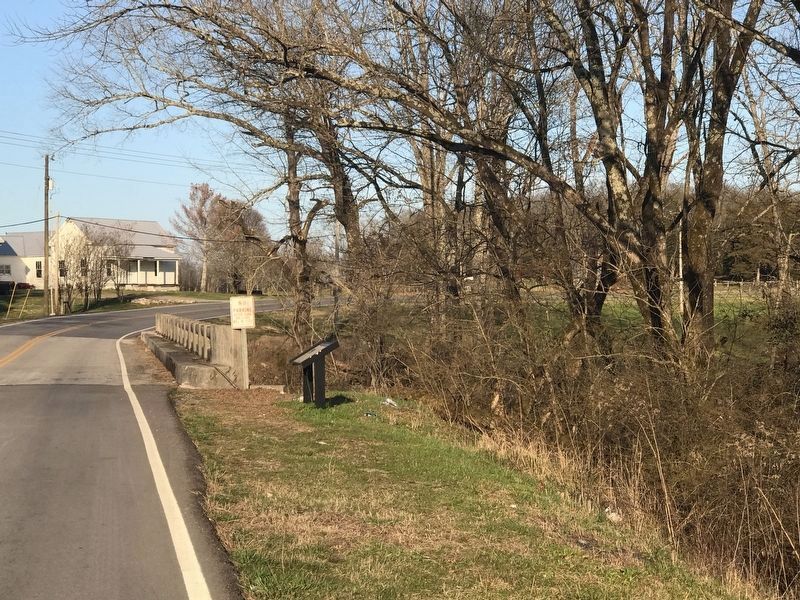
Looking west. Owens (Owing's) Spring in background.
The Childress site today consists of a two-story frame structure with columns in front that is believed to be the main house of the wartime Childress plantation. The residents of the area remember it as the Henderson House, and say that the last Childress widow had a brother named Henderson who acquired the property.
Captions (left to right):
• The Childress House
• From the map of Col. William E. Merrill, Chief Engineer, Army of the Cumberland
• Owens (Owing's) Spring
Erected by Chickamauga Campaign Heritage Trail; Sponsored by Capital Bank.
Topics and series. This historical marker is listed in these topic lists: African Americans • War, US Civil • Waterways & Vessels. In addition, it is included in the Chickamauga Campaign Heritage Trail series list. A significant historical month for this entry is September 1863.
Location. 34° 49.974′ N, 85° 19.002′ W. Marker is near Chickamauga, Georgia, in Walker County. It is on Old Bethel Road 0.2 miles east of Cove Road (Georgia Route 341), on the right when traveling east. Touch for map. Marker is in this post office area: Chickamauga GA 30707, United States of America. Touch for directions.

Regionally, this marker is in the Mountains. It is also in the American South, specifically in the Deep South, in Appalachia, and specifically in Southern Appalachia. Globally, it is in North America, the Western Hemisphere, the Western World, and the Anglosphere. Historically, it finds itself in what was once the original Cherokee Nation, the territory of the Mississippian Culture, one of the original Thirteen Colonies, one of the Confederate States of America, and the Antebellum South.
Other nearby markers. At least 8 other markers are within 3 miles of this marker, measured as the crow flies: Bethel Church (approx. ¾ mile away); Veterans Memorial (approx. ¾ mile away); Bird's Mill and Worthens' Gap (approx. ¾ mile away); Chickamauga Prince Hall Lodge No. 221 (approx. 1.8 miles away); Glass's Mill Battle Site (approx. 2.8 miles away); a different marker also named Glass's Mill Battle Site (approx. 2.8 miles away); Cavalry Corps. (approx. 2.9 miles away); Wheeler's Cavalry Corps (approx. 2.9 miles away). Touch for a list and map of all markers in Chickamauga.
Other markers no longer nearby. Gowan’s (Gower’s) Ford And Widow Glenn’s Grave (was approx. 1.2 miles away but has been confirmed missing); J. Beatty's Brigade (was approx. 2.3 miles away but has been confirmed missing); Negley's Division (was approx. 2.3 miles away but has been confirmed missing); Helm's Brigade (was approx. 2.8 miles away but has been confirmed missing).
Credits. This page was last revised on April 4, 2021. It was originally submitted on March 9, 2021, by Duane and Tracy Marsteller of Murfreesboro, Tennessee. This page has been viewed 1,150 times since then and 137 times this year. Photos: 1, 2. submitted on March 9, 2021, by Duane and Tracy Marsteller of Murfreesboro, Tennessee.
