Jekyll Island in Glynn County, Georgia — The American South (South Atlantic)
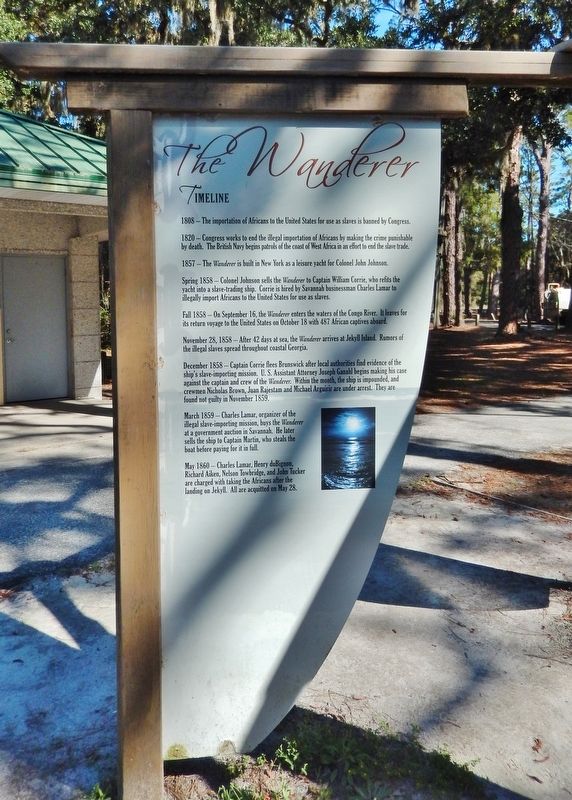
The Wanderer — Timeline

Photographed by Cosmos Mariner, March 10, 2021
1. The Wanderer — Timeline Marker
1808 — The importation of Africans to the United States for use as slaves is banned by Congress.
1820 — Congress works to end the illegal importation of Africans by making the crime punishable by death. The British Navy begins patrols of the coast of West Africa in an effort to end the slave trade.
1857 — The Wanderer is built in New York as a leisure yacht for Colonel John Johnson.
Spring 1858 — Colonel Johnson sells the Wanderer to Captain William Corrie, who refits the yacht into a slave-trading ship. Corrie is hired by Savannah businessman Charles Lamar to illegally import Africans to the United States for use as slaves.
Fall 1858 — On September 16, the Wanderer enters the waters of the Congo River. It leaves for its return voyage to the United States on October 18 with 487 African captives aboard.
November 28, 1858 — After 42 days at sea, the Wanderer arrives at Jekyll Island. Rumors of the illegal slaves spread throughout coastal Georgia.
December 1858 — Captain Corrie flees Brunswick after local authorities find evidence of the ship's slave-importing mission. U. S. Assistant Attorney Joseph Ganahl begins making his case
this page online
March 1859 — Charles Lamar, organizer of the illegal slave-importing mission, buys the Wanderer at a government auction in Savannah. He later sells the ship to Captain Martin, who steals the boat before paying for it in full.
May 1860 — Charles Lamar, Henry duBignon, Richard Aiken, Nelson Towbridge, and John Tucker are charged with taking the Africans after the landing on Jekyll. All are acquitted on May 28.
Erected by State of Georgia.
Topics. This historical marker is listed in these topic lists: African Americans • Industry & Commerce • Law Enforcement • Waterways & Vessels. A significant historical year for this entry is 1857.
Location. 31° 1.286′ N, 81° 26.041′ W. Marker is on Jekyll Island, Georgia, in Glynn County. It can be reached from Beach View Drive 0.1 miles north of South Riverview Drive. Marker is located in The Wanderer interpretive kiosk, just north of the parking lot at St. Andrews Beach Park.
Photographed by Cosmos Mariner, March 10, 2021
2. The Wanderer — Timeline Marker

Regionally, this marker is on the Coastal Plain, on the Georgia Coast and the Golden Isles, and on the Sea Islands. It is also in the American South, specifically in the Deep South, and on the Eastern Seaboard. Globally, it is in the North Atlantic Region, North America, the Western Hemisphere, the Western World, and the Anglosphere. Historically, it finds itself in what was once New Spain, the territory of the Mississippian Culture, one of the original Thirteen Colonies, one of the Confederate States of America, and the Antebellum South.
Other nearby markers. At least 8 other markers are within walking distance of this marker: The Wanderer — Timeline: Continued (here, next to this marker); The Wanderer — Cilucangy: Ward Lee (here, next to this marker); The Wanderer — What Happened to the Survivors: Their Stories (here, next to this marker); The Wanderer — Built For Speed (here, next to this marker); The Wanderer — Arrival (here, next to this marker); Wanderer Memory Trail

Photographed by Cosmos Mariner, March 10, 2021
3. The Wanderer Interpretive Kiosk
Related markers. Click here for a list of markers that are related to this marker. Wanderer Memory Trail
Also see . . . The Wanderer. New Georgia Encyclopedia website entry:
Captain William Corrie oversaw the ship's transformation from luxury yacht to rudimentary slave transport in New York. One of the last alterations he requested was storage, with the capacity to hold 15,000 gallons of drinking water. Some observers were suspicious that this and other modifications indicated that the vessel would be used to smuggle enslaved people. Despite the rumors and red flags, however, the Wanderer managed to pass all inspections and was subsequently cleared for its voyage. (Submitted on March 12, 2021, by Cosmos Mariner of Cape Canaveral, Florida.)
Additional keywords. The Wanderer — Timeline
Credits. This page was last revised on April 6, 2024. It was originally submitted on March 12, 2021, by Cosmos Mariner of Cape Canaveral, Florida. This page has been viewed 518 times since then and 47 times this year. Photos: 1, 2, 3. submitted on March 12, 2021, by Cosmos Mariner of Cape Canaveral, Florida.
