Jefferson City in Callaway County, Missouri — The American Midwest (Upper Plains)
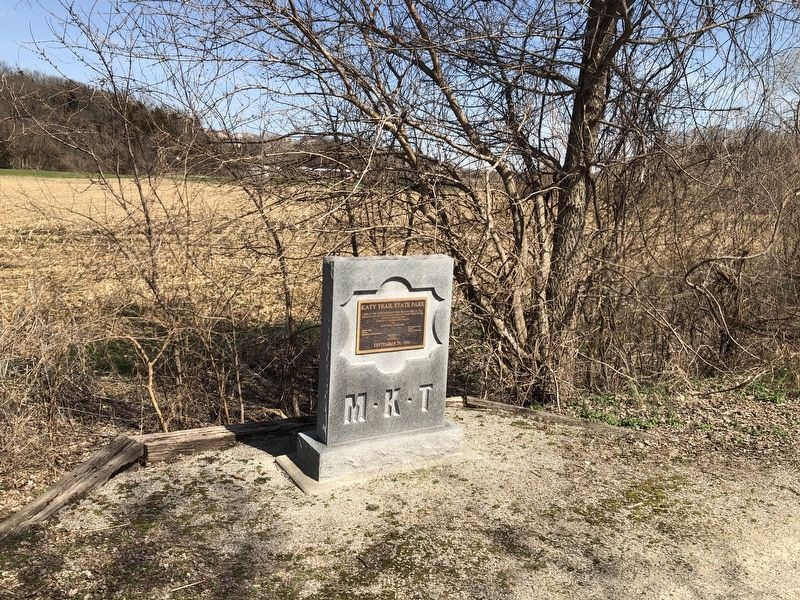
Katy Trail State Park
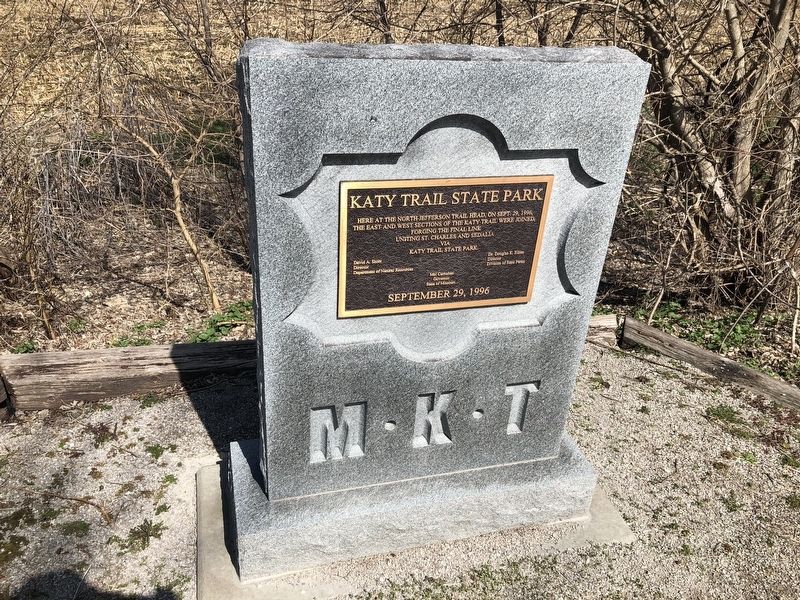
Erected 1996 by Missouri Department of Natural Resources.
Topics and series. This historical marker is listed in these topic lists: Parks & Recreational Areas • Railroads & Streetcars • Roads & Vehicles. In addition, it is included in the Katy Trail State Park series list. A significant historical date for this entry is September 29, 1996.
Location. 38° 36.364′ N, 92° 9.751′ W. Marker is in Jefferson City, Missouri, in Callaway County. It is on Katy Road 0.9 miles north of Oilwell Road, on the right when traveling north. Touch for map. Marker is in this post office area: Holts Summit MO 65043, United States of America. Touch for directions.

Regionally, this marker is in Little Dixie and in the Missouri River Corridor. It is also in the American Midwest, in the Lewis & Clark Corridor, and in the Corn Belt. Globally, it
this page online
Other nearby markers. At least 8 other markers are within walking distance of this marker: The Great Flood of 1993 (a few steps from this marker); Lewis and Clark in Missouri (a few steps from this marker); Missouri State Parks (a few steps from this marker); N. Jefferson to Hartsburg (a few steps from this marker); Jefferson City & Fulton Points of Interest (within shouting distance of this marker); N. Jefferson to Tebbetts (within shouting distance of this marker); History of Jefferson City Area (within shouting distance of this marker); Bicentennial Monument (within shouting distance of this marker). Touch for a list and map of all markers in Jefferson City.
Additional commentary.
1. North Jefferson History
In 1871, David Kennedy effected a name change for a village across the Missouri River from
Cedar City was the terminus of that spur line, and business was such that two trains daily were required to accommodate commerce and passenger service on the line. Each morning one train would originate at Mexico and the other at Cedar City. They would complete their transit in the morning and then both would make the return trip to their respective starting points in the afternoon.
Shortly after the construction of a depot at Cedar City, a partial roundhouse was built to turn the engine around for the return trip. It required the muscle power of local residents to effect the turn. When the whistle blew a certain signal, available residents of the town would appear to provide the manpower. The C&A Rail Company enjoyed a prospering business of commercial freight

Photographed by Wayne Johnson
3. Historic Atlas Image Displaying North Jefferson Area
Callaway County, Missouri Historic Atlas, 1919 Township 44N Range 11W
That stable, profitable business changed rapidly in 1895 and 1896 with the completion of the Missouri, Kansas and Texas Railroad passing north of Cedar City in 1895, and then the completion of the bridge crossing the Missouri River at Jefferson City in 1896. With the combination of the new bridge and railroad, commerce through Cedar City — mostly to Jefferson City — increased immensely.
To handle the loading and unloading of shipments and passengers, it was necessary to create a new rail stop on the MK&T line approximately one mile north of Cedar City. The rail stop was located in SW SE SE Section 04, Township 44N, Range 11W, on the lands of J. and M. L. Irvine, and it was named North Jefferson. Little is known about the original North Jefferson, but the 1897 Historic Atlas map definitively shows a depot at that location, and it is presumed that facilities
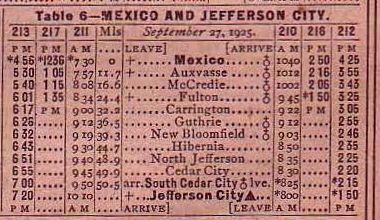
The Official Guide of the Railways, December 1925
4. Chicago and Alton Timetable No. 6, December 1925
As described in Commentary No. 1, this timetable shows two trains in each direction between Mexico and South Cedar City each day. It promises a 20 minute transfer to Jefferson City. That black triangle leads to a footnote that reads “Connections are made at South Cedar City with Electric Line to and from Jefferson City.” Read the table down on the left side and up on the right side.
The spur line from the KATY line at North Jefferson was a smaller gauge rail line for trolley service crossing the bridge to and from the depots to the Jefferson City trolley network. The bridge was completed in 1896, but the trolley line throughout the City of Jefferson and crossing the bridge to South Cedar and North Jefferson was completed and servicing travelers and commerce on April 05, 1911 (see image No. 4). The C&A depot is at South Cedar and the KATY depot is North Jefferson. Notice that on the 1919 Atlas image there is fine lettering indicating "Electric Line".
Shortly thereafter, the C&A rail line was extended through Cedar City and turned east, terminating at a location at the north end of the
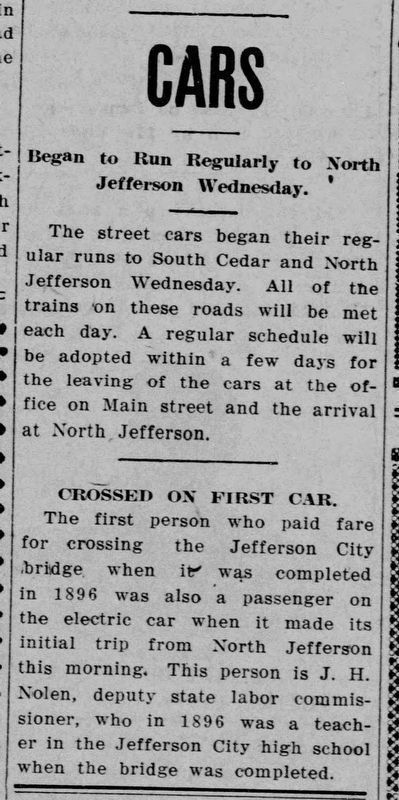
Article in the Jefferson City Tribune, April 5, 1911
5. Cars Began to Run Regularly to North Jefferson Wednesday
See commentary No. 2 for a transcript
— Submitted May 24, 2026, by Wayne Johnson of Jefferson City, Missouri.
2. Transcript of the April 15, 1911 newspaper article shown on Image No. 5
CARS Began to Run Regularly to North Jefferson Wednesday.
The street cars began their regular runs to South Cedar and North Jefferson Wednesday. All of the trains on these roads will be met each day. A regular schedule will be adopted within a few days for the leaving of the cars at the office on Main street and the arrival at North Jefferson.
Crossed on First Car.
The first person who paid fare for crossing the Jefferson City bridge when it was completed in 1896 was also a passenger on the electric car when it made its initial trip from from North Jefferson this morning. This person is J. H. Nolen, deputy state labor commissioner, who in 1896 was a teacher in the Jefferson City high school when the bridge was completed.
— Submitted June 22, 2026, by Wayne Johnson of Jefferson City, Missouri.
3. The Katy in the 1920s at North Jefferson
By the mid-1920s the MK&T was referring to itself as the Missouri-Kansas-Texas Lines, with its name on timetables abbreviated to M-K-T and nicknamed The Katy. A look at their December 1925 timetable shows North Jefferson was on the main line that ran from St. Louis, Missouri, to Denison, Texas. The timetable shows six daily passenger trains scheduled to stop at North Jefferson, three in each direction. M-K-T trains No. 9 (southbound) and No. 10 (northbound) were the “local” trains. Locals were slow trains that stopped at every station and had no
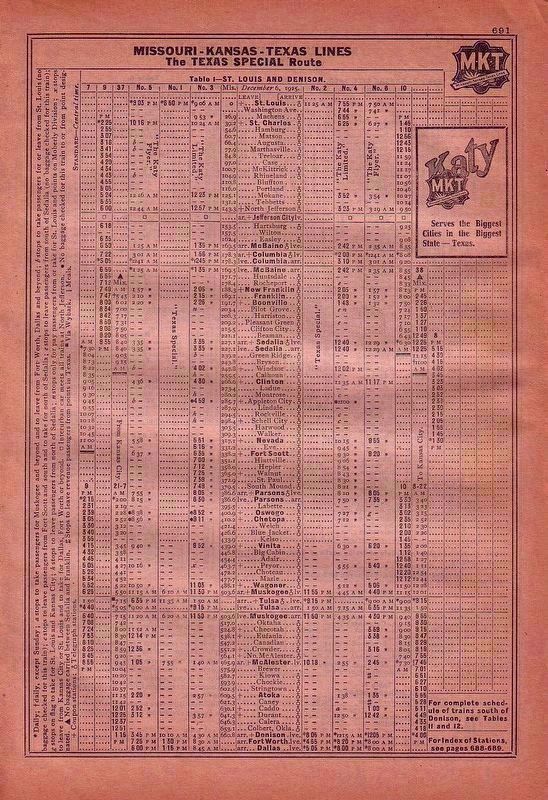
The Official Guide of the Railways, December 1925
6. M-K-T (the Katy) Timetable No. 1, December 1925
Click on image to zoom in. Read the table down on the left side and up on the right side. You’ll find North Jefferson on the last line of the first section, just above Jefferson City. Note the Jefferson City entry has no times listed. Timing was up to the electric trolley line that ran from North Jefferson to Jefferson City across the bridge.
In addition to this timetable for their main line, The Official Guide to the Railways for December 1925, includes 35 other M‑K‑T timetables listing connecting passenger service on their other lines in Missouri, Kansas, Texas, and Oklahoma.
In addition to this timetable for their main line, The Official Guide to the Railways for December 1925, includes 35 other M‑K‑T timetables listing connecting passenger service on their other lines in Missouri, Kansas, Texas, and Oklahoma.
The other four were named trains. Trains No. 3 and 4, The Katy Limited, and trains No. 5 and 6, The Katy Flyer. Those trains stopped only at larger towns, and North Jefferson, the junction for Jefferson City, was one of them. M-K-T had a third named train, its fastest, the Texas Special, but that pair of trains (train No. 1 southbound and No. 2 northbound) sped through overnight without stopping in North Jefferson.
The M-K-T named-trains through North Jefferson carried first-class “through cars,” that originated and/or were destined beyond MKT’s tracks. They went to and from San Antonio, Dallas, Fort Worth, Houston, Galveston, Tulsa, Oklahoma City, Kansas City, and Minneapolis-St. Paul. These cars had private drawing rooms, sleeping berths that converted to couches during the day, and its passengers were steps away from kitchen-dining cars as well as club cars and lounges that were reserved for first class passengers only.
The four named trains and the two locals kept the Katy North Jefferson station busy at all hours of the day and night. Trains were expected at 12:44, 3:19, and 9:40 AM, and at 12:57, 3:23, and 6:00, PM according to the 1925 schedule.
— Submitted June 23, 2026, by J. J. Prats of Powell, Ohio.
Credits. This page was last revised on June 23, 2026. It was originally submitted on March 25, 2021, by Devry Becker Jones of Washington, District of Columbia. This page has been viewed 381 times since then and 46 times this year. Photos: 1, 2. submitted on March 25, 2021, by Devry Becker Jones of Washington, District of Columbia. 3. submitted on May 24, 2026, by Wayne Johnson of Jefferson City, Missouri. 4. submitted on June 23, 2026, by J. J. Prats of Powell, Ohio. 5. submitted on June 22, 2026, by Wayne Johnson of Jefferson City, Missouri. 6. submitted on June 23, 2026, by J. J. Prats of Powell, Ohio.
