Winchester, Virginia — The American South (Mid-Atlantic)
Second Battle of Winchester
June 13, 1863
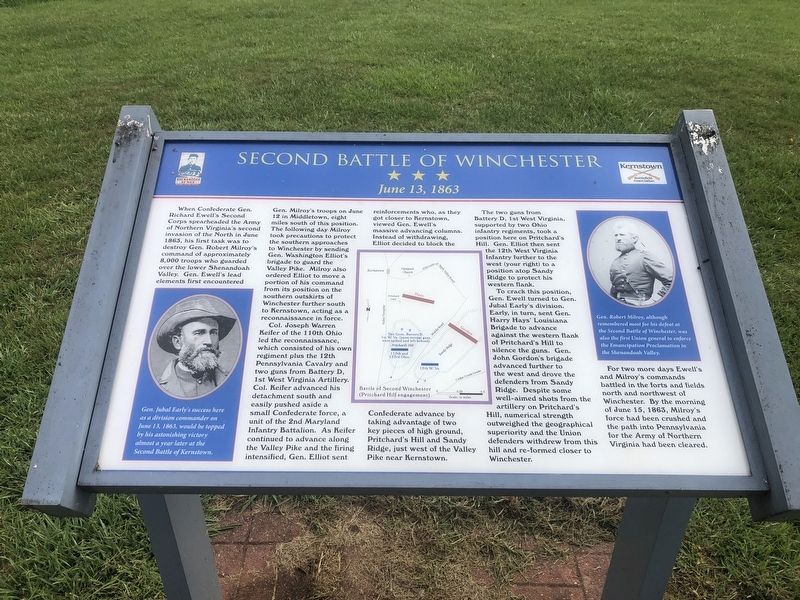
When Confederate Gen. Richard Ewell's Second Corps spearheaded the Army of Northern Virginia's second invasion of the North in June 1863, his first task was to destroy Gen. Robert Milroy's command of approximately 8,000 troops who guarded over the lower Shenandoah Valley. Gen. Ewell's lead elements first encountered Gen. Milroy's troops on June 12 in Middletown, eight miles south of this position. The following day Milroy took precautions to protect the southern approaches to Winchester by sending Gen. Washington Elliot's brigade to guard the Valley Pike. Milroy also ordered Elliot to move a portion of his command from its position on the southern outskirts of Winchester further south to Kernstown, acting as a reconnaissance in force.
Col. Joseph Warren Keifer of the 110th Ohio led the reconnaissance, which consisted of his own regiment plus the 12th Pennsylvania Cavalry and two guns from Battery D, 1st West Virginia Artillery. Col. Keifer advanced his detachment south and easily pushed aside a small Confederate force, a unit of the 2nd Maryland Infantry Battalion. As Keifer continued to advance along the Valley Pike
this page online
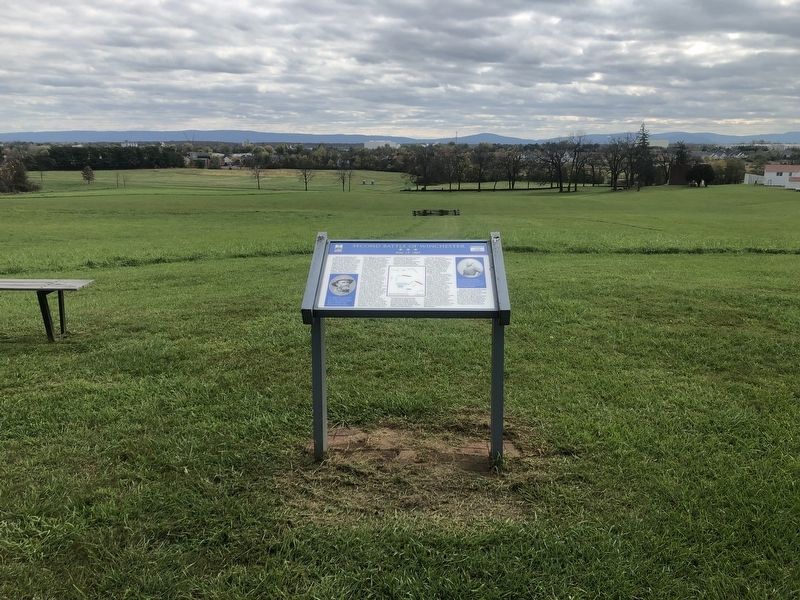
The two guns from Battery D, 1st West Virginia, supported by two Ohio infantry regiments, took a position here on Pritchard's Hill. Gen. Elliot then sent the 12th West Virginia Infantry further to the west (your right) to a position atop Sandy Ridge to protect his western flank.
To crack this position, Gen. Ewell turned to Gen. Jubal Early's division. Early, in turn, sent Gen. Harry Hays' Louisiana Brigade to advance against the western flank of Pritchard's Hill to silence the guns. Gen. John Gordon's brigade advanced further to the west and drove the defenders from Sandy Ridge. Despite some well-aimed shots from the artillery on Pritchard's Hill, numerical strength outweighed the geographical superiority and the Union defenders withdrew from this hill and re-formed closer to Winchester.
For
[Sidebars:]
Gen. Jubal Early's success here as a division commander on June 13, 1863, would be topped by his astonishing victory almost a year later at the Second Battle of Kernstown.
Gen. Robert Milroy, although remembered most for his defeat at the Second Battle of Winchester, was also the first Union general to enforce the Emancipation Proclamation in the Shenandoah Valley.
Erected by Shenandoah At War; Kernstown Battlefield Association.
Topics. This historical marker is listed in this topic list: War, US Civil. A significant historical month for this entry is June 1863.
Location. 39° 8.765′ N, 78° 11.807′ W. Marker is in Winchester, Virginia. It is on Battle Park Drive half a mile west of Saratoga Drive, on the right when traveling west. Touch for map. Marker is at or near this postal address: 610 Battle Park Dr, Winchester VA 22601, United States of America. Touch for directions.

Regionally, this marker is in the Shenandoah Valley. It is also in the American South, specifically in the Upper South, and in the Mid-Atlantic. Globally, it is in North America, the Western Hemisphere, the Western World, and the Anglosphere. Historically, it finds itself in what was once the territory of the Mississippian Culture, one of the original Thirteen Colonies, one of the Confederate States of America, and the Antebellum South.
Other nearby markers. At least 8 other markers are within walking distance of this marker: The Second Battle of Kernstown (a few steps from this marker); The First Battle of Kernstown (a few steps from this marker); Pritchard Family Cemetery (about 300 feet away, measured in a direct line); a different marker also named The Second Battle of Kernstown (about 800 feet away); a different marker also named The First Battle of Kernstown (approx. 0.2 miles away); The Pritchard House (approx. 0.2 miles away); Site of the Original Pritchard Barn (approx. 0.2 miles away); Agriculture in the Shenandoah Valley (approx. 0.2 miles away). Touch for a list and map of all markers in Winchester.
Other markers no longer nearby. The First Battle of Kernstown (was about 500 feet away but has been replaced with another marker now near it); a different marker also named The Second Battle of Kernstown (was about 500 feet away but has been replaced with another marker now near it).
Credits. This page was last revised on April 4, 2021. It was originally submitted on November 2, 2020, by Devry Becker Jones of Washington, District of Columbia. This page has been viewed 599 times since then and 27 times this year. Last updated on April 3, 2021, by Bradley Owen of Morgantown, West Virginia. Photos: 1, 2. submitted on November 2, 2020, by Devry Becker Jones of Washington, District of Columbia.
