Near Williamsburg in James City County, Virginia — The American South (Mid-Atlantic)
Interpreting Jamestown
Photographed by Bill Coughlin, August 14, 2008
1. Interpreting Jamestown Marker
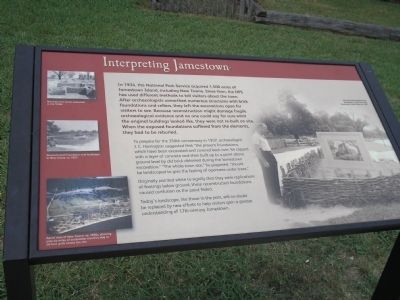
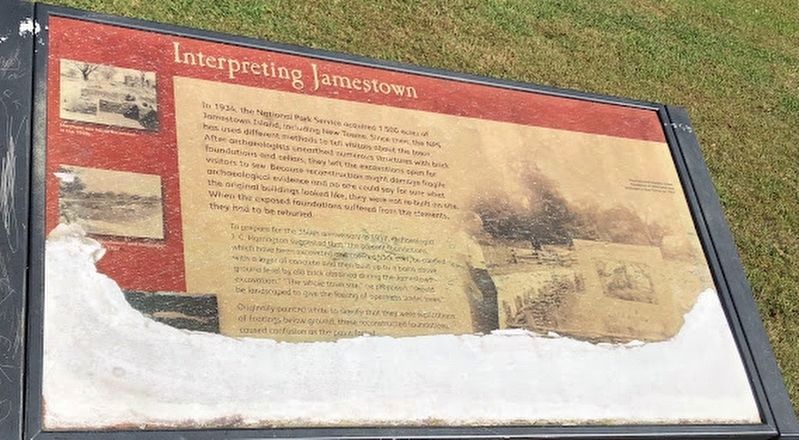
To prepare for the 350th anniversary in 1957, archaeologist J. C. Harrington suggested that “the present foundations, which have been excavated and covered back over, be capped with a layer of concrete and then built up to a point above ground level by old brick obtained during the Jamestown excavation.” “The whole town site,” he proposed, “should be landscaped to give the feeling of openness under trees.”
Originally painted white to signify that they were replications of footings below ground, these reconstructed foundations caused confusion as the paint faded.
Today’s
this page online
Erected by Colonial National Historic Park.
Topics. This historical marker is listed in this topic list: Colonial Era. A significant historical year for this entry is 1934.
Location. 37° 12.457′ N, 76° 46.611′ W. Marker has been reported damaged. Marker is near Williamsburg, Virginia, in James City County. It can be reached from Colonial Parkway, on the right when traveling west. Marker is in the "New Towne" section of the Historic Jamestown unit of Colonial National Historic Park. Touch for map. Marker is in this post office area: Williamsburg VA 23185, United States of America. Touch for directions.

Regionally, this marker is on Virginia’s Peninsula, in Coastal Virginia, and in the Hampton Roads Metropolitan Area. It is also in the American South, specifically in the Upper South, in the Tidewater, and on the Eastern Seaboard. Globally, it is in the North Atlantic Region, North America, the Western Hemisphere, the Western World, and the Anglosphere. Historically, it finds
Photographed by Bill Coughlin, August 14, 2008
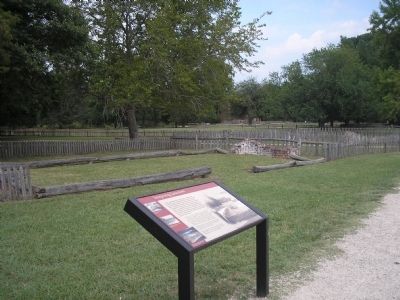
2. Marker in Historic Jamestowne
Other nearby markers. At least 8 other markers are within walking distance of this location: Colonial Highway (within shouting distance of this marker); Efforts of a Virginia Tradesman 1670s (within shouting distance of this marker); Water and Well (within shouting distance of this marker); A Jamestown Warehouse 1630s-1699 (within shouting distance of this marker); Backstreet – Jamestown’s Main Street 1620-1699 (about 300 feet away, measured in a direct line); A Campsite pre-1607 (about 400 feet away); The Greate Road – An Early Highway pre-1607-1700s (about 400 feet away); Ditch and Mound (about 400 feet away). Touch for a list and map of all markers in Williamsburg.
More about this marker. The right of the marker contains a photograph of the “Reconstructed Marable house foundation in white brick and landscape in New Towne, ca. 1957.” The left of the marker features several photographs of various excavations in Jamestown. These include, “Merchant row
Photographed by Bill Coughlin, August 14, 2008
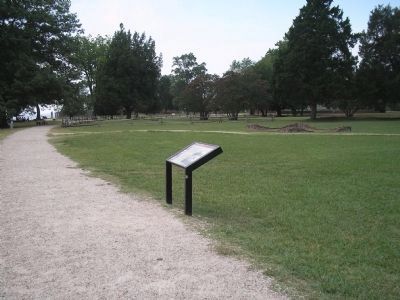
3. Interpreting Jamestown Marker
Some foundations excavated in New Towne can be seen behind the marker.
Also see . . .
1. Interpreting Jamestown. Colonial National Historic Park from National Park Service website. (Submitted on March 20, 2009, by Bill Coughlin of Woodland Park, New Jersey.)
2. Historic Jamestowne. Historic Jamestowne is the site of the first permanent English settlement in America. The site is jointly administered by APVA Preservation Virginia and the National Park Service. (Submitted on March 20, 2009, by Bill Coughlin of Woodland Park, New Jersey.)
Photographed by Andrea Capps
4. Interpreting Jamestown Marker
Credits. This page was last revised on June 24, 2025. It was originally submitted on March 20, 2009, by Bill Coughlin of Woodland Park, New Jersey. This page has been viewed 1,060 times since then and 20 times this year. Photos: 1, 2, 3. submitted on March 20, 2009, by Bill Coughlin of Woodland Park, New Jersey. 4. submitted on June 19, 2025, by Andrea Capps of Lake, Illinois.
