Manassas, Virginia — The American South (Mid-Atlantic)
Enslaved of Liberia
1825 - 1865
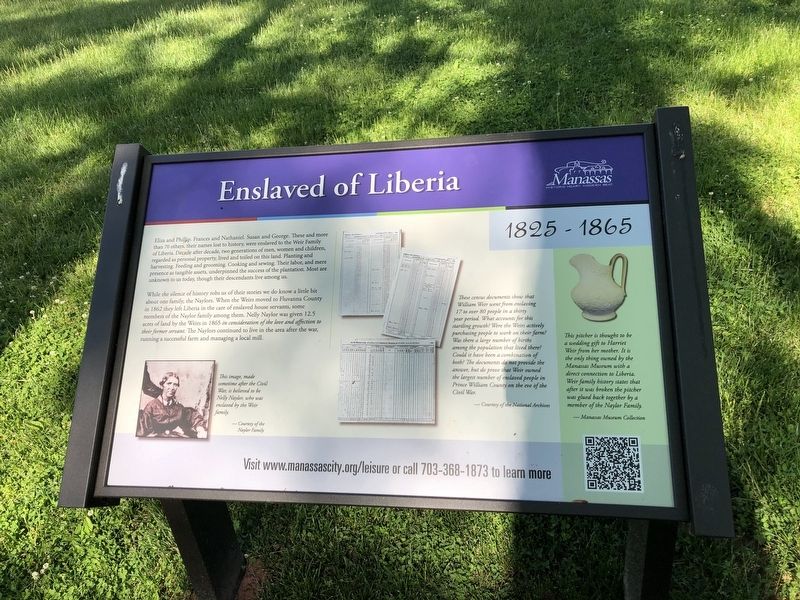
Eliza and Phillip, Frances and Nathaniel, Susan and George. These and more than 70 others, their names lost to history, were enslaved to the Weir Family of Liberia. Decade after decade, two generations of men, women and children, regarded as personal property, lived and toiled on this land. Planting and harvesting. Feeding and grooming. Cooking and sewing. Their labor, and mere presence as tangible assets, underpinned the success of the plantation. Most are unknown to us today, though their descendants live among us.
While the silence of history robs us of their stories, we do know a little bit about one family, the Naylors. When the Weirs moved to Fluvanna County in 1862 they left Liberia in the care of enslaved house servants, some members of the Naylor family among them. Nelly Naylor was given 12.5 acres of land by the Weirs in 1865 in consideration of the love and affection to their former servant. The Naylors continued to live in the area after the war, running a successful farm and managing a local mill.
[Captions:]
This image, made sometime after the Civil War, is believed to be Nelly Naylor, who was enslaved by the Naylor family.
These census documents show that William Weir went from enslaving 17 to over 80 people in a thirty year period. What accounts for this startling growth? Were the Weirs actively purchasing people to work on their farm? Was there a large number of births among the population that lived there? Could it have been a combination of both? The documents do not provide the answer, but do prove that Weir owned the largest number of enslaved people in Prince William County on the eve of the Civil War.
This pitcher is thought to be a wedding gift to Harriet Weir from her mother. It is the only thing owned by the Manassas Museum with a direct connection to Liberia. Weir family history states that after it was broken the pitcher was glued back together by a member of the Naylor Family.
Erected by City
this page online
Topics and series. This historical marker is listed in these topic lists: African Americans • Agriculture • Industry & Commerce. In addition, it is included in the Virginia, City of Manassas series list. A significant historical year for this entry is 1862.
Location. This marker has been replaced by another marker nearby. It was located near 38° 46.017′ N, 77° 27.611′ W. Marker was in Manassas, Virginia. It could be reached from the intersection of Portner Avenue and Princeton Park Drive, on the right when traveling north. Touch for map. Marker was at or near this postal address: 8601 Portner Ave, Manassas VA 20110, United States of America. Touch for directions.

Regionally, this marker was in the Washington Metropolitan Area and in Northern Virginia. It was also in the American South, specifically in the Upper South, and in the Mid-Atlantic. Globally, it was in North America, the Western Hemisphere, the Western World, and the Anglosphere. Historically, it found itself in what was once the territory of the Mississippian Culture, one of the original Thirteen Colonies, one of the Confederate
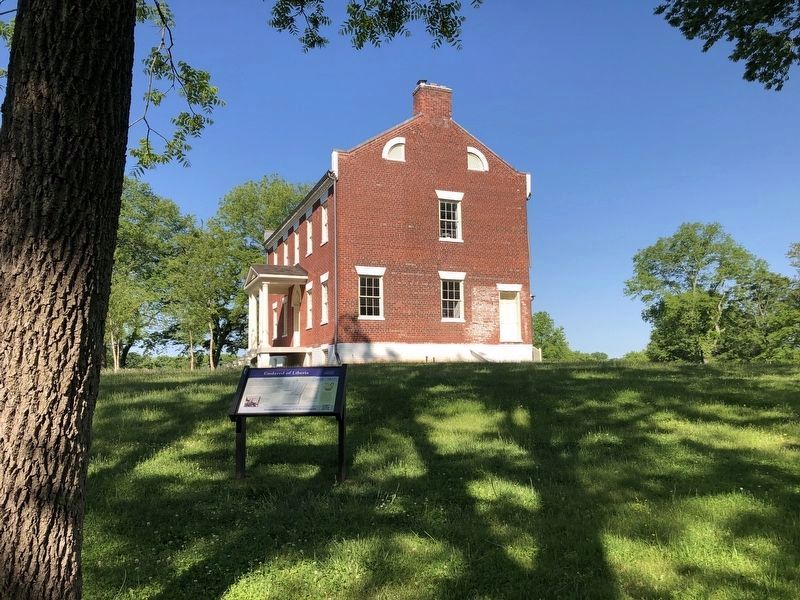
Other nearby markers. At least 8 other markers are within walking distance of this location: A different marker also named Enslaved of Liberia (here, next to this marker); Weir Family Cemetery (within shouting distance of this marker); Liberia (within shouting distance of this marker); a different marker also named Liberia and the Weirs (within shouting distance of this marker); Creating a Garden (within shouting distance of this marker); a different marker also named Liberia (within shouting distance of this marker); Liberia Apiary Buzz (about 400 feet away, measured in a direct line); Manassas 1825 (approx. 0.2 miles away). Touch for a list and map of all markers in Manassas.
Other markers no longer nearby. Liberia and the Weirs (was within shouting distance of this marker but has been replaced with another marker now near it); Turberville Memorial Garden (was within shouting distance of this marker but has been replaced with another marker now near it); Battle of Bull Run Bridge (was about 600 feet away but has been permanently removed).
Credits. This page was last revised on July 14, 2026. It was originally submitted on May 15, 2021, by Devry Becker Jones of Washington, District of Columbia. This page has been viewed 578 times since then and 35 times this year. Photos: 1, 2. submitted on May 15, 2021, by Devry Becker Jones of Washington, District of Columbia.
