Athens in Athens County, Ohio — The American Midwest (Great Lakes)
Lynching in America ⎯⎯⎯ Lynching of Christopher Davis
Community Remembrance Project
Photographed by Rev. Ronald Irick, May 24, 2021
1. Lynching in America side of the marker
Inscription.
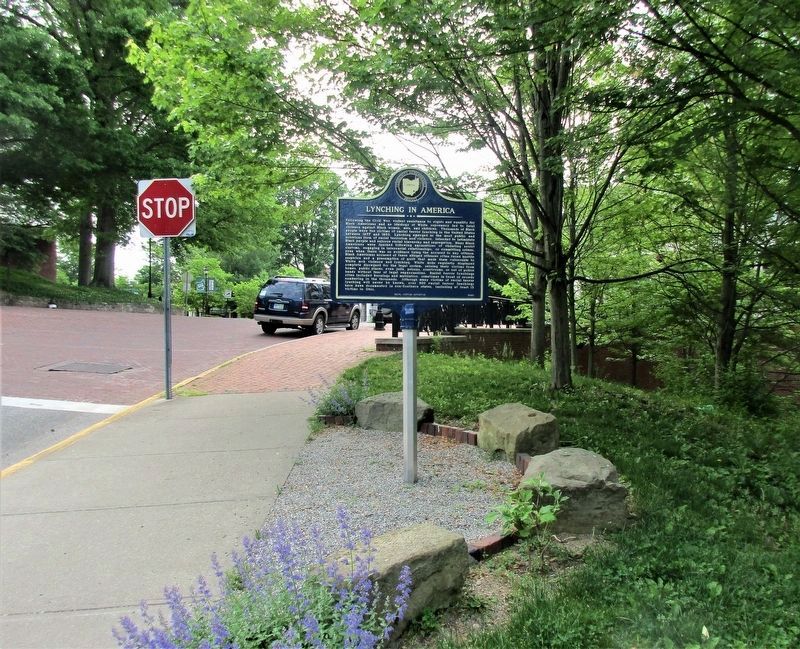
Lynching in America
Following the Civil War, violent resistance to rights for and equality for Black Americans and an ideology of White supremacy led to fatal violence against Black women, men, and children. Thousands of Black people were the victims of racial terror lynching in the United States between 1877 and 1950. Lynching emerged as the most public and notorious form of racial terrorism and violence, intended to intimidate Black people and enforce racial hierarchy and segregation. Many Black Americans were lynched following accusations of violating social customs, engaging in interracial relationships, or committing crimes, even when there was no evidence tying the accused to any offense. Black Americans accused of these alleged offenses often faced hostile suspicion and a presumption of guilt that made them vulnerable to White mob violence and lynching. White mobs regularly displayed complete disregard for the legal system, seizing their victims from homes, public places, even jails, prisons, courtrooms, or out of police hands without fear of legal repercussions. Racial terror lynchings often included burnings
Click or scan to see this page online
and mutilation, sometimes in front of crowds numbering in the thousands. Although many victims of racial terror lynching will never be known, over 300 racial terror lynchings have been documented in non-southern states, including at least 15 victims in Ohio.
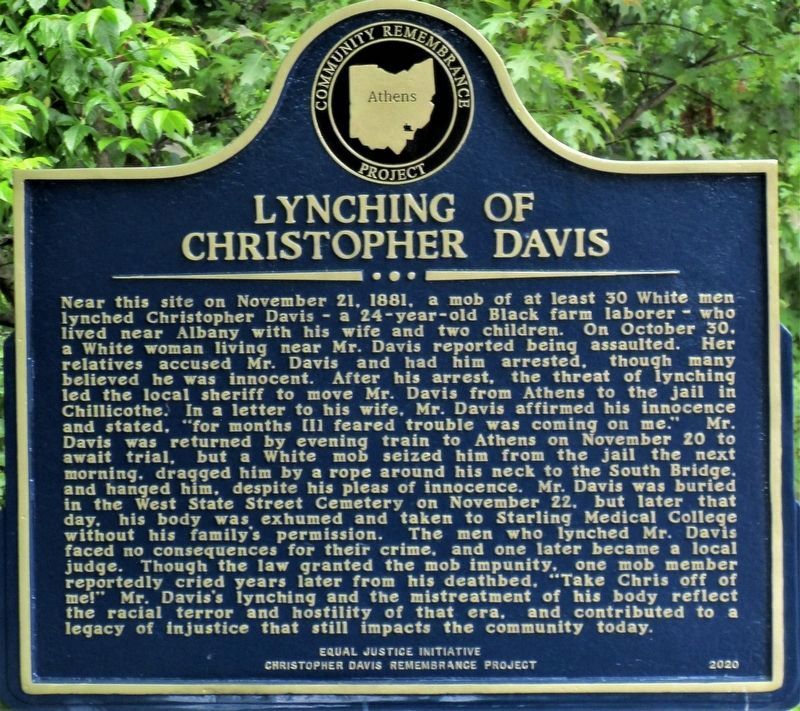
Lynching of Christopher Davis
Near this site on November 21, 1881, a mob of at least 30 White men lynched Christopher Davis- a 24-year old Black farm laborer- who lived near Albany with his wife and two children. On October 30, a White woman living near Mr. Davis reported being assaulted. Her relatives accused Mr. Davis and had him arrested, though many believed he was innocent. After his arrest, the threat of lynching led the local sheriff to move Mr. Davis from Athens to the jail in Chillicothe. in a letter to his wife, Mr. Davis affirmed his innocence and stated, “for months [I] feared trouble was coming on me.” Mr.Davis was returned by evening train to Athens on November 20 to await trial, but a White mob seized him from the jail the next morning, dragged him by a rope around the neck to the South Bridge, and hanged him, despite his pleas of innocence. Mr. Davis was buried
Photographed by Rev. Ronald Irick, May 24, 2021
2. Lynching of Christopher Davis side of the marker
in the West State Street Cemetery on November 22, but later that day, his body was exhumed and taken to Starling Medical College without his family’s permission. The men who lynched Mr. Davis faced no consequences for their crime, and one later became a local judge. Though the law granted the mob impunity, one mob member reportedly cried out years later from his deathbed, “Take Chris off of me!” Mr. Davis’ lynching and the mistreatment of his body reflect the racial terror and hostility of that era, and contributed to a legacy of injustice that still impacts the community today.
Erected 2020 by Equal Justice Initiative Christopher Davis Remembrance Project.
Topics and series. This historical marker is listed in these topic lists: African Americans • Civil Rights • Law Enforcement. In addition, it is included in the Lynching in America series list. A significant historical date for this entry is November 21, 1881.
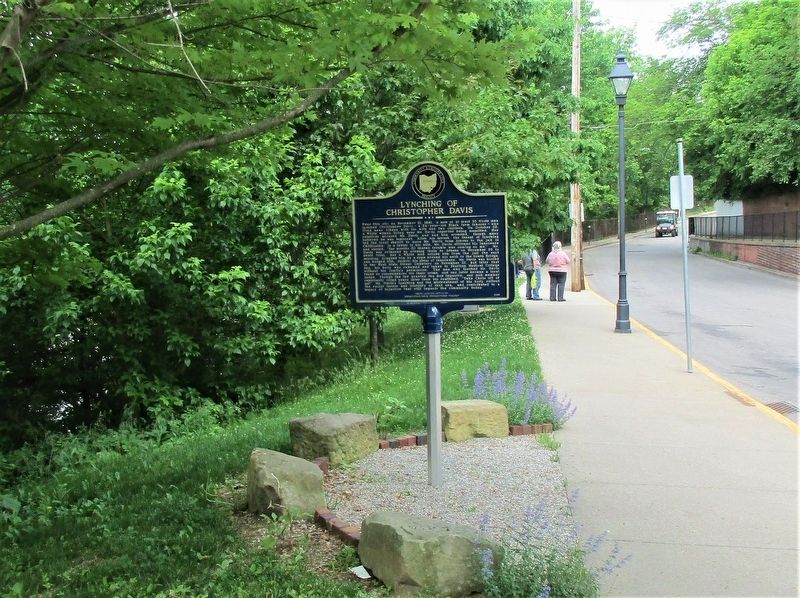
Location. 39° 19.518′ N, 82° 6.106′ W. Marker is in Athens, Ohio, in Athens County. It is at the intersection of West Mulberry and South Court Street, on the right when traveling east on West Mulberry. Located on the campus
Photographed by Rev. Ronald Irick, May 24, 2021
3. Lynching of Christopher Davis Marker
of Ohio University, in front of the Baker University Center. Touch for map. Marker is at or near this postal address: 10 W Mulberry, Athens OH 45701, United States of America. Touch for directions.
Regionally, this marker is in the Hocking Hills. It is also in the American Midwest, in the Ohio River Valley, in Appalachia, and specifically in Northern Appalachia. Globally, it is in North America, the Western Hemisphere, the Western World, and the Anglosphere. Historically, it finds itself in what was once the Haudenosaunee (Iroquois) Confederacy, the territory of the Mississippian Culture, and the Northwest Territory.
Another marker is no longer nearby. The Kissing Circle (was about 700 feet away but has been confirmed missing).
Additional keywords. Jim Crow era; acts of terrorism
Photographed by Brandon D Cross, June 14, 2024
5. Lynching of Christopher Davis Marker
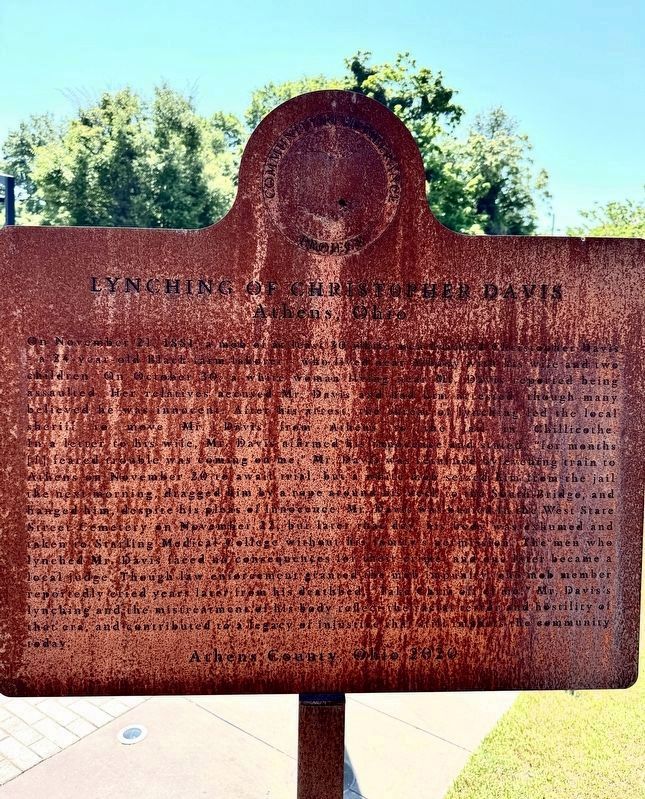
“A Replica marker of one side is located at the Equal Justice Initiatives' National Memorial for Peace and Justice in Montgomery, Alabama. The Equal Justice Initiative supports efforts to locally memorialize documented victims of racial violence and to educate communities about the history of racial injustice.” Mark Hilton
Credits. This page was last revised on October 15, 2024. It was originally submitted on May 24, 2021, by Rev. Ronald Irick of West Liberty, Ohio. This page has been viewed 941 times since then and 94 times this year. Photos:1, 2, 3, 4. submitted on May 24, 2021, by Rev. Ronald Irick of West Liberty, Ohio. 5. submitted on October 14, 2024, by Brandon D Cross of Flagler Beach, Florida. • Devry Becker Jones was the editor who published this page.