Shelbyville in Shelby County, Kentucky — The American South (East South Central)
Lynching in Shelbyville
Community Remembrance Project
Photographed by Duane and Tracy Marsteller, May 31, 2021
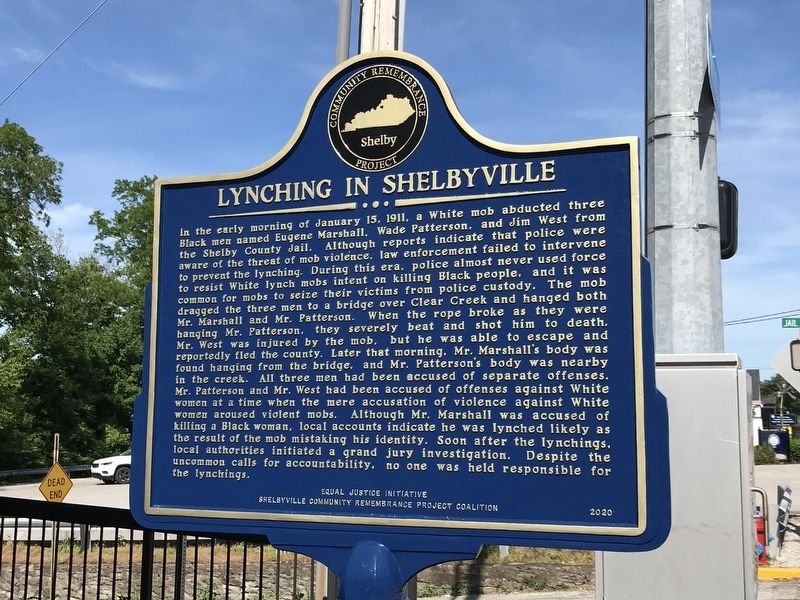
1. Lynching in Shelbyville Marker (Side A)
In the early morning of January 15, 1911, a White mob abducted three Black men named Eugene Marshall, Wade Patterson, and Jim West from the Shelby County Jail. Although reports indicate that police were aware of the threat of mob violence, law enforcement failed to intervene to prevent the lynching. During this era, police almost never used force to resist White lynch mobs intent on killing Black people, and it was common for mobs to seize their victims from police custody. The mob dragged the three men to a bridge over Clear Creek and hanged both Mr. Marshall and Mr. Patterson. When the rope broke as they were hanging Mr. Patterson, they severely beat and shot him to death. Mr. West was injured by the mob, but he was able to escape and reportedly fled the county. Later that morning, Mr. Marshall's body was found hanging from the bridge, and Mr. Patterson's body was nearby in the creek. All three men had been accused of separate offenses. Mr. Patterson and Mr. West had been accused of offenses against White women at a time when the mere accusation of violence against White women aroused violent mobs. Although Mr. Marshall
this page online
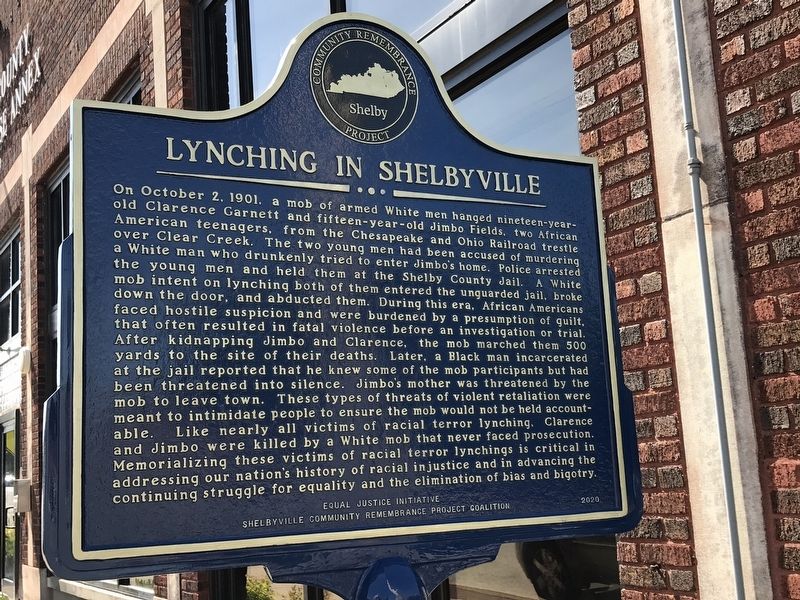
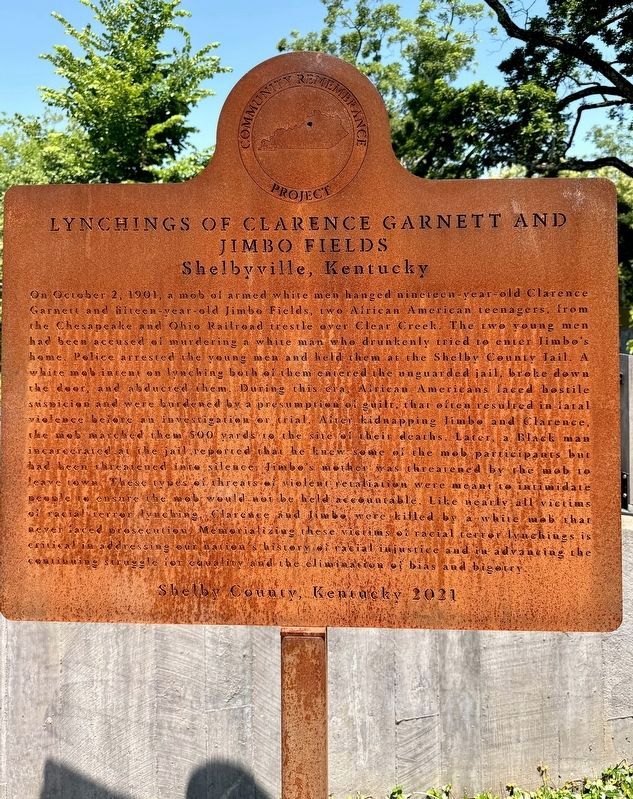
On October 2, 1901, a mob of armed White men hanged nineteen-year-old Clarence Garnett and fifteen-year-old Jimbo Fields, two African American teenagers, from the Chesapeake and Ohio Railroad trestle over Clear Creek. The two young men had been accused of murdering a White man who drunkenly tried to enter Jimbo's home. Police arrested the young men and held them at the Shelby County Jail. A White mob intent on lynching both of them entered the unguarded jail, broke down the door, and abducted them. During this era, African Americans faced hostile suspicion and were burdened by a presumption of guilt, that often resulted in fatal violence before an investigation or trial. After kidnapping Jimbo and Clarence, the mob marched them 500 yards to the site of their deaths. Later, a Black man incarcerated at the jail reported that he knew
Photographed by Duane and Tracy Marsteller, May 31, 2021
2. Lynching in Shelbyville Marker (Side B)
Erected 2020 by Equal Justice Initiative and Shelbyville Community Remembrance Project Coalition.
Topics and series. This historical marker is listed in these topic lists: African Americans • Civil Rights • Law Enforcement. In addition, it is included in the Lynching in America series list. A significant historical date for this entry is January 15, 1911.
Location. 38° 12.706′ N, 85° 12.949′ W. Marker is in Shelbyville, Kentucky, in Shelby County. It is at the intersection of Washington Street (U.S. 60) and Jail Hill Road, on the right when traveling
Photographed by Duane and Tracy Marsteller, May 31, 2021
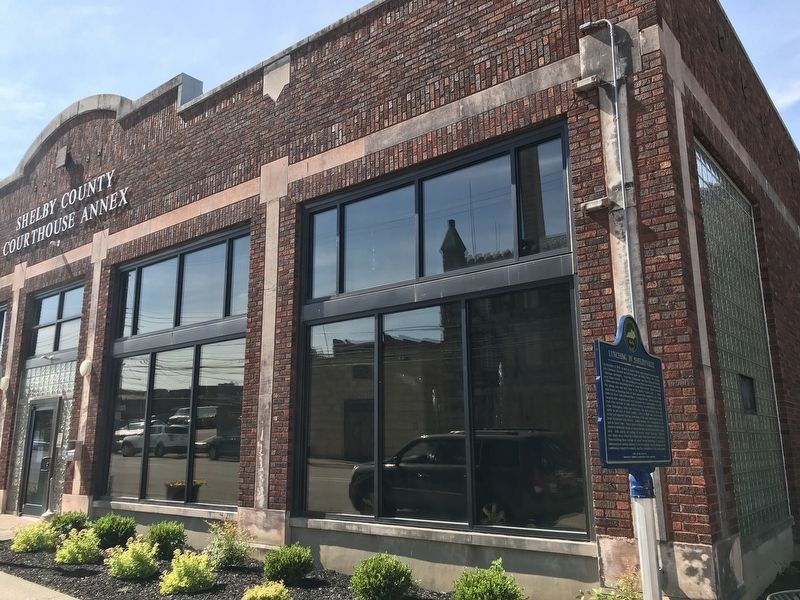
3. Lynching in Shelbyville Marker

Regionally, this marker is in Greater Louisville Area. It is also in the American South and specifically in the Upper South. Globally, it is in North America, the Western Hemisphere, the Western World, and the Anglosphere. Historically, it finds itself in what was once the territory of the Mississippian Culture and also the Antebellum South.
Other nearby markers. At least 8 other markers are within walking distance of this marker: Lynching in America / Lynching of Sam Pulliam (a few steps from this marker); Reconstruction in America / Lynching of Reuben Dennis (a few steps from this marker); Centenary Methodist Church (within shouting distance of this marker); Shelby County, 1792 (within shouting distance of this marker); Soldiers of the American Revolution (within shouting distance of this marker); Shelby County Courthouse (within shouting distance of this marker); Squire Boone's Station, 1779 (about 300 feet away, measured in a direct line); Lewis and Clark in Kentucky 1806 Return of Expedition / Death of Meriwether Lewis
Photographed by Brandon D Cross
4. Lynchings of Clarence Garnett and Jimbo Fields
“A Replica marker of one side is located at the Equal Justice Initiatives' National Memorial for Peace and Justice in Montgomery, Alabama. The Equal Justice Initiative supports efforts to locally memorialize documented victims of racial violence and to educate communities about the history of racial injustice.” Mark Hilton
More about this marker. Located across the street from the jail building where all five boys and men were held before they were lynched.
Credits. This page was last revised on November 10, 2024. It was originally submitted on June 12, 2021, by Duane and Tracy Marsteller of Murfreesboro, Tennessee. This page has been viewed 2,030 times since then and 145 times this year. Photos: 1, 2, 3. submitted on June 12, 2021, by Duane and Tracy Marsteller of Murfreesboro, Tennessee. 4. submitted on October 14, 2024, by Brandon D Cross of Flagler Beach, Florida.
