The Eighteenth Century Piedmont
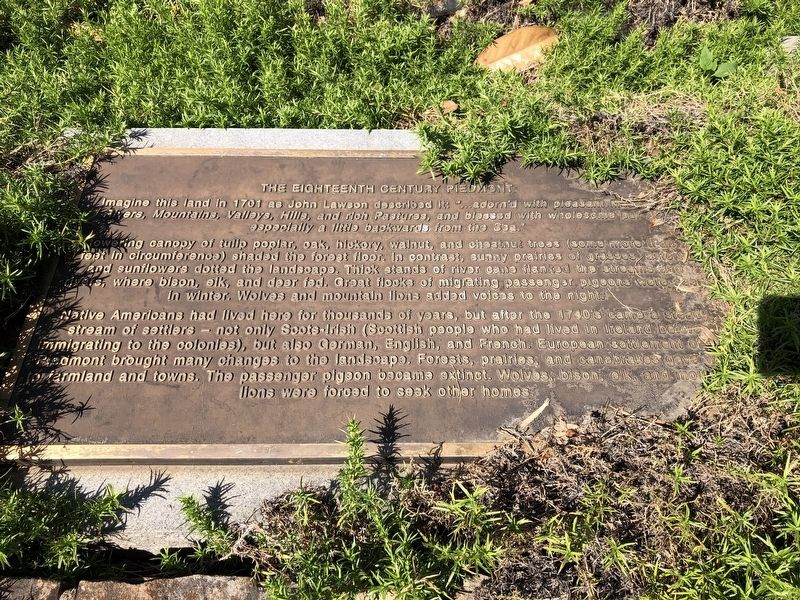
Imagine this land in 1701 as John Lawson described it: "…adorn'd with pleasant Meadows, Rivers, Mountains, Valleys, Hills, and rich Pastures, and blessed with wholesome pur Air especially a little backwards from the Sea."
A towering canopy of tulip poplar, oak, hickory, walnut, and chestnut trees (some more than 2 feet in circumference) shaded the forest floor. In contrast, sunny prairies of grasses of grasses, asters, and sunflowers dotted the landscape. Thick stands of river cane flanked the streams and rivers, where bison, elk, and deer fed. Great flocks of migrating passenger pigeons were seen in winter. Wolves and mountain lions added voices to the night.
Native Americans had lived here for thousands of years, but after the 1740's came a steady stream of settlers — not only Scots-Irish (Scottish people who had lived in Ireland before immigrating to the colonies), but also German, English, and French. European settlement of the Piedmont brought many changes to the landscape. Forests, prairies, and canebrakes, gave way to farmland and towns. The passenger pigeon became extinct. Wolves, bison, elk and mountain
this page online
Topics. This historical marker is listed in these topic lists: Animals • Colonial Era • Indigenous Peoples and Communities • Settlements & Settlers. A significant historical year for this entry is 1701.
Location. 35° 13.757′ N, 80° 50.598′ W. Marker is in Charlotte, North Carolina, in Mecklenburg County. It is in Charlotte center city. It is on West 5th Street just west of North Church Street, on the right when traveling west. Touch for map. Marker is at or near this postal address: 200 W Trade St, Charlotte NC 28202, United States of America. Touch for directions.

Regionally, this marker is in the Piedmont. It is also in the American South and specifically in the Upper South. Globally, it is in North America, the Western Hemisphere, the Western World, and the Anglosphere. Historically, it finds itself in what was once the territory of the Mississippian Culture, one of the original Thirteen Colonies, one of the Confederate States of America, and the Antebellum South.
Other nearby markers. At least 8 other markers are within walking distance of this marker: The First Carolinians

Credits. This page was last revised on February 3, 2023. It was originally submitted on June 20, 2021, by Devry Becker Jones of Washington, District of Columbia. This page has been viewed 328 times since then and 23 times this year. Photos: 1, 2. submitted on June 20, 2021, by Devry Becker Jones of Washington, District of Columbia.
