Charlotte center city in Mecklenburg County, North Carolina — The American South (South Atlantic)
Establishing A New Life
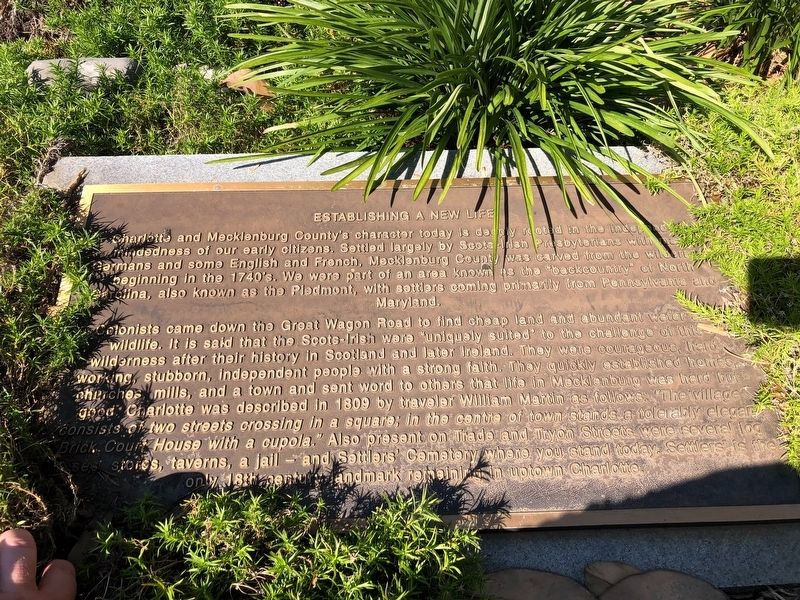
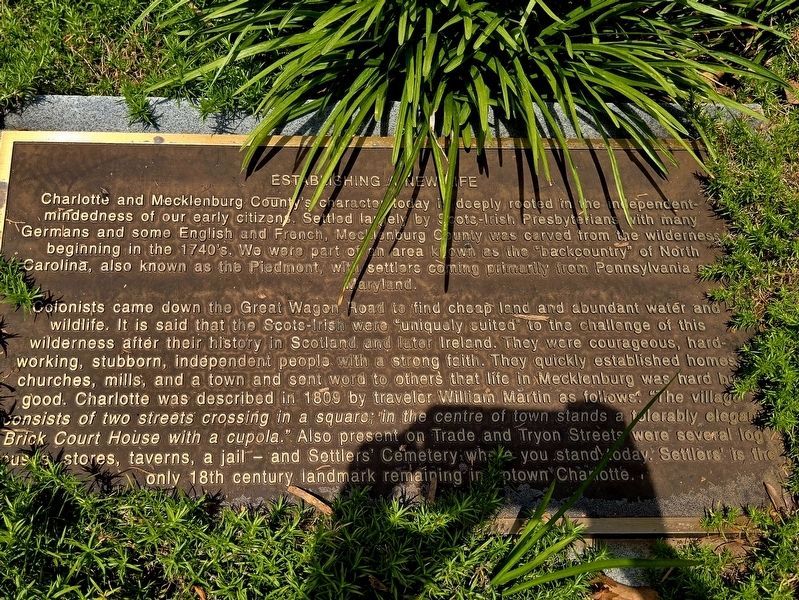
Charlotte and Mecklenburg County's character today is deeply rooted in the independent mindedness of our early citizens. Settled largely by Scots-Irish Presbyterians with many Germans and some English and French, Mecklenburg was carved from the wilderness beginning in the 174's. We were part of an area known as the "backcountry" of North Carolina, also known as the Piedmont, with settlers coming primarily from Pennsylvania and Maryland.
Colonists came down the Great Wagon Road to find cheap land and abundant water and wildlife. It is said that the Scots-Irish were "uniquely suited" to the challenge of this wilderness after their history in Scotland and later Ireland. They were courageous, hard working, stubborn, independent people with a strong faith. They quickly established homes, churches, mills, and a town and sent word to others that life in Mecklenburg was hard but good. Charlotte was described in 1809 by traveller William Martin as follows. "The village consists of two streets crossing in a square; in the centre of town stands a tolerably elegant Brick Court House with a cupola." Also present on Trade and Tryon
this page online
Topics. This historical marker is listed in these topic lists: Cemeteries & Burial Sites • Colonial Era • Settlements & Settlers. A significant historical year for this entry is 1809.
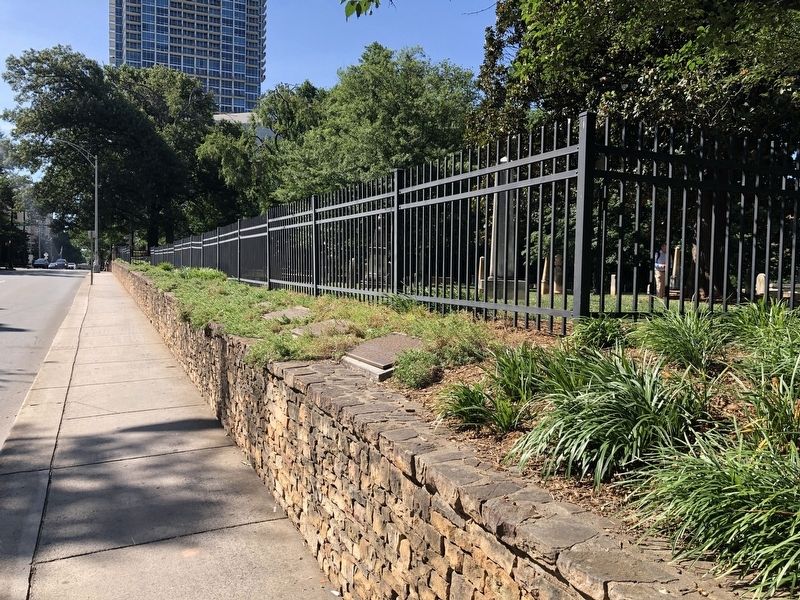
Location. 35° 13.756′ N, 80° 50.597′ W. Marker is in Charlotte, North Carolina, in Mecklenburg County. It is in Charlotte center city. It is on West 5th Street just west of North Church Street, on the right when traveling west. Touch for map. Marker is at or near this postal address: 200 W Trade St, Charlotte NC 28202, United States of America. Touch for directions.

Regionally, this marker is in North Carolina’s Piedmont. It is also in the American South and specifically in the Upper South. Globally, it is in North America, the Western Hemisphere, the Western World, and the Anglosphere. Historically, it finds itself in what was once the territory of the Mississippian Culture, one of the original Thirteen Colonies, one of the Confederate States of America,
Other nearby markers. At least 8 other markers are within walking distance of this marker: The Eighteenth Century Piedmont (here, next to this marker); The Origin Of Our Names (here, next to this marker); The First Carolinians (here, next to this marker); The Mecklenburg Declaration of Independence (here, next to this marker); Captain James Jack's Ride (here, next to this marker); The Battle of Charlotte (here, next to this marker); Hornets' Nest (here, next to this marker); The Importance Of Religion (here, next to this marker). Touch for a list and map of all markers in Charlotte.
Photographed by Mark Parker, June 13, 2024
3. Establishing A New Life Marker
Credits. This page was last revised on June 20, 2024. It was originally submitted on June 20, 2021, by Devry Becker Jones of Washington, District of Columbia. This page has been viewed 295 times since then and 10 times this year. Photos: 1, 2. submitted on June 20, 2021, by Devry Becker Jones of Washington, District of Columbia. 3. submitted on June 19, 2024, by Mark Parker of Hickory, North Carolina.
