Abolitionists
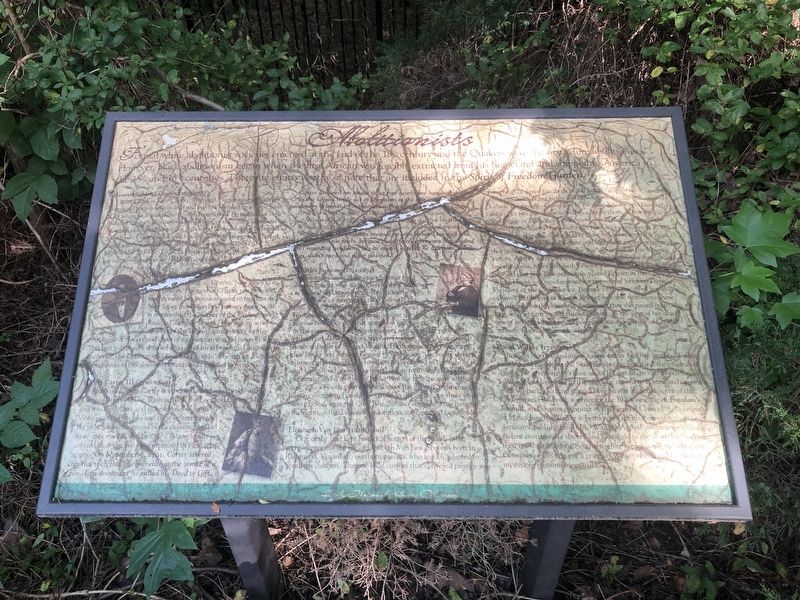
Formal white abolitionist societies emerged at the end of the 18th century and the Quakers were the first white abolitionists. However, black abolitionism began when the first African was forcibly extracted from his homeland and shipped to America in the 15th and 16th centuries. There are efforts worthy of note that are included in the Spirit of Freedom Garden.
William Still (1821 - 1902)
Born in Burlington County, New Jersey to ex-slave parents. His mother Charity ran away and was captured but ran away again to freedom in New Jersey from Maryland' eastern shore. Still is often called the "Father of the Underground Railroad" because by age 24 he was an active member of the Pennsylvania Society for the Abolition of Slavery and chair of its committee to aid runaway slaves. Still later published a detailed account of his efforts to aid runaways in his book "The Underground Railroad Records," wherein he documents the accounts of 649 slaves who successfully escaped to freedom.
Robert Carter III (1728 - 1804)
Although Robert Carter lived close to and was friends with Thomas Jefferson, The Washingtons, the Lees and George
this page online
Why was Robert Carter willing to do what his friends, Washington and Jefferson did not? Again, his biography writes, "Robert Carter is forgotten because he both blended too well and was respected too finely, because the difference between himself and his regarding neighbors, lies as always in what he didn't do, didn't say, didn't need and never justified."
Charles Sumner (1811 - 1874)
Sumner was an abolitionist Senator from Massachusetts who was known in the Congress as autocal and staunch orator particularly
Elizabeth Van Lew (1819 - 1900)
One of the best historical secrets of the South is the simple story of the life of Elizabeth Van Lew. She was born in Richmond, Virginia to northern parents, who quickly adapted to Southern customs. The one local custom that
David Walker (1725 - 1830)
Born in North Carolina to a slave father and free mother, Walker traveled extensively in the South observing first hand the cruelties of slavery. He is reported to have said, "If I remain in this bloody land I will not live long." So in the 1820s, he moved to Boston and operated a second-hand clothing store. There he was an active agent of the Underground Railroad, a writer for the Black newspaper, Freedom's Journal, and charter organizer of the General Colored Association of Massachusetts. Walker is best known for his militant activist document published in 1828, "Walker's Appeal" wherein he calls for violent overthrow of slavery and a struggle to the death for blacks in their quest for freedom. Southern white supremacists including the Governor of Georgia put a price on Walker's head and he died of mysterious circumstances in 1830.
Topics and series. This historical marker is listed in these topic lists: Abolition & Underground RR • African Americans • War, US Civil. In addition, it is included in the Former U.S. Presidents: #01 George Washington, the Former U.S. Presidents: #03 Thomas Jefferson, the Former U.S. Presidents: #18 Ulysses S. Grant, and the Quakerism series lists. A significant historical date for this entry is September 5, 1791.
Location. 38° 19.319′ N, 77° 30.516′ W. Marker is in Fredericksburg, Virginia. It can be reached from Gordon W Shelton Boulevard 0.7 miles north of Willow Lane, on the right when traveling west. Touch for map. Marker is at or near this postal address: 6001 Gordon W Shelton Blvd, Fredericksburg VA 22401, United States of America. Touch for directions.
Regionally, this marker is in the Washington Metropolitan Area and in Northern Virginia. It is also in the American South and specifically in the Upper South. Globally, it is in North America, the Western Hemisphere, the Western World, and the Anglosphere. Historically, it finds itself in what was once the territory of the Mississippian Culture, one of the original Thirteen Colonies, one of the Confederate States of America, and the Antebellum South.
Other nearby markers. At least 8 other markers are within walking distance of this marker: Hallelujah (here, next to this marker); Acts of Bravery (here, next to this marker); Endurance Through It All (here, next to this marker); Voices of the Past (here, next to this marker); Runaways (here, next to this marker); Middle Passage (here, next to this marker); Quest For Knowledge (a few steps from this marker); Henry "Box" Brown (a few steps from this marker). Touch for a list and map of all markers in Fredericksburg.
Also see . . . Abandoned National Slavery Museum. Atlas Obscura article (Submitted on June 28, 2021, by Devry Becker Jones of Washington, District of Columbia.)
Credits. This page was last revised on February 2, 2023. It was originally submitted on June 28, 2021, by Devry Becker Jones of Washington, District of Columbia. This page has been viewed 293 times since then and 32 times this year. Photos: 1, 2. submitted on June 28, 2021, by Devry Becker Jones of Washington, District of Columbia.
