The Louisiana Purchase/El Camino Real De Los Tejas
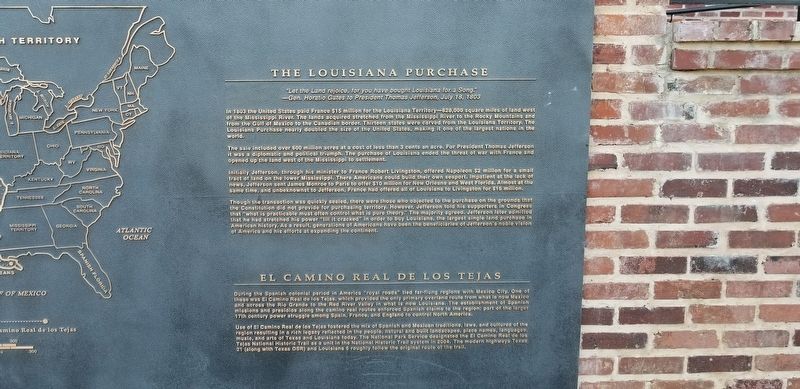
In 1803 the United States paid France $15 million for the Louisiana Territory- 828,000 square miles of land west of the Mississippi River. The lands acquired stretched from the Mississippi River to the Rocky Mountains and from the Gulf of Mexico to the Canadian border. Thirteen states were carved from the Louisiana Territory. The Louisiana Purchase nearly doubled the size of the United States, making it one of the largest nations in the world.
The sale included over 600 million acres at a cost of less than 3 cents an acre. For President Thomas Jefferson it was a diplomatic and political triumph. The purchase of Louisiana ended the threat of war with France and opened up the land west of the Mississippi to settlement.
Initially Jefferson, through his minister to France Robert Livingston, offered Napoleon $2 million for a small tract of land on the lower Mississippi. There Americans could build their own seaport. Impatient at the lack of news, Jefferson sent James Monroe to Paris to offer
this page online
Though the transaction was quickly sealed, there were those who objected to the purchase on the grounds that the Constitution did not provide for purchasing territory. However, Jefferson told his supporters in Congress that "what is practicable must often control what is pure theory." The majority agreed. Jefferson later admitted that he had stretched his power "till it cracked" in order to buy Louisiana, the largest single land purchase in American history. As a result, generations of Americans have been the beneficiaries of Jefferson's noble vision of America and his efforts at expanding the continent.
During the Spanish colonial period in America "royal roads" tied far-flung regions with Mexico City. One of these was El Camino Real de los Tejas, which provided the only primary overland route from what is now Mexico and across the Rio Grande to the Red River Valley in what is now Louisiana. The establishment of Spanish missions and presidlos
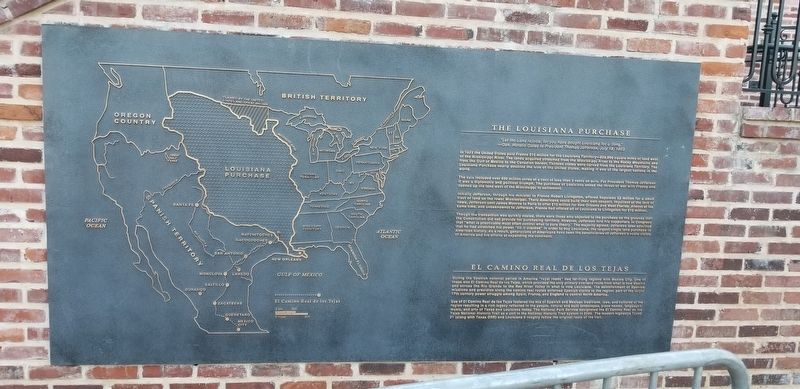
Use of El Camino Real de los Tejas fostered the mix of Spanish and Mexican traditions, laws, and cultures of the region resulting in a rich legacy reflected in the people, natural and built landscapes, place names, languages, music, and arts of Texas and Louisiana today. The National Park Service designated the El Camino Real de los Tejas National Historic Trail as a unit in the National Historic Trail system In 2004. The modern highways Texas 21 (along with Texas OSR) and Louisiana 6 roughly follow the original route of the trail.
Topics. This historical marker is listed in these topic lists: Colonial Era • Natural Resources • Notable Events. A significant historical date for this entry is July 18, 1803.
Location. 31° 45.693′ N, 93° 5.149′ W. Marker is in Natchitoches, Louisiana, in Natchitoches Parish. It is on Front Street north of Church Street, on the right when traveling north. Touch for map. Marker is in this post office area: Natchitoches LA 71457, United

Regionally, this marker is in Central Louisiana. It is also in the American South, specifically in the Deep South, and in the Piney Woods. Globally, it is in North America, a Gulf of Mexico state, the Western Hemisphere, the Western World, and the Anglosphere. Historically, it finds itself in what was once New Spain, the Viceroyalty of New France, the territory of the Mississippian Culture, the Louisiana Purchase, one of the Confederate States of America, and the Antebellum South.
Other nearby markers. At least 8 other markers are within walking distance of this marker: Great Red River Flood of 1945 (here, next to this marker); Saint Denis Tomb (within shouting distance of this marker); Ducournau Building (about 300 feet away, measured in a direct line); The Historic Cane River (about 400 feet away); Natchitoches National Historic Landmark District (about 500 feet away); Roque House (about 500 feet away); a different marker also named Roque House (about 500 feet away); The Red River Campaign (about 600 feet away). Touch for a list and map of all markers in Natchitoches.
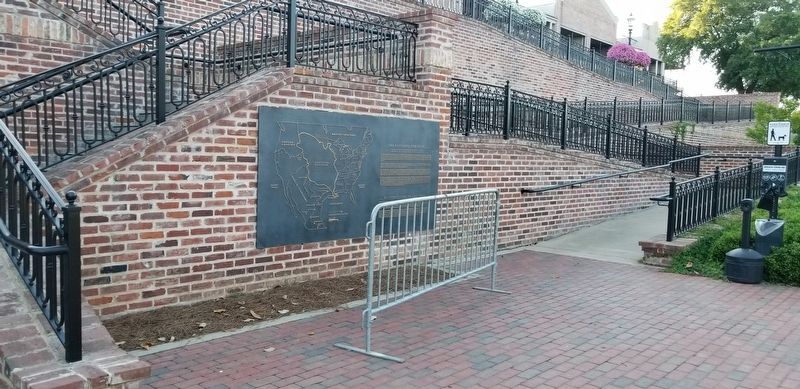
More about this marker. Located on on a stairway leading to the Riverfront Park area between Front Street and Cane River in Downtown Natchitoches
Credits. This page was last revised on July 2, 2021. It was originally submitted on July 2, 2021, by Cajun Scrambler of Assumption, Louisiana. This page has been viewed 556 times since then and 61 times this year. Photos: 1, 2, 3. submitted on July 2, 2021, by Cajun Scrambler of Assumption, Louisiana.
